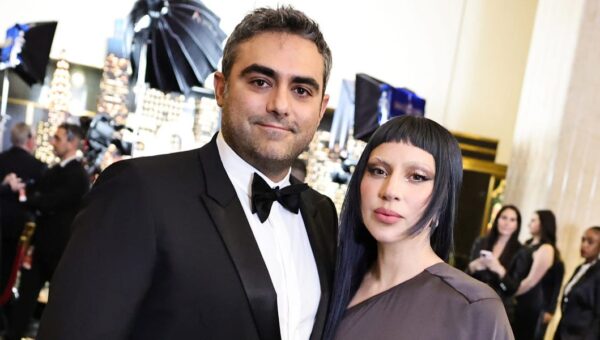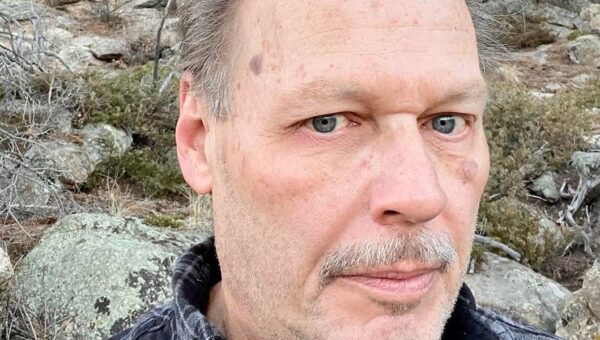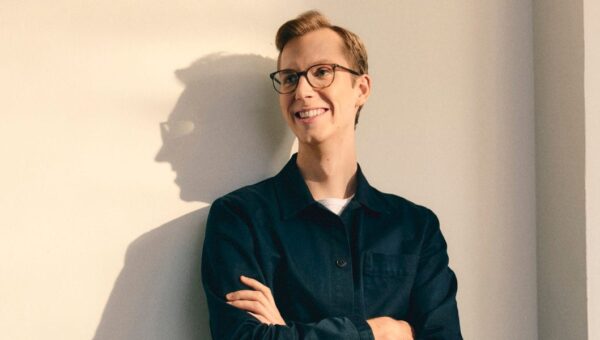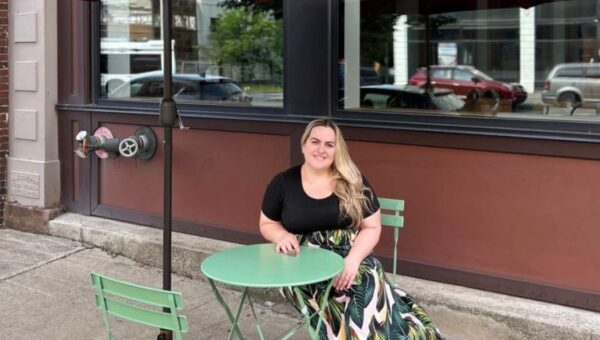

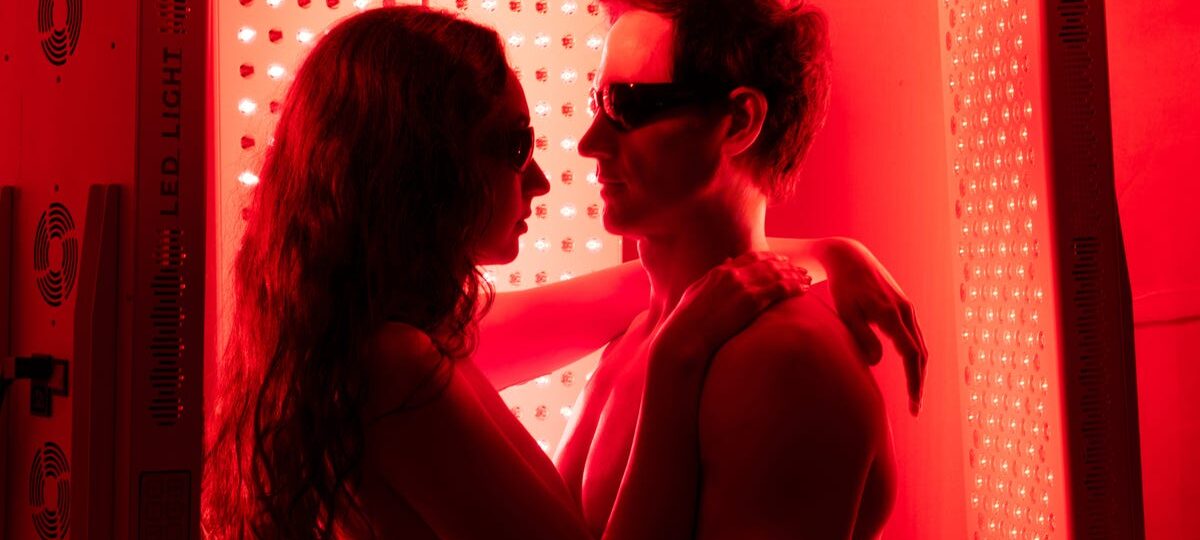
As soon as they had sex on July 27, Bryan Johnson tells me, he knew his cofounder and girlfriend, Kate Tolo, was hours away from getting her period.
Normally, the couple has sex two to three times a week, most often between 3 and 5 p.m. “Too close to Bryan’s bedtime” — 8:30 p.m. — “is a problem,” says Kate, her knee touching Bryan’s thigh on the couch, late afternoon sunlight dappling their pale cheeks.
And it’s electric, they tell me. “It’s all there: primal, love, safety, connection,” Bryan says. “I don’t know what the stat is, but some substantial proportion of women never have an orgasm.” Kate smiles.
She is not among this substantial proportion.
But on that day they hadn’t had sex for some time, because Kate was really, really stressed. “The highest stress levels I’ve ever seen her have,” Bryan says.
She was worried about all that it was going to take to become, as Bryan has put it, “a female Bryan Johnson.” You may have heard something about Bryan’s body, willingly or not.
Maybe it’s how long his penis is erect each night — 4 hours and 2 minutes, which happens to be the exact length of Kenneth Branagh’s film adaptation of “Hamlet.” Maybe it’s the 2,250 calories Bryan ingests each day, a diet that includes 130 grams of protein, 30 vitamins and supplements (some of which he sells through his health optimization startup Blueprint), and something called nutty pudding, all of it consumed before he stops eating at noon.
Bryan, a centimillionaire from a payments company he sold in 2013 and now the face of the $30 billion longevity industry, says he spends $2 million a year on his body to claim the title of most measured man in the world.
He is attempting to de-age every organ and defeat death, his life’s mission.
Now Kate, Blueprint’s cofounder, could become the most measured woman in the world.
Unlike her 49-year-old boyfriend, 30-year-old Kate is less fixated on longevity and more interested in “legibility”: She was recently diagnosed with endometriosis — a chronic uterine condition that affects about 10% of women but is understudied — and wants to create a massive biological portrait of herself to help the world better understand women’s health. “My job is to be the Rosetta Stone for women,” she says in her Australian accent.
From the moment she wakes up at 6:30 a.m. she was to begin an elaborately choreographed four-hour techno-ballet of scratching, sniffing, spitting, scanning, stretching, gripping, vibrating, flexing, plucking, poking, pulling, peeing, and pooping, using some 50 devices and 30 apps that, for $2.6 million a year, would log everything from her pain tolerance to her reaction time, from her grip strength to her vaginal wetness.
Because Bryan, Kate, and their startup’s medical team want to test how these variables change across Kate’s menstrual cycle, she would start this routine — or “protocol” in longevity patois — when her period began.
But she says the stress of the project was prolonging that.
In June, Bryan posted to his 2 million followers on X that they expected she would start menstruating on July 13.
Then another two weeks. “Kate’s well-being depends upon touch,” Bryan tells me. “And so she has been so wound up, and she’s not had intimacy.
And I think her body was just like, ‘I can’t function.'” So when they did finally have sex, Bryan says, “She just melted.” He whispers the last word as it floats in his ultrapurified living room air toward a bookshelf filled with Peter Thiel’s “Zero to One,” biographies of the Founding Fathers, and a well-worn copy of “A Marvelous Work and a Wonder” from Bryan’s past life as a Mormon missionary. “And I was like, well, sure, it’s a couple hours away.” The sex was on Monday.
The cofounders were telling me all this on Wednesday as a sort of apology, or explanation.
They had originally invited me over to interview them while they conducted what Kate was pretty certain was a “world’s first experiment.” They would each swallow a Bluetooth-connected pill and then get in Bryan’s sauna while the pills collected data on how the 200-degree heat changes a man and a woman’s internal body temperatures. “It will be very intimate, we’ll be naked beneath our towels,” Kate told me.
Los Angeles time on Tuesday, Kate texted me: “Hey Zak — I just woke up and have started my period.” He called it.
Bryan Johnson’s menstrualogical johnson was bang on.
Oh, Bryan and Kate, America’s anti-sweets sweethearts, founders who bone as they build, neuro-atypical performance artists puncturing the spongy boundaries of TMI — they had transfixed me ever since they made their relationship public last December, when Bryan posted a gooey 1,300-word tweet that began, “Guys … I have a girlfriend.” At a time when we share more about ourselves with more people than we have in human history, they share even more: when Bryan is performing oral sex on Kate, Bryan’s bone mineral density (in the 99.6th percentile of all men), the particulates of Kate’s vaginal microbiome (“top 1% of all vaginas,” Bryan bugled).
And why does it seem we know so little about the couple we know everything about?
Or, to put it the way they do, What are Bryan and Kate? “Both of us have become concepts.
We’re no longer people,” Bryan says, a line that strikes me as both acute self-awareness as an influencer and savvy self-branding. “We’re obsessed with this question: What is Bryan and Kate?
To be honest, we don’t know.” As concepts, they accept that the commentariat, and actual scientists, will attempt to define them.
To some — to the Ross Douthats, Kara Swishers, and Bill Mahers of the world — they are attention whores, pseudoscientific grifters, human lab rats, prisoners to optimization, vampires, Gilgamesh with a selfie stick, Dorian Gray with peptides.
Kate is a gold digger, Bryan is a narcissistic control freak, a match made in the hell they’ll find themselves in when their quest for immortality on Earth inevitably fails, as it has every human who ever lived.
To others — including billionaires chasing eternal youth and people who see the couple as putting their time and money to more beneficial uses than most billionaires — they are pioneers.
They are shackling themselves now so that they may free humanity from poor health in the future.
They are liberating us from a limp new Puritanism of celibacy and squeamishness.
Kate is a modern Marie Curie, Bryan is a modern, virile Jesus Christ, a match made in the AI heaven we’ll all soon be living in. (The Lamb of God comparison actually comes from Bryan on his Substack.) “What if we’re the new Adam and Eve?” Kate, who grew up Catholic, asks. “Except we don’t destroy the Garden of Eden, we build the Garden of Eden.” This is what Bryan and Kate say is the ultimate aim of their project, as business partners and romantic partners (a distinction as blurry as Bryan’s exquisitely hydrated urine is clear): They want to become models for “how humans successfully co-evolve with AI.” As the technology develops into a superintelligence, they believe it may destroy us.
They want to ensure the opposite, that AI helps us live in perfect health and harmony in perpetuity, both in our current bodies and as homo sapiens evolve into a new man-machine species. “Right now we live in a world where every corporation is trying to take apart pieces of you to make you die quicker,” Kate continues. “What if we built the environment, literally here in this house, with a garden, with a dog” — they just got a Belgian malinois, the soulful-eyed Katara, who will be, naturally, the most measured dog in the world — “with a relationship, where we architect it, stone by stone, to make it so that it’s actually caring for you?” OK.
These are the questions that summoned me to Bryan’s dark gray stucco mansion in Venice, California.
And then to Kate’s apartment across town.
The couple live separately; they’ve never spent a night together.
Bryan fears it would disturb his sleep.
When you arrive at Bryan Johnson’s house, he does not offer you a glass of water.
He asks if you want to know your face age.
So he leads you upstairs, bounding two steps at a time — full of side quests, the 6-foot Bryan is training to be able to dunk a basketball — and into his personal clinic down the hall from his bedroom.
He has you close your eyes and mount your head to a Visia Complexion Analysis Camera System.
It looks like the machine you wedge your head into at the optometrist where you focus on the hot air balloon, except it takes high-resolution pictures of your face that’s displayed on a 49-inch monitor, which Bryan points to with a Sharpie to show you your wrinkle, pore, and sun spot percentiles.
It shows your actual age and your AI-analyzed TruSkin Age.
Maybe your five-step routine of smudging moisturizer and other goops on your face almost every day for the past decade has spared you a face that’s 10 years older than you.
Maybe you’ve wasted thousands of dollars on gunks that could’ve been dumped into your kids’ college funds.
Then Bryan tells you that he and you are skin twins: He’s 49 but his TruSkin Age is also 37.
Then you look at him and realize what it takes to skinmog.
He looks like he’s been beaten up by a mustard monster — there are jaundice splotches all over his cheeks and chin.
He had just done a regular round of BroadBand light therapy, collagen stimulator injections, and microneedling, and the bruises won’t mend for a couple of weeks.
Kate, whose face age is 21, arrives and hugs Bryan in a long embrace.
She examines your face on the screen, and recommends you moisturize every day.
Bryan then shows you some other longevity toys in his clinic — a shock-wave joint repair machine, an intermittent hypoxia-hyperoxia training breathing machine, a red-light therapy machine — with the same enthusiasm and intensity your kindergartener’s classmate Maverick had when he showed you the entirety of his Lego Ninjago collection.
Bryan leads you into a bathroom, where, in front of the toilet, there’s a freezer set to negative 80 degrees Fahrenheit.
He opens it and shows you some of the dozen or so samples inside, including his blood and Kate’s menstrual blood.
The thermostat rises from minus 79.9 to minus 79.8, and Kate asks Bryan, with some urgency, to shut the freezer.
She does not want to risk losing any more menstrual blood, which she’s sending to five companies studying endometriosis to analyze.
When she got her period early on Tuesday morning, she screamed so loudly about how much she was bleeding and not collecting for sampling — “all the precious data we were losing!” — that she says her neighbor pounded on her door to check that she hadn’t been stabbed.
So Bryan shuts the freezer, you go downstairs, and he offers you a glass of water.
Then you sit across from them on a big red sectional, and ask your hosts how they met.
Kate says that until she met Bryan, she thought she’d likely go through life alone, and she was fine with that.
She later read aloud to me a decade-old text she says is representative of her history with men and people in general — her response to a friend who told her he had feelings for her.
Answer: Can we continue to be friends for the next month?
And if by the 3rd of February, you still feel the same, I will seriously consider your proposal.
The reason I’m saying this is because so often I find people find interest in me because I am unique, but it’s not deep connection in the way they think it is.
What I have found is it often ends up that the novelty of the idea of me wears off, and the person no longer feels the need to experience dating me.
The youngest of her Bosnian immigrant parents’ three children (her father is 16 years older than her mother), Kate spent much of her childhood in Queensland feeling like a stranger to the world, living among her own thoughts.
She says she struggles to articulate herself to this day. “Usually I’m with Bryan, and Bryan just articulates for me, which makes it so much easier,” she told me in a later one-on-one conversation.
She fell in love with sewing at age 8, moved to New York after college and started working in operations and as a technical designer for fashion brands like Proenza Schouler and the North Face.
She says she hated fashion’s commercialization, and became increasingly fascinated with how AI would reshape humanity.
In December 2016, when she was 21, Kate saw a quote from Bryan cited in the futurist Ray Kurzweil’s Singularity University newsletter, in which Bryan talked about the need to reframe the dynamic from “AI vs. humans” to “the merger of humans and AI.” Intrigued, she sent Bryan a LinkedIn message asking him to chat more about the idea. “10 mins is all I need :),” she wrote.
Bryan tells me his first memory is when he was 3, rubbing his father’s back in bed, “because I could tell he felt bad.” His parents had just gotten a divorce.
His father struggled with a drug addiction and was rarely around for Bryan’s childhood.
Bryan got married at 24, in what he’s described as a kind of arranged marriage to another Mormon.
In 2007, he founded Braintree, a payments platform.
As he’s recounted many times on podcasts, X, TikTok, his YouTube channel, and the Netflix documentary “Don’t Die,” he ran himself into the ground building his startup.
He became 50 pounds overweight, fell into a depression, and was occasionally suicidal.
In 2013, he sold Braintree for $800 million, got a divorce, and left the church.
He hired prostitutes and got into psychedelics, according to reporting from The New York Times.
For a time, his parents stopped talking to him, and he was unable to see his three children.
To this day, he says the only one of his kids he has a close relationship with is the middle child, Talmage, 21, who is sitting at a computer desk across the kitchen in earshot of this conversation.
Bryan has also infused himself with Talmage’s plasma.
In 2016, Bryan founded Kernel, which makes snowboard-like helmets that measure brain activity.
A few years later, he started getting obsessed with longevity and letting AI, not his brain, plan the details of his regimen.
As he says in “Don’t Die,” “I walked into this because I was marching into an early grave.
Now I’ve built an algorithm that takes care of me better than I can myself.” He adds, “removing my mind has been the best thing I’ve ever done for me.” Four years and several emails from Kate later, Bryan responded, and Kate went in for an interview to be his executive assistant at Kernel in early 2021.
It was still the pandemic, and Bryan was wearing a black N95 mask. “I looked at him in the eyes, and just this knowing came over me.
I knew I was going to have to accept that I was in love with this man,” Kate says. “And it was complicated, right?
I was like, damn, this is going to be hard to navigate.” Bryan says he fell for Kate slowly. “It took a long time for me to trust Kate,” he says, as it has with anyone he’s met since becoming extremely wealthy.
When you have a “resource in abundance,” he tells me, people “always have an angle.” Kate is not the first employee Bryan has dated.
He was previously engaged to Taryn Southern, who helped with marketing both Kernel and Bryan’s personal brand.
A lawsuit Southern filed in 2021 alleged Bryan fired her after breaking up with her while she underwent treatment for breast cancer.
She claimed that Bryan demanded she sign an employee separation agreement with punitive confidentiality terms.
An arbitrator ruled that Southern had to adhere to the separation agreement.
Bryan also posted a YouTube video, “My Ex-Fiancée Sued Me For $9,000,000,” and claimed that he had been attacked by “the dark underground accusation economy.” (Southern did not respond to requests for comment.) Kate was charmed by Bryan’s growing obsession with de-aging himself.
She eventually suggested that he start posting about his longevity journey, and that she could help him “build the Bryan character” and make it a “public science experiment,” as she puts it.
They stayed in the office late into the night, crafting posts that would turn the man into the brand.
Sometime in 2022, Bryan was at a brain-computer interface conference, and up past his bedtime.
The break in his routine prompted a moment of spontaneity.
He returned to his hotel room and called Kate to tell her he had feelings for her.
They dated in private for three years.
Last Thanksgiving, Bryan broadcast “Bryan Johnson Takes Magic Mushrooms” on X, a five-hour livestream in which he ingested a “heroic dose” of psilocybin, purportedly to test whether the psychedelic has the same longevity benefits on humans as it may have on some rats.
Beyond the strange appearances from Salesforce CEO Marc Benioff, Grimes, and Bryan’s father, the thing most viewers commented on from the “science experiment” was the oddly close synergies between the business partners.
Kate, who was serving as Bryan’s trip-sitter, rubbed his back, asked him to take his shirt off, and held his hand in silence for 20 minutes as he tripped balls.
Days later, Bryan posted his 1,300-word epistle to hard launch their relationship.
He called Kate the Abigail to his John Adams. “As my son considers possible partners, he wisely models them off Kate,” Bryan wrote.
They’ve since posted dozens of lugubrious and lurid love letters on X, most of them from Bryan.
His prose is often romantasy meets Journal of Cell Biology.
In one 700-word post about their foreplay, he writes, “Her vestibular bulbs engorge, forming a soft, pressurized cuff. … Full body release waits in suspended agony, yet we stubbornly refuse to concede there is an end.
We will grow young together.” Bryan tells me he spent weeks drafting this post in a Google Doc. “I like the idea of us being a reference point for people,” he says. “When I was growing up, I would try to find marriages that I wanted to emulate.
So I’m personally very motivated by that.” With each post about themselves, they say they always “put the business first,” and often worry if this will be the one that “shuts us out from legitimate society.” Bryan says that, “as far as we can tell, we have only gained more access to power and status,” since they’ve started sharing detail of their sex lives. (Blueprint’s investors include the Winklevoss twins, Ari Emanuel, Andrej Karpathy, Kim Kardashian, Logan Paul, and Paris Hilton.) Now Kate, who produced Bryan, has had to embrace, not altogether unwillingly, a new phase of life as a highly visible product. “I just spent the past three months grieving the death of my anonymity and my ability to not have to worry about what is somebody talking to me for,” she says. “You can’t go back.
It just permanently changes your sense of self.” Beyond the gold digger claims, many people comment on their 18-year age gap. “For sure, he’s younger than me,” says Kate. “He makes me feel old.
I get worried about not being able to keep up.” Kate also tells me this: “My blanket assumption about the world is: Believe nothing.
Any time I hear anyone say anything, any book, nothing I consume, I actually believe.
I hold everything as, How many degrees from the truth is this?” Was she offering a warning label for the entire attention economy?
The couple are a study in high-contrast, if nuanced, contradictions.
They say they don’t care about money. “I’ve made my money in life, I don’t need money.
Kate has never been driven by money,” Bryan told The Wall Street Journal in July.
They are also cofounders of one startup that sells olive oil, nut mixes (“a key part of Bryan Johnson’s breakfast protocol”), and an “age-defying” moisturizer, and another startup that sells Bryan’s exact protocol, along with a dedicated concierge team and access to a “BryanAI” chatbot — for packages ranging from $75,000 to $1 million a year. (They declined to say whether they are profitable.) They say social media is a toxin that corrodes your mental and physical health and makes you less attractive. “We’d rather be off grid,” Bryan says.
Social media is also the engine of their brand; it’s where “Bryan Johnson” and “Kate Tolo” most readily exist.
They accept that it’s a necessary evil.
They say they’re indifferent toward celebrity and their image. “Neither Kate nor I care about fame at all.
They also declined to participate in shoots with multiple photographers Business Insider was considering commissioning for this story, and insisted they pay for and provide their own photographs. “If you want something creative, stylized, or symbolic, that’s a layer of communication sitting on top of our likeness, we need creative control on the outcome: styling, hair, makeup, location, photographer alignment,” Kate wrote to our photo team.
The photographs you see in this story are what they sent us.
They say they’re mostly a normal couple.
They have a monthly game night (Settlers of Catan, Mafia) with another couple, a software engineer and a crypto entrepreneur.
On the rare occasions they go to a restaurant, Bryan does not eat.
They’ve shared only a handful of meals together.
They don’t do gifts. “Neither of us value material things,” Bryan says. “We’re both always trying to reduce our material footprint but expanding the geography of what our relationship can be.” They have no plans to get married or to have children.
This didn’t surprise me — soothing what would surely be the most measured baby in the world overnight would torpedo Bryan’s nighttime boners down to the length of a YouTube short.
But it runs counter to the rising strain of pronatalism among tech’s elite.
Anduril cofounder Palmer Luckey, for example, a friend of Bryan’s, has said, “If you don’t have 2.1 kids minimum, you’re a traitor to the nation and our ideals.” It’s also a wrinkle to something Kate tells me: “Every decision we make is for humanity 500 years from now.” One way to ensure humanity’s survival is to make more humans.
Kate and Bryan stress there are other ways. “The idea of having kids, it’s just so much work, and we’re already doing such a rich thing” with their protocol pursuits and businesses, says Kate. “I can’t imagine that not cannibalizing one another.” The only time Kate asks to go off the record is the 15 minutes she spends driving us from Bryan’s house to her apartment, because she’s a very nervous driver.
Back on the record, Kate takes me and Bryan to her bedroom and shows us the device she places in her vagina at night.
They call it a techno-tampon. (If you’re in the market for one, the technical name is a vaginal photoplethysmogram transducer, and it will set you back $1,400.) It looks like a translucent thumb drive, with a cord at one end that Kate tapes to her thigh so it stays in place, while the other end is plugged into a MacBook on a TV tray next to her bed.
All night, it collects data on blood flow to her vagina, “which is a proxy for nighttime erections,” Kate says.
The Basement Flood Detector 9000 has never been used in an overnight setting before, Kate tells me, so they called an IT guy at the medical hardware company BioPac to help MacGyver it. “It’s really interesting that women have nighttime arousal cycles like men,” says Bryan, balancing on a vibration plate Kate uses to activate her muscles. “How are we in the year 2026 and this thing that happens in a female body every night, no one knows?
It’s wild.” He whispers the last word.
Kate walks me through her new 44-step morning routine, which begins by spitting into a tube to test her cortisol, swabbing her inner cheek to sample her oral microbiome, and then unplugging the techno-tampon.
Among other tasks, she breathes into a mask to test her resting metabolic rate, takes memory tests with a Kernel helmet, completes a multiple-choice scratch-and-sniff quiz to gauge her sense of smell, and measures the size of her breasts. “What’s your baseline?” Bryan asks. “What was yours today?” “I want to say 38 centimeters, something like that,” Kate says. “Do you want to find out?” “No, I was just curious of my total chest size,” Bryan says. “Sorry, side quest.” What, exactly, Kate and their medical team will glean from the some 14 million data points they expect to collect from Kate’s body over her next four cycles is unclear.
Critics have cast it as another vanity project from the couple, and say that little to nothing can be gleaned from a sample size of one woman.
Kate hopes it helps inform future research in women’s health. (When I talked to her in early September at the start of her second cycle, she said she’s begun to be able to tell what day of her cycle any woman is on by looking at her — an incredible party trick, if only they partied.) They also plan to use AI to compare all of Bryan’s daily biomarkers with hers, to determine how interconnected they may be. “We may find out, does Bryan control when my period starts?” Kate says. (Apple’s AI transcribes this part of my recording, portentously, as, “Does Bryan control when my career stops?”) Bryan riffs on this. “If you’re an AI and you’re looking at the biochemical output of an XY configuration and an XX configuration, what do you see?” he says. “What are the emergent patterns?
And then you can ask, What is the emergent phenomena of this intelligent species?
Should women have more power?” Kate spends another 20 minutes showing us the rest of her bedroom-cum-clinic: her vaginal microbiome swabs, her own Visia Complexion Analysis Camera System.
As we walk back down to the living room to wind down our afternoon together, Bryan now descends one step at a time to pull out his phone and fire off a tweet: “been thinking things over and wonder if i’ve taken this whole longevity thing too far.” We live our lives, do whatever we do, and then we sleep.
It’s as simple and ordinary as that,” Michael Cunningham writes in the lyrical winddown to the novel “The Hours.” “A few jump out windows, or drown themselves, or take pills; more die by accident; and most of us are slowly devoured by some disease, or, if we’re very fortunate, by time itself.” Even the high priest of “Don’t Die” may be beginning to come to terms with this immutable fact of death.
Earlier this summer, Bryan drafted plans for his funeral.
He had just been diagnosed with autoimmune gastritis, a stomach disease with no cure.
It’s treatable, but associated with anemia and an increased risk for stomach cancer. “My stomach is eating itself,” he posted on X.
His detractors rejoiced — the man who would live forever would meet his maker like the rest of us.
Bryan maintains his longevity regimen did not cause the disease, and that he’s now determined to find a cure. “If we’re pursuing Don’t Die, there’s got to be a rite of passage,” he says. “To prove ourselves worthy of this goal, we need to go through the darkness of the night.” But if he was going to die, he wanted his haters to open his funeral by gloating about how they were right.
The program he drafted began with a speech from Nassim Nicholas Taleb, the NYU mathematician who has often called Bryan’s pursuits fanciful and hurtful to humanity. “Too Much Skin in the Game,” was the title Bryan gave his talk.
Then came Ray Kurzweil, with a speech called “Just Missed the Singularity,” and talks from the podcasters David Friedberg, Theo Von, and Andrew Schulz, and then Talmage, with a talk titled “My Dad.” Kate was last.
Bryan had not given her speech a title. “The story kind of writes itself,” Bryan says of his diagnosis. “It is rich with irony, and we anticipate irony to rule our lives.” What’s the most ironic thing that could happen next?
They break up. “What if we don’t survive this?” Kate asks.
She and Bryan have talked about the possibility that her becoming a “female Bryan Johnson” “puts so much stress on our relationship that we don’t survive it,” she says.
Everything they do is to plan 500 years in the future, but their own future as a couple is less certain. “It would be painful, devastating.” Bryan says. “It would be good content,” he adds.
I ask them if, presuming they are going to die, they’d rather live for two more years and be together, or 10 years more alone.
Bryan pauses and looks at the floor.
Kate looks at him agape, “You little sneak,” she says. “I didn’t say anything,” he says. “I’d say two years,” Kate says. “The difference between two and 10 is nothing.
Why not say between two and never?” OK, two and never, I say. “I’d choose never,” Kate says.
She looks at Bryan. “And I’d choose never for you, too.
With infinite life, you could clone someone again in a petri dish.” Now Bryan is agape. “What an amazing idea, if I took your genome and cloned you,” Bryan says. “Wild,” he whispers.
Bryan must leave his girlfriend’s place soon to start his bedtime routine alone.
The couple waves goodbye to me as they hold each other.
Soon after, I sit on a bench on the Venice boardwalk — where the sun cranks up my TruSkin Age and a homeless man defecates beside a tchotchke shop, where there is no freezer to preserve his stool sample —and I wonder how many degrees from authenticity my afternoon with Bryan and Kate was, what to believe from the exhibition the exhibitionists just put on.
I believe their love is real, and strangely beautiful.
They laugh easily, they finish each other’s sentences, they’re on tenterhooks for each other’s every word, their winding minds and histories map onto each other’s in snug and surprising ways.
I believe they know they’re a little absurd, and they delight and play in the absurd world they’ve created and curated.
I believe the world they present to us on our tiny screens is at times life-giving, and a numbing distraction from the fact that we are going to die.
Try as they might, Bryan and Kate cannot answer or control the mystery of who they are.
And humanity, not Bryan and Kate, will decide what their archetype is in 500 years.
It’s possible they are a model for how humanity and AI co-evolve, and they are one countervailing force to the rampant doomsday predictions in Silicon Valley right now.
On Sunday night, a day after Anthropic CEO Dario Amodei and the leaders of three other top AI companies agreed to slow the development of AI to better mitigate its risks, Bryan sent me a voice memo. “I don’t trust anyone’s assessment of AI risk,” he said. “But I also think we’ve swung too hard in being pessimistic and fearful.
And I think AI is the only thing that gets humanity to the horizons we imagine.” But if everyone followed the way of Bryan and Kate, culture would stop, life would slow to a crawl.
Since she’s begun her new protocol, not even sex is spontaneous.
It’s placed on their Google calendars in half-hour windows for their medical team to see, marked as “Bryan and Kate time.” Kate has an app where she presses a button to log every time they have sex, and another if she orgasmed, a button button.
Bryan says that “conquering death will be humanity’s greatest achievement.” Sometimes, we conquer death in moments Bryan and Kate are denying themselves: soft hands and martini’d whispers in a 4 a.m. cab, breakfast burritos in bed, tiny eyes fluttering back to sleep at sunrise after a night of colic — the silly, simple, sweet, unproductive, biomarker-depleting “hour here or there when our lives seem, against all odds and expectations, to burst open and give us everything we’ve ever imagined,” as Michael Cunningham puts it.
The moments that may bring death nearer, but life nearer still.
Discover more from NAIRAVOICE.COM.NG
Subscribe to get the latest posts sent to your email.