Everyone is talking about AI agents — and Business Insider’s reporters and editors are no different.
Agents go a step beyond chatbots and are capable of planning and achieving multi-step tasks.
This can range from making a restaurant reservation to inviting a friend for lunch to buying clothes you are on the lookout for.
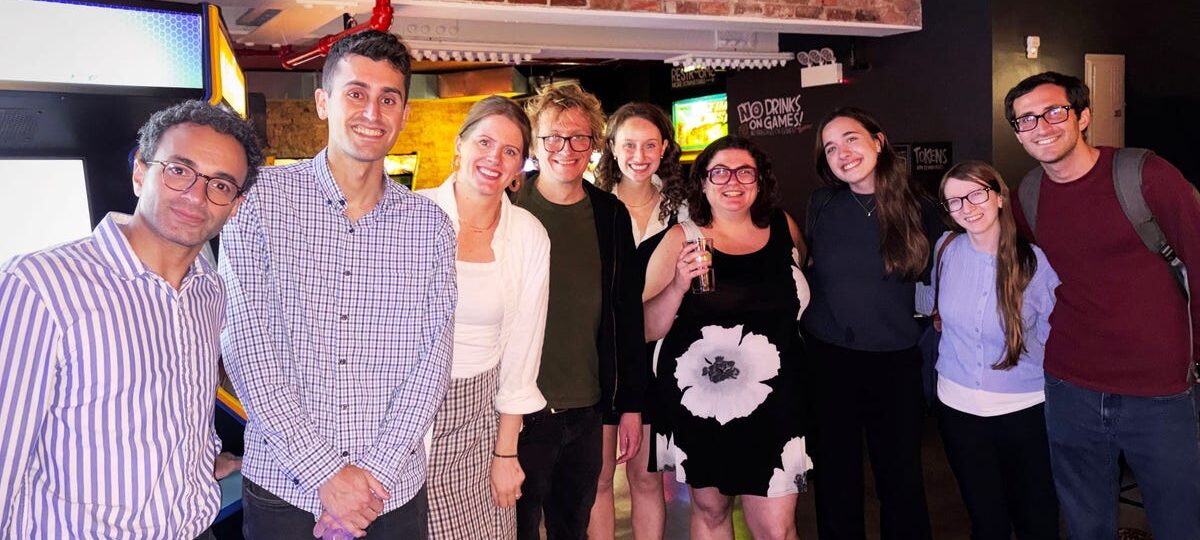
To get a sense of how members of different generations feel about the emerging world of AI agents, I, a Gen Z fellow on the Business Insider Economy team, talked to my colleagues, spanning from Gen Z to elder millennials, about their stances on the divisive topic.
While the younger generation expressed a lot of worries around privacy, the millennials in the group were cautiously optimistic about how agents could be helpful at work and at home.
Many of my Gen Z peers agreed that growing up with technology made them more aware of its limitations and dangers — making them more hesitant about handing over their information to AI agents.
They also seemed most concerned about privacy and scams.
The younger members of the Economy team aren’t alone — a recent poll from the Pew Research Center found that Americans under age 30 are increasingly skeptical of AI’s benefits.
Ayelet Sheffey, our Gen Z senior education reporter, said she was not open to handing over the control to an AI agent to get things she needed done. “I’m hearing about people using AI and they’re like feeding their bank information or personal things into a software — that just immediately turns me off,” she said. “Not only for the privacy reasons, but also, I just don’t trust anyone or anything else to get tasks done.” Allie Kelly, a Gen Z economy reporter, said that while being a reporter is a public-facing job, there is other information she prefers to keep private.
While she is open to using it for professional purposes, she is more hesitant to use it for personal reasons, not knowing how the information she provides to the agent can be used. “If I want an agent to analyze something, I will give it something specific to analyze — I’m not going to give it access to my inbox,” she said. “It’s not just my information; sometimes it’s sources’ information, so I just want to be cognizant of that.” Juliana Kaplan, a Gen Z senior reporter, said she is wary of handing her personal information over to companies that could have different incentives influencing how their AI agents work.
She posed a rhetorical question: If a company with an AI agent had a deal with a credit card company, and she was using an agent to choose her next credit card, would it be influenced to recommend that one? “I would have to do a lot of research into the amount of due diligence they have done with my information,” she said. “At that point, I’m like, I can just do it myself.” Noah Sheidlower, a Gen Z senior economy reporter, said, “I’m all for efficiency and maximizing time I could be spending on things that are meaningful to me, but I don’t fully trust giving up my authority and agency to make decisions.
I’ve read stories of agents invading privacy and doing tasks it should not be doing that have harmful repercussions, and I want to stay in control as much as I can until the agents are more advanced.” Madison Hoff, a Gen Z economy reporter, said that while she sees the value of agents in helping manage work, she enjoys working on things herself.
When looking for craft ideas in her free time, she said she enjoys the process of looking around her and finding ideas — even if an AI agent would help her do it more quickly. “I rather just use the brain power a little more and do the research,” she said.
Several of the Gen Z reporters said that while friends in creative fields were more hesitant to adopt AI agents, peers in finance, consulting, and tech-adjacent fields seemed more open to adopting them earlier.
The idea that AI agents still have a long way to go before they are accurate and efficient enough was shared by the Economy team’s millennial editors, who held a more cautious optimism about the future of adopting agents to streamline workflows and team operations.
Bartie Scott, a millennial and economy deputy editor, said that while she has environmental concerns about using AI, she does see potential in using it to reduce her screen time — especially with voice agents. “As someone who has a job that’s on a screen, it can feel insurmountable sometimes,” she said. “We have so much to do in modern life that you feel burned out — And I think this, maybe in an ideal world, could be like a solution to that.” Scott said that while she is not an early adopter of technology, once she has seen people she respects say the technology is trustworthy and easy to use, she might be inclined to dabble in it.
Examples she thought of would be if she could get an agent to help brief her on her workday priorities and daily check-ins. “If I could do all that with voice commands, that would kind of be a dream,” she said.
Andy Kiersz, a millennial and senior economic data editor, agreed that he might be more in the mid-adopter camp than the early-adopter camp.
If a “sufficiently long period of time” passes with no major data breaches and a situation like planning a trip arises where it would be useful, he said he would consider using an agent.
Kiersz sees some potential for agentic AI at work. “I could totally see putting an agent to go crawl repositories of economics papers and read through the abstracts,” he said.
He sees himself sending agents to do the “tedious side of the job,” so he can focus on the “interesting side of the job.” Two millennials on the team had the most hands-on experience with these new toys.
Ryan Kailath, an elder millennial and senior editor, is a “big pointsmaxxer,” as a member of many airline loyalty programs.
Yet, finding awards when booking is always a hefty logistical task.
So Kailath used Muse, the personal AI agent launched by Meta in early September, to see what all the fuss was about and look into booking for an upcoming trip.
Although the AI agent took the lead, it encountered many problems that Kailath had to resolve manually, such as login credentials and two-factor authentication codes required to continue the search. “My one test case where I thought, ‘Here’s a big friction in my life, maybe an agent could make this friction easier,’ it failed miserably,” he said.
Yet, Kailath said that if it improved in the future, he would no doubt use it.
Our Senior Reporter, Jacob Zinkula, also had a brief 10-minute encounter with Muse.
Zinkula, a young millennial, downloaded the app to see if it could help him get a future reservation at a high-demand restaurant for the Christmas season, but has yet to figure it out.
Caught in the cusp of the Gen Z and millennial generations, he is more cautious about letting an AI agent make financial decisions on its own, but is open to waiting to see how they could develop and be useful in the future. “I try to be open but skeptical,” he said. “It doesn’t feel like there’s an immediate need for me to like jump onto it too soon.
That said, I’m open to ways it could be helpful going forward.
For better or worse, this stuff’s probably not going away.”
Discover more from NAIRAVOICE.COM.NG
Subscribe to get the latest posts sent to your email.