
Long-range Ukrainian strike drones have brought Russian President Vladimir Putin’s war home and are increasingly affecting the everyday lives of millions of his own people.
In Moscow, cars line up for hundreds of meters at gas stations as fuel has become scarce.
In illegally annexed Crimea, electricity disruptions have left residents without power for days.
And across Russia, logistics warehouses belonging to Wildberries and Ozon, the country’s largest online retailers, have been destroyed, causing tremendous revenue losses for thousands of merchants and delivery disruptions for customers.
Fires are burning across Putin’s empire.
Closer to the front lines, Ukrainian medium-range strike drones are devastating Russian logistics, severely disrupting the fuel, ammunition, and supplies Moscow needs and significantly slowing its advance.
At the heart of these effective strike campaigns is a growing dependence on a stack of US technology and American intelligence that Ukraine does not control.
Starlink internet terminals from Elon Musk’s SpaceX have become the operational backbone of many Ukrainian drone missions.
The Hornet drones produced by Perennial Autonomy, the company founded by former Google CEO Eric Schmidt, are Ukraine’s best mid-range strike drones.
And Palantir, led by CEO Alex Karp and co-founded by Peter Thiel, provides AI software that plays a major role in route planning and mission outcomes for long-range strikes.
Markus Reisner said that the combination of capabilities like US intelligence, AI for operational execution, and Starlink as the communications infrastructure “is what makes it possible for the Ukrainians to conduct and sustain this medium- and long-range campaign against Russia in the first place.” When Donald Trump returned to the White House, his early clashes with Ukrainian President Volodymyr Zelenskyy and outreach to Vladimir Putin fueled fears that Washington might attempt to cut a deal at Kyiv’s expense.
The situation has instead changed fundamentally, with Ukraine deepening its reliance on US intelligence, technology, and weaponry, but the same capabilities enabling battlefield wins are also a potential point of failure outside Kyiv’s control.
Ukrainian officers involved in these drone campaigns — who know the consequences when foreign support falls short, be it artillery shells or Patriot interceptors — say they fear that decisions in Washington or by American tech companies could abruptly weaken Ukraine on the battlefield and its hand in future negotiations. “Many of my colleagues, and I as well, are very nervous about how we would work without Starlink,” a Ukrainian officer who goes by the call sign Jura told WELT, which is part of the Axel Springer Global Reporters Network. “We have discussed this issue several times: What if Elon Musk or somebody at SpaceX turns it off?” Starlink has changed the way Ukraine executes its mid-range strike campaign.
Jura said operating with and without Starlink is “absolutely two different paradigms.” The shift began in spring and accelerated in recent months, as Ukrainian forces started regularly equipping mid-range strike drones — including systems such as the Ukrainian FP-2 — with Starlink terminals.
Without Starlink, crews have to understand radio communications, calculate terrain and antenna heights, deploy relay drones, and optimize radio links over long distances.
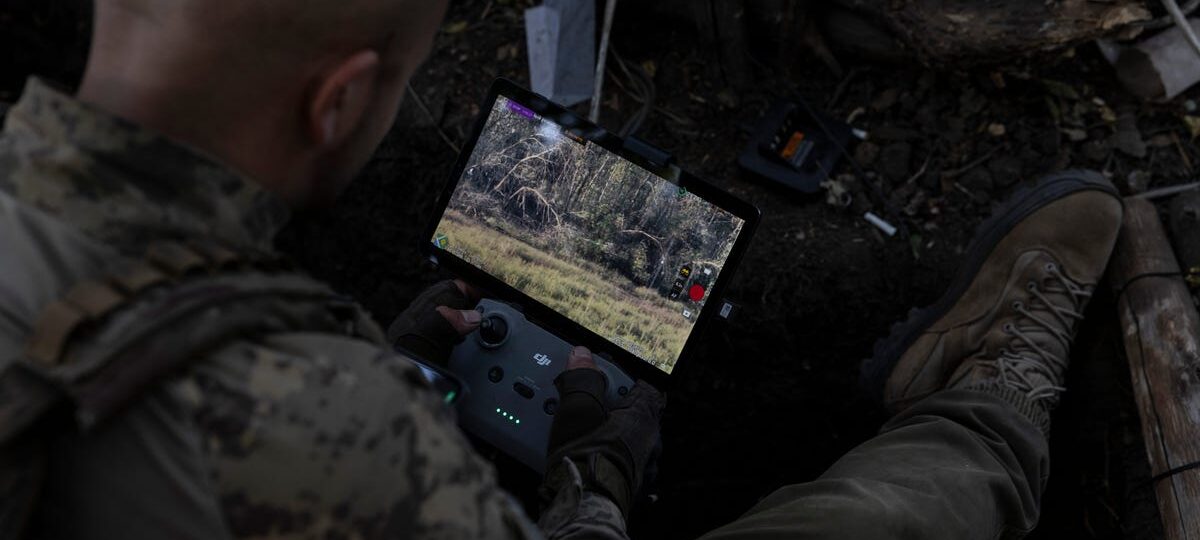
Starlink removes much of that complexity. “Starlink gives you the possibility not to study radio physics,” Jura said. “It simplifies everything.” Starlink allows operators to maintain a live video connection with a drone until just before impact.
Operators can correct the drone’s course during final approach, observe targets, and assess whether a strike was successful.
When using conventional radio-controlled systems, Jura said, drone operators often lose the video feed shortly after locking onto a target.
Starlink can also provide what he calls “synthetic GPS coordinates,” which can help the drone navigate when conventional GPS is jammed, he said.
Those battlefield advantages, however, come with a dependence on SpaceX’s rules and permissions.
After SpaceX moved to block Russian military use of Starlink earlier this year, the Ukrainians also faced stricter registration requirements, Jura said.
For instance, terminals used on drones now have to be individually registered and authorized for high-speed operations.
SpaceX did not respond to requests for comment on Ukraine’s Starlink use.
Alex, an officer in Ukraine’s Unmanned Systems Forces, told Business Insider, also part of the Global Reporters Network, that no other American technology is as irreplaceable as Starlink right now.
He described it as a “highly critical” element of Ukraine’s battlefield drone operations.
Perennial Autonomy’s Hornet, which is supported by Starlink connectivity, is one of the most widely used mid-range strike drones in service.
Several thousand US-made Hornet drones were launched over the course of this summer.
The drone can carry warheads weighing up to five kilograms and strike targets between 50 and 150 kilometers, depending on its payload and battery configuration.
Operators familiar with internal procurement documentation put the unit price at between $7,500 and $10,000, making it relatively inexpensive compared with other mid-range strike drones.
The Hornet has been crucial in Ukraine’s mid-range strike campaign targeting Russian logistics in the occupied south.
A source close to the company told Business Insider they estimate that for every $1 worth of Hornet drones deployed in combat, roughly $60 worth of Russian assets are destroyed.
This ratio underscores Ukraine’s broader efforts to find cost-effective ways to degrade Russia’s military.
One Ukrainian officer whose team used Hornet drones at the front for several months earlier this year told WELT that his unit recorded a confirmed strike rate of at least 60%, with more than 40% of all launches resulting in direct hits.
Only around 15% were disrupted by Russian electronic warfare or shot down.
The officer said that the unit encountered problems with the detonation system, with some warheads failing to explode on impact.
But Ukraine’s experienced drone operators are used to modifying drones they receive, fixing any technical shortcomings.
Austrian military analyst Gustav Gressel characterized the combination of Hornet attack drones and Starlink terminals as the backbone of Ukraine’s mid-range strike campaign. “Yes, there is no way around Starlink,” he said. “The dependence is growing because Starlink is increasingly needed, and because, in terms of sheer numbers, there are basically no other drone or deep-strike systems that can provide replacements this cheaply.” At the same time, Gressel warned that Ukraine’s operational advantage from Starlink could shrink as Russia moves to field its own satellite communications system, known as Rassvet, which could see broader front-line deployment as early as 2027 to restore the capabilities it lost earlier this year.
When access to Starlink was cut off for Russian forces in the spring, it caused considerable disruption, according to intercepted radio communications obtained by WELT from Ukraine’s Bureviy Brigade.
Like Ukraine, Putin’s troops had also increasingly adopted the terminals on a large scale, including portable Starlink Mini terminals used by assault units.
Ukraine’s intense large-scale drone strike campaigns have heavily targeted Crimea, attempting to cut off the peninsula from Russia, as well as Russia’s wartime economy.
Ukrainian drones are striking supply vehicles, energy facilities, and shadow-fleet vessels, among other targets.
Ukraine’s Unmanned Systems Forces said that during Operation “Crimean Switch Off,” Ukrainian drones struck 27 energy hubs across Crimea and Russian-occupied territories in southern Ukraine between August 17 and 22.
Meanwhile, concentrated drone strikes on Russian logistics are putting Putin’s forces under intense pressure. “If you can destroy transportation trucks, rail infrastructure, ammunition storage sites, and disrupt fuel deliveries, it becomes very difficult for Russian forces to conduct operations,” said Ben Hodges, former commanding general of the US Army Europe. “We know from history that war is a test of will, but it’s also a test of logistics,” he said, adding that “the Ukrainians are hammering Russian logistics.” The Unmanned Systems Forces also said that their drone units have attacked 242 Russian vessels belonging to the so-called shadow fleet since July, 134 in the Sea of Azov and 108 in the Black Sea.
These attacks have been carried out using both aerial one-way attack drones and naval drones.
Ukraine’s Magura naval strike drones have a range of hundreds of kilometers and rely on Starlink terminals for real-time remote piloting and live video feeds, according to Ukrainian operators who spoke with WELT.
In addition to striking Russian oil tankers, Ukraine has systematically targeted the infrastructure of Putin’s oil empire.
This means refineries and ports such as Novorossiysk, a major hub for Russian oil exports and imports.
These strikes are being carried out with Ukrainian-made long-range drones, some of which can now reach targets up to 3,500 kilometers away and carry between 50 and 75 kilograms of explosives.
While the drones themselves are built in Ukraine, the strike campaigns often still rely heavily on American communications, software, intelligence, and other combat capabilities.
WELT saw how data-driven Ukraine’s drone campaign against Russia has become during a visit to a warehouse in central Ukraine in early June.
There, military intelligence drone operators were planning flight routes for drones that would strike targets inside Russia just hours later.
On their screens, they could see a constant flow of real-time information: weather conditions, Russian positions, and flight data. “For every day and every hour, we have information about how they relocate their air-defense systems and electronic warfare,” said a Ukrainian commander with the call sign Vector. “For every night, we use different flight routes.
We never repeat them.” At the heart of these drone operations is AI-powered software heavily shaped by technology from the US company Palantir, which helps bring relevant battlefield data together into a continuously updated operational picture.
Palantir did not respond to requests for comment on Ukraine’s use of its technology. “We can compare our previous routes and missions from different years,” Vector said. “We know which corridors work best.” Kyiv’s extensive dependence on US technologies for its drone strike operations has enabled battlefield victories but has also created frictions at the highest levels.
Zelenskyy said recently that a dispute over whether SpaceX would allow Starlink to be used for deep strikes inside Russia contributed to his falling out with then-Defense Minister Mykhailo Fedorov.
The defense ministry, the president said, gave him assurances that turned out to be unfounded ahead of negotiations with US leadership.
Eager to pursue the Russian missile launchers targeting Ukrainian cities, Zelenskyy has said he hopes Musk will reconsider his opposition to allowing Ukraine to use Starlink over Russian territory.
This week, he gave Musk the Order of Freedom for “outstanding personal contributions to the protection of human life and freedom” and for supporting US-Ukraine ties.
Ukrainian officers say that the dependence on Starlink extends well beyond long-range strikes.
The commander of a UGV unit in the Lava regiment of the 2nd “Khartia” Corps, who goes by the call sign Mathematician, told Business Insider most uncrewed ground vehicles now use Starlink.
Close to the border on the Ukrainian side, he said, that generally isn’t an issue.
On the other side, “it’s a problem.” The dispute over Starlink’s use outside Ukraine captures the vulnerabilities running through the country’s strike campaign and other increasingly sophisticated uncrewed operations heavily dependent on US technology and support.
Some critical capabilities still depend on decisions made by American companies.
Ukraine’s determination to eliminate the missile launchers inside Russia has become particularly urgent because of its critical shortage of US-made Patriot interceptor missiles, which Kyiv relies on to defend itself against Russia’s ballistic missiles.
Zelenskyy recently said his country would need around 300 Patriot missiles for the winter to prevent the worst.
Whether — and how well — Ukraine makes it through this winter will therefore once again depend heavily on the United States.
This story comes courtesy of the Axel Springer Global Reporters Network, which harnesses the resources of the company’s newsrooms to publish ambitious scoops, investigations, interviews, opinion pieces, and analysis.
It allows journalists — including those from The Telegraph, Business Insider, POLITICO, WELT, BILD, Onet, and Fakt — to collaborate on major stories for an international audience of hundreds of millions across platforms.
Discover more from NAIRAVOICE.COM.NG
Subscribe to get the latest posts sent to your email.