
The United States recognises only Beijing and does not support formal independence by Taiwan, but historically has also stopped short of explicitly saying it opposes independence.
Under US law, the United States is required to provide weapons to Taiwan for its defence, but it has been ambiguous on whether US forces would come to the island’s aid.
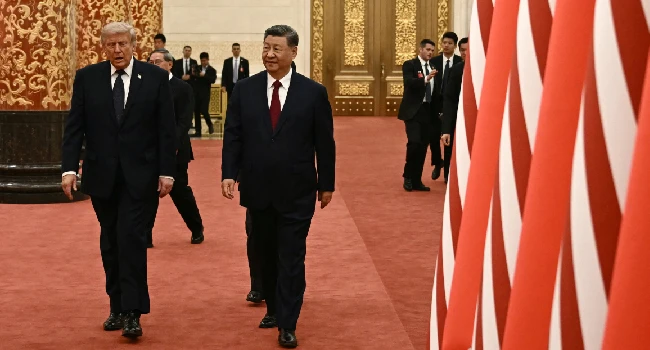
Xi had begun the summit with a warning on Taiwan, whose President Lai Ching-te considers the island already independent, making a declaration unnecessary.
Xi had told Trump that missteps on the sensitive issue could push their two countries into “conflict”.
In a statement focused on an interview a day earlier by Secretary of State Marco Rubio, who said US policy toward Taipei was unchanged, Taiwan’s foreign ministry thanked the United States for showing “it supports and values Taiwan Strait peace and stability”.
No Details On ‘Fantastic’ Deals
Trump said China had agreed to buy 200 “big” Boeing jets as well as American oil and soybeans.
“We’ve made some fantastic trade deals, great for both countries,” he said after a walk with Xi among the rose bushes in the gardens of Zhongnanhai, a central leadership compound next to Beijing’s Forbidden City.
“We’ve settled a lot of different problems that other people wouldn’t have been able to solve,” Trump added, without providing specifics.
Xi promised to send Trump rose seeds for the White House Rose Garden and said it was a “milestone visit”.
But there were no formal announcements from companies or from China on trade deals.
The reserve on the Chinese side echoes the tone of the summit as a whole, where Trump’s overtures to Xi — whom he described as a “great leader” and “friend” — were met with a more muted response from Beijing.
Jacob Stokes, a senior fellow at the Center for a New American Security, said the trip ultimately was more about setting a tone than about deliverables, which Trump usually seeks.
“Trump got the optics he was looking for and the Chinese were happy to give them to him,” Stokes said.
Little On Iran
Trump had delayed the trip once due to the war in Iran, which has rebuffed his appeals for an agreement and retaliated by exerting control over the key Strait of Hormuz, sending global oil prices soaring.
Trump said Xi had assured him that China was not preparing military aid to Iran. Israel has alleged that Beijing has provided key missile technology to Tehran.
The Chinese foreign ministry on Friday released a statement on Iran saying “shipping lanes should be reopened as soon as possible”.
Trump also acknowledged that he could not persuade Xi to free Jimmy Lai, the Hong Kong pro-democracy media tycoon who was imprisoned in a clampdown and whose cause is broadly backed in Washington.
“He told me, Jimmy Lai is a tough one for him to do,” Trump told reporters.
Bonnie Glaser, managing director of the German Marshall Fund’s Indo-Pacific program, noted that Trump had already sounded half-hearted in his public comments on Lai.
“My sense is that the Chinese see that this is not a top priority for the United States,” she said.
“What Trump seems to want most is purchases of American products — that appears to be his highest priority.”
The two leaders had been expected to discuss extending the one-year tariff truce that paused their frenetic 2025 trade war, struck during their last meeting in October.
But Trump told reporters on the way home that it “wasn’t brought up”.
On the streets of Beijing, reaction to the talks was tepid.
“This meeting could be considered a success –- though, to be honest, none of us really had very high expectations to begin with,” Zhang Yong, a 46-year-old IT worker, told AFP.
Discover more from NAIRAVOICE.COM.NG
Subscribe to get the latest posts sent to your email.