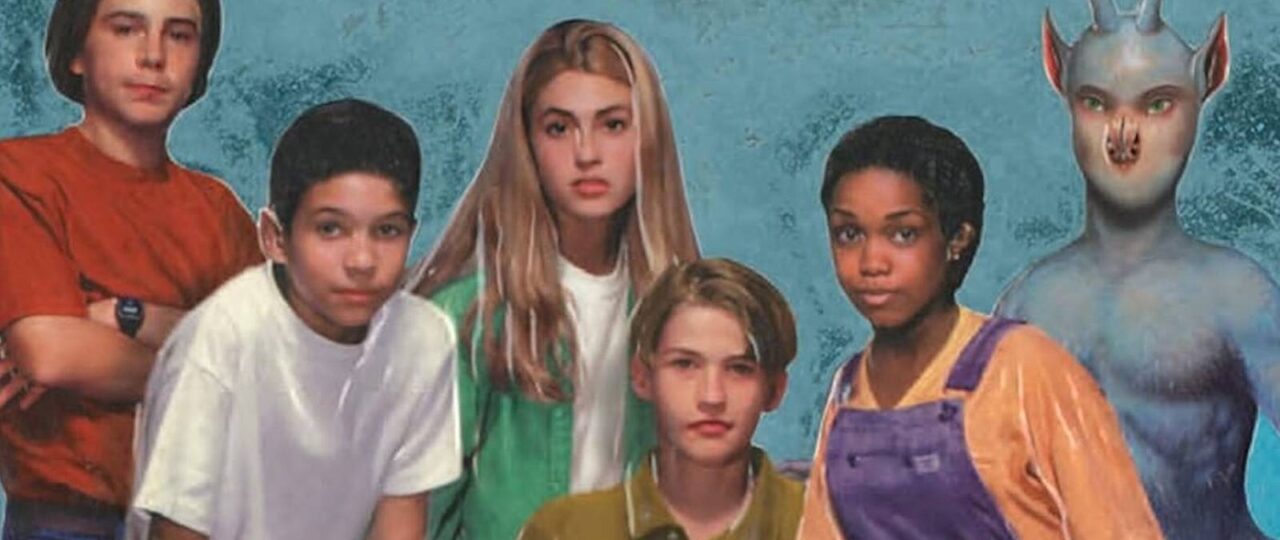
Scholastic has come a long way since its founding in 1920. Its content ranges from fun, educational adventures like The Magic School Bus to light horror stories like Goosebumps. Then you have more unique and out-there works, like Animorphs, which ran from 1996 to 2001. Written by Katherine Applegate and her husband Michael Grant with the aid of a team of ghostwriters, this was a science fiction series about alien parasites called the Yeerks invading Earth in the hopes of enslaving humans to use in their galactic war against the Andelites, an advanced race of space-centaurs. Earth’s only hope comes in the form of five teenagers who use Andelite technology to transform into animals, and a young Andelite cadet who is the sole survivor of a deadly space battle.
What set Animorphs apart from Scholastic’s other series wasn’t just its creative sci-fi setting, but the level of detail and maturity put into it — namely, its approach to war. The fact that the books were written for kids did not stop the husband-wife duo from writing about gory battles, genocide, paranoia, and propaganda, among other horrors of war. This honesty gave Animorphs a unique identity in the world of children’s literature, and even thirty years after the first book was published, it has aged like fine wine for its nuanced handling of such heavy topics.
Good and Evil Aren’t so Clear-Cut in ‘Animorphs’
<<img src="https://static0.colliderimages.com/wordpress/wp-content/uploads/2026/10/animorphs-eye.jpg?q=49&fit=crop&w=825&dpr=2" />
Image via Scholastic</figure>
Most children’s media try to keep their depictions of war simple. You’ll generally have one side portrayed as the aggressor with aspirations of conquest, and another as the victim or underdog trying to fight against them. At first, Animorphs follows this trend. The six protagonists are underdogs forced to use their morphing powers to keep their identities safe from the Yeerks, a ruthless galactic empire that has already subjugated other species. The kids are forced to use guerrilla tactics to avoid open warfare until the Andelites arrive with reinforcements.
However, the series is very quick to throw a wrench in this perception. The noble and heroic Andelites are soon revealed to be vain, arrogant, and paranoid, as it was one of their scientists who gave the Yeerks the technology to take to space. We even see them use propaganda to cover their tracks. In Book 8, The Alien, the Andelites are furious when they learn their morphing technology is known by the humans and force a young cadet to take the fall for the leak of information. It’s just the first of many instances where Applegate and Grant delve into how governments try to control the narrative in wars, showing that often, your allies in a war are only so because they hate your enemy as much as you.
Likewise, the Yeerks are full of nuances. Yes, they are parasites who take away the autonomy of their hosts, but to not do so is to live a blind, deaf life eternally swimming in the pool of your birth, all while possessing a mind as complex as any human’s. Their expansionist war occurred partially because they were overwhelmed by this impossible reality they had been exposed to, and partially because the Andelites were trying to contain them on their home world. Several Yeerk characters are complex individuals, with wants, goals, aspirations, and even loved ones. Many of them even sympathize with the plight of their hosts and would gladly try to find a way to peacefully coexist, but they are bullied into silence by the military and the ruling Council of Thirteen. More than an evil alien species out to conquer humanity, the Yeerks are a young empire hated by an established power and internally divided, hampered by their biology and inexperience.
Perhaps the best example of this complexity can be seen within the protagonists themselves. While everything they do is to save humanity from enslavement, they often have to step into morally dubious territory. One example happens early in the series in Book 7, The Stranger, when the Animorphs destroyed a device that allowed Yeerks to feed when outside their hosts every three days. While a major victory that slowed down the Yeerks’ plans, it also caused hundreds of Yeerks to die an agonizing death by starvation, to say nothing of all the human hosts who were also quietly killed off. The protagonists would also use torture as needed and had a horrible track record when it came to recruiting members. This makes sense in a lot of ways; what teenager is going to fight a secret war for years and not go a little crazy? It all shows the reader that wars are almost never simple good vs. evil, and that everyone has the chance to be a hero or a villain.
- The Wachowskis’ 1999 film won four Academy Awards, including Visual Effects and Film
Editing. - Bullet time was shot with a rig of roughly 120 still cameras firing in sequence around the
actors. - Keanu Reeves trained in martial arts for about four months before a frame was shot,
recovering from neck surgery the whole time. - It opened the same year as Fight Club and eXistenZ, in a run of films about not trusting the
world in front of you.
- Mad Max: Fury Road won six Academy Awards in 2016, more than any other film that year.
- George Miller storyboarded the entire film as roughly 3,500 panels before there was a
script. - The chase was shot almost entirely practical in the Namib Desert, with real vehicles and
real stunt performers. - Anya Taylor-Joy and Chris Hemsworth carried the prequel, Furiosa: A Mad Max Saga, in 2024.
- Blade Runner 2049 won Roger Deakins his first Oscar for cinematography, on his fourteenth
nomination. - The film also took Best Visual Effects, 35 years after Ridley Scott’s 1982 original.
- Villeneuve shot it on large-format film and kept the fog and rain practical on set wherever
he could. - Three short films by Luke Scott and Shinichiro Watanabe bridge the 30-year gap between the
two movies.
- Denis Villeneuve’s Dune won six Academy Awards in 2022, including Cinematography and
Original Score. - Hans Zimmer turned down Christopher Nolan’s Tenet so he could score Dune instead.
- Dune: Part Two arrived in 2024 and brought in Austin Butler, Florence Pugh and Christopher
Walken. - David Lynch’s 1984 version and Alejandro Jodorowsky’s unmade one are both their
own legends by now.
- The 1977 original won six Academy Awards plus a special achievement award for sound effects.
- John Williams’ score was recorded by the London Symphony Orchestra and became the
best-selling symphonic film soundtrack ever. - Andor took the galaxy somewhere colder and earned Emmy nominations for drama series in both
seasons. - The saga now runs across eleven feature films and a growing shelf of series on Disney+.
‘Animorphs’ Deals With the Traumas of War
<<img src="https://static0.colliderimages.com/wordpress/wp-content/uploads/2026/10/animorphs.jpg?q=49&fit=crop&w=825&dpr=2" />
Image via Scholastic</figure>
Applegate and Grant vividly detail the atrocities of the conflict. The battles between the Animorphs and Yeerk controllers leave very little to the imagination when it comes to body horror. The Yeerks might have access to advanced technologies and strong alien hosts, but a blow from the paw of an adult grizzly bear or the bite force of a Siberian tiger is enough to cause major damage. These clashes are bloody and hectic, with plenty of severed limbs, torn-out eyes, broken bones, and worse. The morphing technology protects their bodies, but the psychological effect weighs heavily on the kids.
Many times, the kids are reduced to tears when they change back to human form due to close calls with death. They can also get stuck in animal form if they don’t change back within two hours. Some, like the athletic fashionista Rachel, end up embracing the violence and become hardened killers. Others, like the animal-loving Cassie, are repulsed by it, leading them to make drastic choices in the name of finding a resolution to the conflict. The longer the conflict goes on, the greater the mental strain becomes, leading to tragic consequences for the characters and their loved ones.
In Book 1, The Invasion, de facto leader Jake learns that his older brother, Tom, is a controller, and he is unable to rescue him. Thus, he is forced to be on his guard constantly. His best friend, Marco, later learns that his mother, who was presumed to have died in a boating accident, is actually Visser One, the highest-ranked member of the Yeerk military. And while the other Animorphs don’t have controller family members, it highlights how terrifying the Yeerks are: they can literally be anyone, and you won’t know until it’s too late. This reinforces a deep sense of isolation and paranoia. When enemies could be anywhere, how do you go about making allies?
In the end, all these qualities make Animorphs such a mature and nuanced series. Sure, it still has plenty of silly adventures and the infamous covers are decidedly goofy, but at its core, the books introduced kids to war by highlighting the human cost, not just in the lives lost, but in how the psychology of those living through such horrors is slowly eroded. Here, good people are forced to do terrible things in order to survive, and atrocities can come from anywhere and anyone. In doing so, Animorphs created one of the best children’s sci-fi series that is still remembered and celebrated to this day.
Discover more from NAIRAVOICE.COM.NG
Subscribe to get the latest posts sent to your email.