
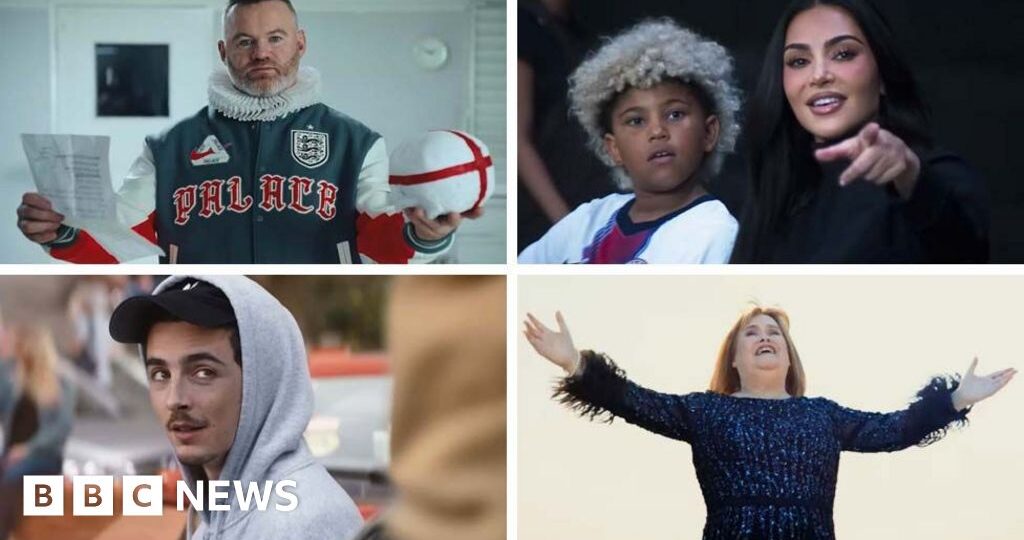

 Nike/Palace/England/Adidas/Irn-Bru
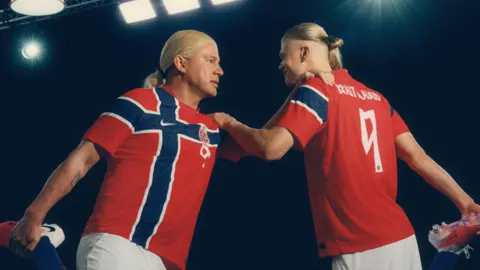
Almost six minutes into Nike’s frenzied recent football-themed advert, Norwegian superstar striker Erling Haaland finally leaps into life.
Having hitherto sat around the film set waiting patiently with his supposed stunt double, US actor Channing Tatum, the Manchester City forward appears as if from nowhere in slow motion – and in final boss mode – to ruin a young player’s shot at glory.
Rip the Script, as the ad is called, features Haaland alongside fellow goal machines Kylian Mbappe and Cristiano Ronaldo.
But more notably, it also features a sea of stars from other parts of the entertainment galaxy that are adjacent to the beautiful game.
They include fictional soccer coach Ted Lasso, Kim Kardashian and her PSG supporting son Saint West, and rappers/football fans Travis Scott, Central Cee and Blackpink’s Lisa, as well as basketball icon LeBron James – who is a minority owner in Liverpool FC.
James and Ronaldo appear together looking less like sports stars and more like characters from the X-Men or Justice League.
The cinematic commercial got tongues wagging online last week and capped a crazy run of lengthy, star-studded videos dropping ahead of the Fifa Men’s World Cup.
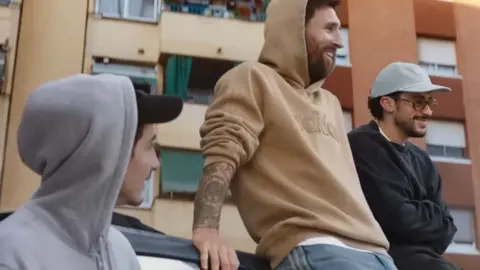
It landed soon after Marty Supreme star and Chelsea fan Timothée Chalamet had been seen pulling together a band of “Backyard Legends“, aka footballers Lamine Yamal, Jude Bellingham and Trinity Rodman, in Adidas’s five-minute offering.
Its free-flowing neighbourhood tournament was also enjoyed by Puerto Rican music star Bad Bunny as well as Lionel Messi and – via the wonders of technology – a regenerated young David Beckham from his playing days.
 Nike
NikeElsewhere, a collaboration between Palace Skateboards streetwear, Nike and England brought us former captain Wayne Rooney delivering a patriotic rallying cry from the pages of William Shakespeare’s Richard II.
And many other brands, including Brahma, Budweiser and Pepsi, have all been creatively vying for the attention of football fans, as have Lays Crisps and Lego.
“It’s very exciting and fun to start seeing everybody put their pieces on the table,” Caleb Jensen, one of Nike’s executive creative directors, tells BBC News.
“It does feel like it’s a World Cup in itself, just in the world of advertising.”
Of course, there have always been World Cup-adjacent adverts – from Diego Maradona starring for Coca-Cola in 1982 to a young Scott Parker doing keepie-uppies for McDonald’s in 94 and the Brazil team’s memorable airport scenes set to a samba beat in 98.
But the ambition and scale of these latest productions – which have been widely shared across social media – appear to have ramped up this time around.
Many feel more like mini-movies than conventional commercials.
“Young people don’t want to feel like they’re being marketed to,” reasons Jensen’s creative partner Blair Warren.
Advertising journalist Gurjit Degun, from industry publication Campaign, believes this is part of a broader trend towards companies “creating entertaining content” over more traditional ads.
“These adverts are less about selling products like football boots and fizzy drinks – though they are still in there – and more about cultural engagement and lifestyle,” she says.
The trend can also be seen in Christmas adverts, such as Waitrose’s four-minute festive rom-com The Perfect Gift starring Keira Knightley and Joe Wilkinson, Degun says.
And given that the US is one of the World Cup host nations, she suggests brands are potentially “tackling it in the way they approach the Super Bowl ads” – by going big and long.
Shorter versions of many commercials – like the Instacart one featuring Ben Stiller and Benson Boone in a retro-pop music video – have appeared on TV during breaks in the action, while directing viewers to see more online.
Hydration breaks during this summer’s matches will make it a game of four quarters, not two halves, and therefore allow broadcasters to sneak in more promos.
 Adidas
Tom Berendsen, managing director of production company Business/Club, this year made a Super Bowl advert for Skittles starring Elijah Wood, surreally, as a magical horned woodland creature.
Berendsen’s company says its aim is to make films, or “absurdist entertainment”, for people “who hate commercials”.
“Selling products is dead,” he says. “And I think brands have quickly realised that in order to make anyone [care], you have to entertain them, which is easier said than done.”
Businesses are now looking to production companies and directors, he says, who are “big in the world of creating entertainment” – making music videos, short films and features.
One such creative, Oscar-winning Mexican director Alejandro González Iñárritu (The Revenant, Birdman) arguably kicked off the trend in 2010 with his epic Write The Future ad, which had a bearded Rooney living in a caravan park while dreaming of success.
“Big brand ambassadors” like Rooney are needed to stand out in the “saturated” advertising space, says Berendsen.
“The only way that you cut through that barrier is to bring in people with cultural significance that they [viewers] respect.
“But, God, does it cost brands a lot of money to do this.”
His own company is now working on a short sitcom and a series of sketches that subliminally serve as an endorsement for a new drink.
“In the old days, you would have a product, and then you’d have advertising to sell a product. Nowadays you create entertainment that happens to sell a product.”
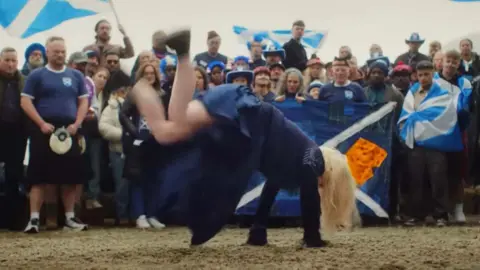
Scottish soft drink Irn-Bru poured some fizz into fans’ algorithms last week – ahead of the men’s side’s first World Cup appearance in 28 years – with the release of a tongue-in-cheek music video, We’re Made in Scotland from Girders.
It finds singer Susan Boyle – teed up by midfielder John McGinn – booming out a balladic version of a retro jingle atop the Forth Bridge, while Franz Ferdinand’s Alex Kapranos is seen shredding his guitar somewhere near a loch.
Comedian Paul Black and actor Kevin Oakes also appear, but, according to Shelley Smoller, chief creative officer at Lucky Generals, which oversaw the campaign, the focus is firmly on “celebrating Scottish football fans”.
“Irn-Bru doesn’t have the budgets of some of the other bigger brands, so they have to have a different point of view and punch above their weight,” she says.
“We did loads of research to actually find out what the fans are feeling, what the Tartan Army is going through during this time, and what they feel about it.
“So it’s not celebrating football greatness or the heroic athletes or the cinematic aspiration that other brands are trying to tap into, but more like the ridiculous travel plans, the impossible odds, the financial irresponsibility and the sleep deprivation – and really tap into Scottish culture that way.”
 Irn-Bru
Highlighting the “experiences and challenges” faced by fans during a “genuinely global cultural moment”, Smoller says, was the approach in order to make something “very human and easy to relate to”.
“As competitive as football is, with all the rivalry, it’s the same for brands, and everyone’s trying to compete to get the biggest stars, and so you need to give more than that.”
Brands like Nike and Irn-Bru have suggested there is more content still to come throughout the tournament, so we’re likely to see new material and more adverts as the summer goes on.
They may depend on how events play out for teams like Scotland.
“What I will tell you is there are going to be certain ways of making it relevant to the different phases of the tournament,” Smoller smiles.
Discover more from NAIRAVOICE.COM.NG
Subscribe to get the latest posts sent to your email.