The US Navy is testing whether it can robotically refuel naval drones at sea, a capability that could allow them to operate for longer in higher-threat waters.
Uncrewed surface vessels may not need a crew, but they still need fuel to operate.
The recent test is a step toward a fully autonomous refueling process that Navy officials say could eventually let the service send uncrewed vessels into dangerous waters for longer without human support elements.
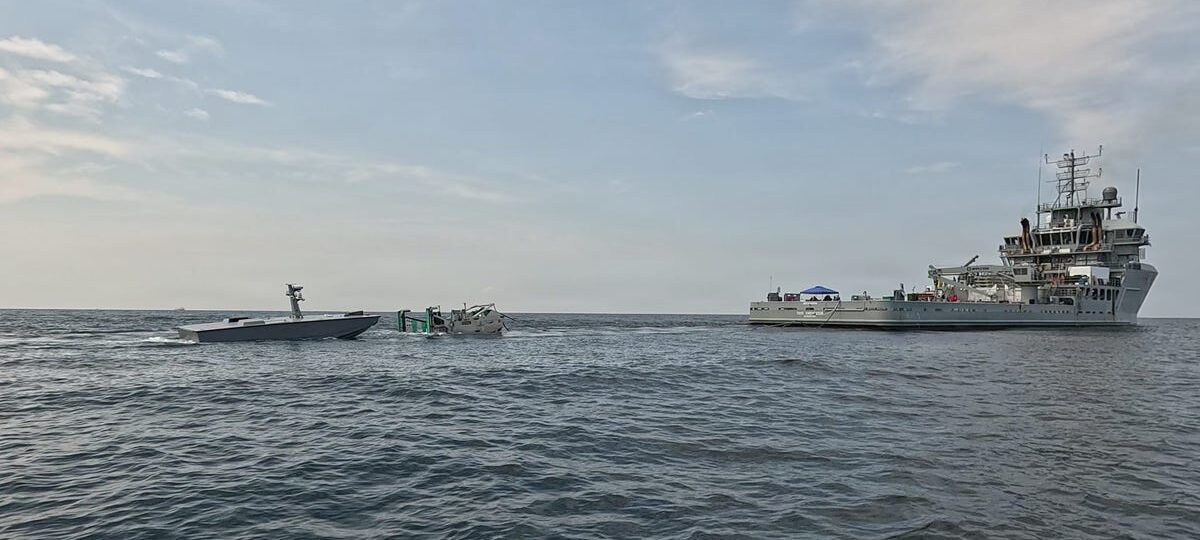
The Naval Air Warfare Center Weapons Division shared details Wednesday of a recent refueling demonstration involving the remotely controlled T38 USV built by Maritime Tactical Systems Inc. and a towable capture-and-connection robotic refueling system made by Sealartec.
During the testing in the waters off Joint Expeditionary Base Little Creek-Fort Story in Virginia, the drone and the refueling system completed dozens of capture, refuel, and release exercises.
Four hundred gallons of fuel were transferred to the T38.
The immediate problem the Navy is trying to solve is tied to the Navy’s testing of hypersonic and other long-range weapons.
Those tests, “where flight profiles can extend thousands of miles beyond fixed-range boundaries,” can “require data-collection assets to be distributed across a vast area,” Spencer Holloway, director of the division’s Blue Water Instrumentation Future Capabilities Office, said in a release.
Naval drones are useful for gathering that data, but having to return for fuel cuts into their time on station.
Holloway said that “every time an unmanned vessel must return to port for fuel, we lose persistence, reduce coverage and redundancy, and interrupt the mission.” The Navy sees a broader application as well. “This will allow us to have greater reliance on unmanned vessels instead of manned, and we can push the USV into higher threat areas without risking manned vessels and personnel,” Ronald Raymer, branch head for capability, innovation, science and technology integration at US Fleet Forces Command, said in the release. “It will also allow us to distribute greater capability into an area without having to invest in large expensive manned vessels,” he said.
The August demonstration was not fully autonomous.
The Navy’s next step is a complete end-to-end test in which a drone boat can meet up with a robotic refueling system, approach it, connect, take on fuel, disconnect, and return to its mission without operator control every step of the way.
To do that, Holloway said, the systems involved will need more precise maneuvering and better local positioning.
Discover more from NAIRAVOICE.COM.NG
Subscribe to get the latest posts sent to your email.