

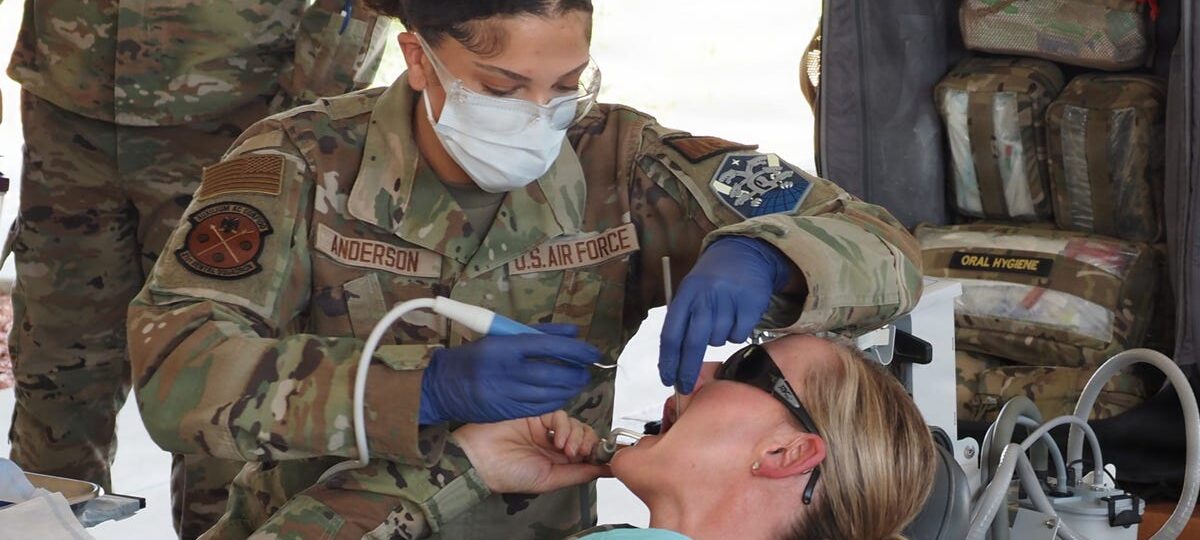
A painful toothache or an oral infection might not sound like an injury that could sideline a soldier in combat, but US Army dental leaders warn that in a future conflict, such easily overlooked conditions could take troops out of the fight, consume scarce evacuation capacity, and further stress a strained medical system.
Most of the Army’s major exercises don’t include dental emergencies in their casualty scenarios, dentists said in a recent professional article, leaving commanders with an incomplete picture of the medical and triage or evacuation demands they could face in large-scale combat.
Dental emergencies can quickly render troops “non-mission-capable,” the authors wrote, because pain can make it difficult to eat, think clearly, or carry out important tasks like operating weapons.
They described this as a significant “hidden casualty load.” Unlike combat wounds, most dental problems can be easily fixed if dental teams are nearby, but despite their important role in military health care, “deployable dental capabilities continue to decline,” authors wrote, underscoring an “urgent need for accurate dental emergency modeling in war-gaming to emphasize the importance of [non-battle related injuries] and dental emergencies.” Past wars indicate substantial demand.
Dental emergencies accounted for 19% of all treatment at military hospitals near the front lines during the war in Iraq.
Another recent article by Army dentists said that dental disease and other non-battle injuries made up nearly 16% of all medical evacuations among troops fighting the Islamic State in Iraq and Syria.
Almost all dental patients treated by forward dental teams returned to duty after one or two visits, the authors wrote.
Without dental care close to the front, however, soldiers may have to travel farther to receive treatment, potentially removing them from duty for as long as a week.
Casualty evacuations for any type of health concern or injury, major or minor, are likely to pose a problem for the military in future large-scale combat.
The proliferation of drones, both attack and surveillance systems, across the Ukrainian battlefield have made quick evacuation largely impossible, a stark difference from the US experience during the post-9/11 wars.
In a recent military news release for a healthcare training event, Army dentist Lt.
Jesse Thietten said dental care “is a low-hanging-fruit solution for medical as a whole.
Military medicine needs solutions to account for the anticipated systemic medical overload in [large-scale conflicts.]” Dental emergencies could rank among the top five most common reasons for casualty evacuation in such a fight, Thietten added.
For troops deployed abroad in multinational settings alongside partner forces, dental concerns are “the number one reason” for casualty evacuation, he added.
Thietten helped develop a lightweight expeditionary dental platform for special operations teams training in remote parts of Europe, where teams asked for help treating dental emergencies without easy access to traditionally robust medical facilities.
The goal was to bring care closer to troops rather than having to shuttle them to far-off clinics.
Such an approach reflects what Thietten argues the broader force will need in a future fight, including more dental work before troops deploy, along with smaller, more mobile dental teams that can operate close to units in the field.
Within the Air Force, less than 1% of the service’s dentists deploy,” said Air Force Col.
Anita Shade, chief of dental services for the 21st Medical Group, in the same news release. “Our dental teams are often disconnected from the heart of the readiness mission that we work to support, day in and day out,” she said.
That disconnect may become more pronounced when combat casualties can’t easily be moved from the battlefield to established hospitals and care facilities. “Asymmetric/hybrid drone warfare shows us that we now need to plan and prepare for prolonged patient management in the field due to the unpredictability of patient transport,” Shade said.
Another problem for some military dentists is more basic — broken field equipment and a lack of medical supplies, hampering training opportunities.
Two Army dentists cited those problems in another article from this summer on how military dentistry must adapt for future conflict.
While preparing for a unit exercise, they found that their field equipment had not been used in nearly a year and that critical equipment including their sterilizer unit was broken, underscoring further readiness challenges.
Discover more from NAIRAVOICE.COM.NG
Subscribe to get the latest posts sent to your email.