

- Near the end of World War II, Germany surrendered to the Allies, but Japan refused.
- To end the war quickly, President Truman’s government decided to drop an atomic bomb on Hiroshima.
- On August 6, the atomic bomb “Little Boy” was dropped, killing an estimated 80,000 people.
Some generals argued that the war should have ended with a final invasion of Japan, but they also advised that it could result in the deaths of up to 1 million US troops.
Among other reasons, Truman didn’t want more US soldiers to die, so he chose to proceed with the atomic bomb if Japan wouldn’t surrender, Al Jazeera reported.
Many military leaders believed the atomic bomb was unnecessary and that Japan would surrender without the use of atomic bombs.
But a committee of advisors, led by the Secretary of War Henry Stimson, argued that there was a consensus supporting the bomb and that it needed to be dropped to end the war.
On July 16, a test atomic bomb was successfully detonated in New Mexico. Less than a fortnight later, Truman issued his warning to Japan.

On July 26, Truman made the Potsdam Declaration. He told Japan to unconditionally surrender or face “prompt and utter destruction.”
Japan ignored Truman’s demand.
US intelligence also showed that Japan, which had 2.5 million troops, was preparing for an American invasion.
Japan had readied thousands of suicide planes and more than 560,000 soldiers for an expected US invasion. Reports also showed that Japan planned on executing all US prisoners as soon as US armed forces landed in Japan, according to the National WWII Museum.
The plan to use the atomic bomb proceeded.

A crew of 12 was assembled on a US military base on Tinian, an island in the Northern Marianas in the Pacific. Colonel Paul Tibbets was named pilot, and Captain Robert Lewis was his co-pilot, per The New York Times.
Captain William Parsons was the weaponeer, and Second Lieutenant Morris Jeppson was the electronic test officer, according to the Atomic Heritage Foundation.
On August 5, the crew was briefed about their mission. Hiroshima, which had an active military base, had been chosen for bombing.

Tibbets told the crew they would be dropping bombs on Hiroshima, a city of about 350,000 people, but he didn’t tell them they would be dropping an atomic bomb.
The atomic bomb was called “Little Boy.”

It was a 10-foot-long uranium bomb that weighed 9,788 pounds.
On August 5, Little Boy was loaded onto an American B-29 bomber Tibbets had called “Enola Gay” after his mother.

It was confirmed that the drop would take place the next day.
At 12:15 a.m. on August 6, the crew listened to a prayer composed for the occasion.

At the time, there was no certainty that the flight would survive the explosion.
At 2:45 a.m., Enola Gay and two other B-29 observation bombers took off.

Because Enola Gay’s cargo was so heavy, it required the entire 2-mile runway to take off.
Three weather planes also left Tinian. Each one flew to a potential target city — Hiroshima, Kokura, and Nagasaki — to check if weather conditions would permit a bomb drop.
At 3 a.m., Parsons and Jeppson began to arm Little Boy. The crew would soon learn they were carrying the world’s first atomic bomb.

They inserted gunpowder and a detonator into the bomb.
At 7:15 a.m., they removed the safety devices and inserted arming devices. Little Boy was ready to be deployed.
At 7:30 a.m., Tibbets told his crew, “We are carrying the world’s first atomic bomb.”
At 8:24 a.m., the weather plane over Hiroshima relayed that it was fine to proceed.

Tibbets told his crew it had been confirmed. He said, “It’s Hiroshima.”
The plan was to drop the bomb on the Aioi Bridge, a T-shaped bridge that Tibbet had earlier said was, “the most perfect aiming AP (aim point) I’ve seen in this whole damn war.”
At 8:15 a.m. local time, Little Boy, the world’s first atomic bomb used in battle, was dropped from 31,060 feet in the sky.

It fell nearly 6 miles in 43 seconds before exploding 1,900 feet from the ground, the BBC reported.
Witnesses recalled a flash of blinding light before a giant mushroom-shaped cloud filled the sky.
The fireball grew 900 feet in diameter. The power of the blast was the equivalent of 12-15,000 tons of TNT.
Tibbets pulled a sharp 155-degree turn as soon as the bomb was dropped, knowing there was less than 45 seconds to get away.
By the time the bomb exploded, Enola Gay was 11.5 miles away.
The mushroom cloud reached about 20,000 feet into the sky.

At the core of the fireball, the temperature was more than 1 million degrees Celsius, while the surface reached as high as 4,000 degrees Celsius, according to Hiroshima City.
Tibbets later wrote about the explosion in his memoir, describing the mushroom cloud as “boiling upward like something terribly alive,” The New York Times wrote in his obituary.
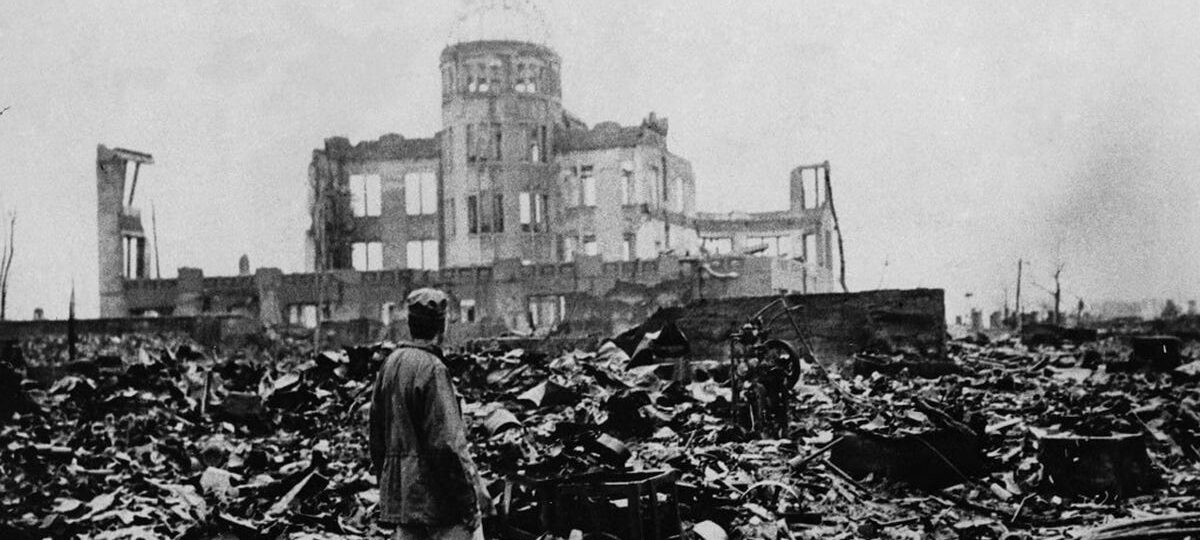
At the time, it was the most destructive bomb used in the history of war, instantly wiping out 5 square miles of Hiroshima.

The explosion wiped out 62,000 buildings. As many as 80,000 people are estimated to have been killed instantly.
The precise number of fatalities is not known, but the City of Hiroshima reported an estimated 140,000 people died by the end of 1945 from the effects of the explosion, including radiation poisoning and burn wounds.
According to the US Department of Energy’s Manhattan Project history, the final death count over the next five years was almost 200,000.
The explosion was so devastating that some people were vaporized, leaving nothing behind except for their “nuclear shadow.”

These shadows were actually what the surfaces looked like before the blast, but they appeared dark compared to everything else bleached by the atomic heat, LiveScience reported.
Roof tiles were fused by the heat, while bronze and granite statues melted away.

Across the city, fires began to spread, causing even more damage.
After the explosion, the Enola Gay circled the city three times before turning back toward the base.

It wasn’t until they were 368 miles from the city that they could no longer see the mushroom cloud, AHF reported.
At 2.58 p.m., the Enola Gay landed back on Tinian. The mission had taken about 12 hours.

While it was not enough to end the war, it had changed the world.
Hours later, Truman told Japanese leaders that if they did not “now accept our terms they may expect a rain of ruin from the air, the like of which has never been seen on this Earth.”

Sixteen hours after the bomb, he told them the US was now “prepared to obliterate more rapidly and completely every productive enterprise the Japanese have above ground in any city.”
“We shall destroy their docks, their factories, and their communications. Let there be no mistake; we shall completely destroy Japan’s power to make war,” he said.
Three days after the bomb was dropped on Hiroshima, a second, more powerful bomb known as the “Fat Man” was dropped on Nagasaki.

It killed an estimated 70,000 people, including those who later succumbed to the effects of the bomb, by the end of 1945, PBS reported.
On August 14, 1945, Japan surrendered.

The Japanese Emperor Hirohito announced the surrender via a recorded radio message the following day.
On September 2, 1945, Japanese representatives formally signed the Instrument of Surrender, officially bringing the war to an end.
Sources for this story included AHF, NationalWW2Museum, BBC, History.com, Al Jazeera, Hiroshima City, LiveScience, The New York Times, PBS, and The History Press.
Editor’s note: The story was first published in August 2023 and most recently updated in August 2026.
Discover more from NAIRAVOICE.COM.NG
Subscribe to get the latest posts sent to your email.