

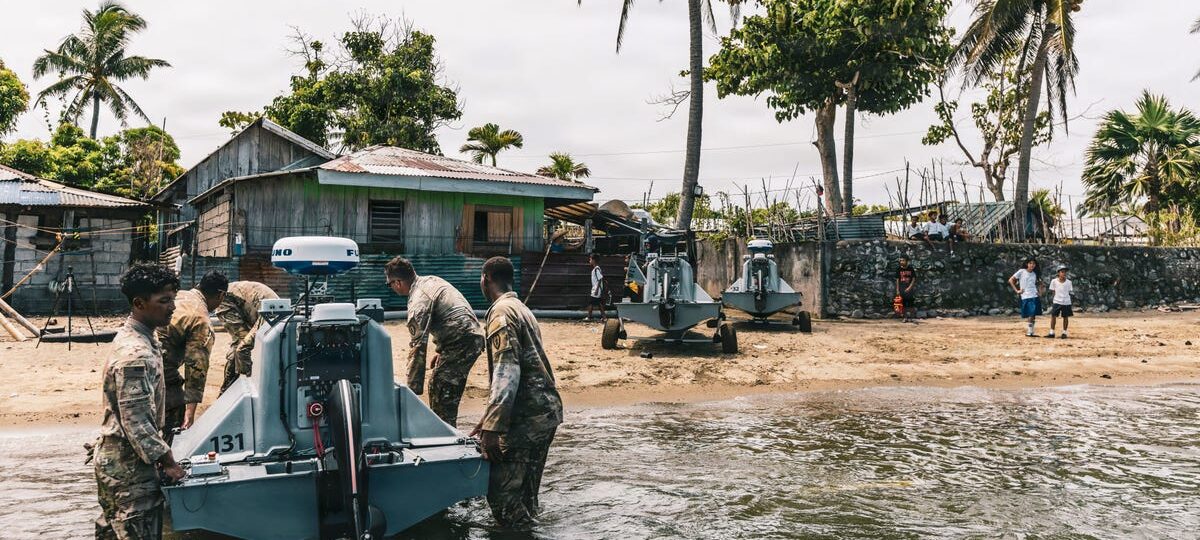
The US Army is interested in acquiring drone boats to supplement its limited fleet of supply and transport watercraft in the Pacific.
The Army faces fleet size and readiness problems with its watercraft.
Uncrewed surface vessels, or USVs, are seen as a potential solution that could relieve the logistics strain on crewed watercraft, operating in more forward-deployed environments and quickly dispatching supplies, weapons, and equipment.
Speaking with reporters at a media roundtable last week, Maj.
Gavin Gardner, head of 8th Theater Sustainment Command, said the Army anticipates testing a drone boat sometime as early as next summer.
He said that the Army could ultimately end up buying a fleet of anywhere between 30 and 100 medium-sized vessels capable of carrying eight to ten 20-foot containers.
He didn’t identify companies involved but said that some firms had traveled to the region and demonstrated some of their systems.
These future autonomous vessels could range in size and use, but larger ones would need to be capable of carrying shipping containers, supplies, and soldiers. “I could see those operating in the US PACOM area of responsibility,” Gardner said, referring to US Pacific Command, which oversees military operations in the region. “I think that gives you a ton of operations, inventory in motion, easy to respond.
And then because they’re autonomous, and we can work with our partner nations forward, you have those berthed up everywhere from Korea to Japan, the Philippines, Australia, Singapore, Thailand, etc.” Those vessels could be controlled from the command’s headquarters in Hawaii but would likely be forward-deployed in response to a constant demand on Army vessels to deliver supplies and equipment in the Pacific area, he added.
The expectation is that the first contracted vessel would head out to Hawaii this time next year and assist in moving equipment and supplies in the Hawaiian islands for evaluation.
The Army’s watercraft problem has long been a challenge for the service.
In 2024, the US Government Accountability Office, a congressional watchdog, reported that the mission-capable rate of the Army’s 70 watercraft had slid from more than 70% in 2020 to less than 40% in 2024, partially due to long-standing maintenance issues.
The service is currently working to address problems with its fleet in ways beyond autonomous surface vessels.
In 2024, the Army activated its first new composite watercraft company in decades, and it has plans to receive a total of seven Maneuver Support Vessels (Light); one is currently in service.
Another composite watercraft company is set to be activated in October, Gardner said, and one potentially consisting of autonomous and crewed vessels could be ready next year.
The Army doesn’t view USVs as a wholesale replacement of crewed watercraft but rather a complement. “I use autonomous watercraft to do routine delivery, and then I see my manned Army watercraft systems to really give commanders operational maneuver to deliver at the time and place of our choosing, on the beach, that maybe an autonomous watercraft doesn’t have the capability to do, but current Army watercraft systems are designed to do,” he said.
The command is also looking at pulling prepositioned watercraft out of storage, using contractor-owned and -operated vessels, training Army personnel on those contractor vessels, and relying on allies like Japan and the Philippines for assistance to address shortfalls.
Discover more from NAIRAVOICE.COM.NG
Subscribe to get the latest posts sent to your email.