

After a long day selling multimillion-dollar condos in downtown Miami, Maile Aguila retreats to her five-acre farm about 30 miles south.
The place is a far cry from the city’s soaring high-rises, where uber-rich buyers enjoy access to perks like indoor lap pools, private padel courts, and spacious balconies overlooking the water.
Tucked inside a barn on Aguila’s property, though, is an amenity that would feel right at home in any penthouse: her prized infrared sauna.
Aguila, 71, has lived on the property for decades, but she awoke to the wonders of the sauna a couple of months ago at an event hosted by Biohack Miami. “When you walk out of there, you feel brand new,” says Aguila.
Several evenings a week, she cranks up Bad Bunny or Marc Anthony and sinks into the hot glow for 20 minutes.
Then she enjoys the best sleep she’s had in years.
Our twin obsessions with longevity and looksmaxxing — hacking our way to healthier lives and looking hotter while doing it — are reshaping not just bodies but homes, turning spare rooms and garages into dens of tech-enabled optimization rather than lo-fi leisure.
The McMansion era had its man caves and home movie theaters; the pandemic sent everyone scrambling to set up a home office or a makeshift gym.
The biggest flex these days is a cold plunge, red-light therapy room, or sauna.
These modern luxury markers aren’t solely for the superrich.
It’s never been cheaper to bring the spa home: the model Aguila bought fits two people and costs less than $5,000.
I also spoke with a 27-year-old Austin couple who transformed an empty covered patio into what they’ve playfully dubbed a “wellness hut,” complete with sauna and cold plunge, for less than $8,000 — a fraction of the cost of a typical kitchen renovation.
Of course, the wealthy are all in on this stuff, too.
During a recent trip to Miami, I watched health-conscious patrons curl up in hyperbaric oxygen chambers and chatted with condo developers at the bleeding edge of the wellness boom.
I’m always a little wary of buzzword-y sales pitches, which can veer into the nonsensical, but the longevity craze seems to have real legs.
For health-obsessed homeowners, that means a host of new status symbols.
America’s homebuyers are a fickle bunch.
Marble countertops were all the rage until buyers warmed to quartz.
Popcorn ceilings, once en vogue, are now a liability.
At least open floor plans are still hot — wait, nope, people suddenly want defined living spaces again.
The latest real-estate buzzword is “wellness.” Mentions of the word in Zillow listings increased 33% last year, the home search platform said, while “spa-inspired” bathrooms showed up 22% more often.
The uptick likely reflects a couple of things, says Amanda Pendleton, Zillow’s home-trends expert: More people are splurging on nice-to-haves like steam showers and wet rooms, while savvy real estate agents are recognizing the surge in interest and grasping for anything that could fall under a capacious definition. “It’s sort of a mixed bag,” Pendleton tells me. “It is marketing, but it’s also that these features truly are more common in homes today than they were a year ago.” Cold plunges and saunas are undeniably on the rise.
The US sauna market is expected to grow in value by $161.3 million from 2025 to 2030, according to a report from the market-intelligence firm Technavio.
Grand View Research, a similar firm, projects an even bigger rise in the cold plunge segment, from roughly $355 million in 2025 to $660 million by 2033.
In addition to these mainstays, luxury homes have turned into testing grounds for more exotic amenities.
Rich buyers are turning what might once have been a walk-in closet into a red-light therapy room, or swapping a hyperbaric chamber for a plush sofa.
High-dollar condo developers are also allocating more square footage to amenities for buyers looking to optimize their health.
Aguila’s latest undertaking is selling units at HQ Residences Miami, a condo tower in the city’s Edgewater neighborhood where the second-highest floor is devoted entirely to wellness rituals like the requisite hot-and-cold spa circuit as well as yoga, pilates, and robotic massages.
The most expensive units will go for $2.2 million.
On the more affordable end is House of Wellness, another planned condo development in Miami, where units start at $400,000.
The 35-floor tower will include a full-service spa and offer residents a personalized health assessment each year. “Longevity, it’s in our DNA,” says Ricardo Dunin, the developer behind the project. “I mean, who doesn’t want to live longer?
Just outside Miami, I toured Oasis Hallandale, a development that includes two residential towers, restaurants, and a “fitness and biohacking hub” called Oasis Fit, where residents of the condos — priced from $750,000 to $5.02 million — will enjoy heavily discounted access to features like cryotherapy, peptide injections, several saunas, and a range of recovery treatments.
The place leans more into the sterile feel of a doctor’s office than the soothing tones of a new-age spa, but it’s easy to imagine a resident spending a good chunk of their day there, hopping from a pilates class to the recovery room and maybe tacking on an hour of hyperbaric oxygen therapy.
While multimillion-dollar homes may represent the most aspirational end of this shift, I found myself more struck by the regular people devoting slices of their living rooms or backyards to cheaper, prefab longevity tech.
The more attainable versions of these status symbols are nonetheless still flexes — especially from my vantage point in a cramped New York City apartment.
Roger and Haley Macin, both 27, began their house hunt in Austin with dreams of finding a place that could accommodate their growing obsession with the cold plunge.
Haley, in particular, had been following the work of functional medicine doctor Mark Hyman and seeking out any treatments that could reduce stress and anxiety — the cold plunge was the only thing she tried that delivered instant results. “The first time I did it, I was like, ‘Oh my god,’ Haley tells me. “I had energy all day.
My body felt better, my mind felt clearer.” They found their match in a low-slung, two-bedroom home with a separate structure in the backyard that had once served as a single-car garage.
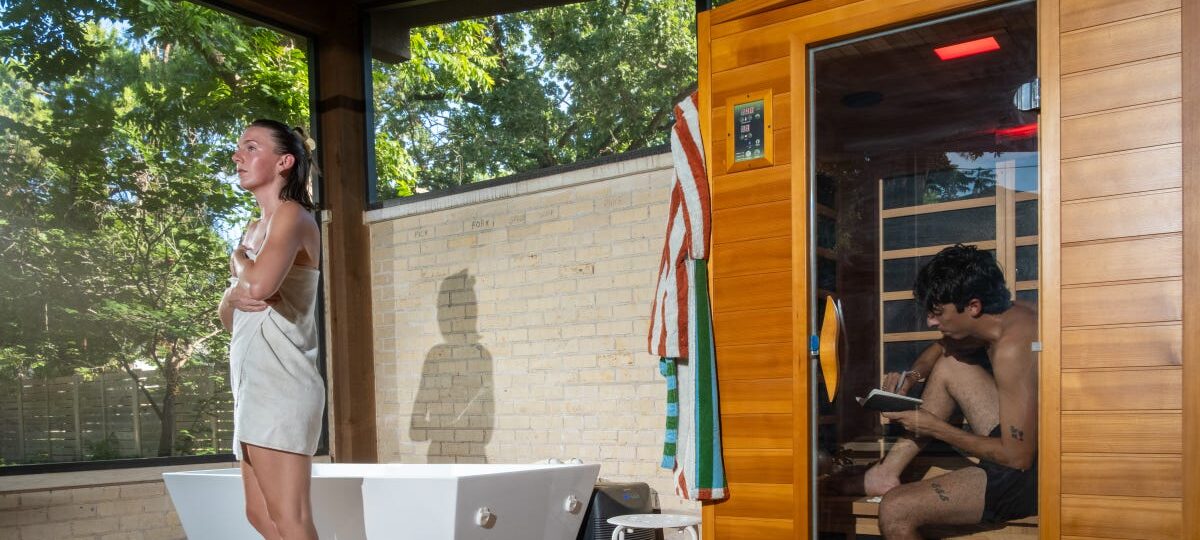
Bug nets on the sides let in light while the roof offered protection from the elements, making it a prime spot for their cold plunge, which they purchased for roughly $6,000 soon after moving in. “We got a cold plunge before we even got, like, a guest bed or a lot of our furniture,” Haley says.
In addition to their big splurge, they’ve since added more features to round out what they affectionately call their “wellness hut,” like a two-person infrared sauna they purchased for about $1,500 and assembled themselves.
Sometimes friends drop by to hang out and rotate between the heat and cold.
Roger says he knows a few other people who have cold-plunge setups, and he comes across many other boosters on LinkedIn, where he spends a lot of time for work: “They’re like, ‘I live and die by the cold plunge.'” Compact amenities like these are natural fits for the age of the shrinking American home, with the typical new house about 300 square feet smaller than it was a decade ago.
Stressed out and stretched thin, today’s professionals are searching for ways to maximize their space and reduce the amount of time they spend driving to and from the gym. “We work all day, so we don’t really have time to go to another location for a workout, or then a third location for a sauna and cold plunge,” Roger tells me.
For now, at least, wellness features may or may not juice your home’s value.
Zillow found that homes with cold plunges sell for 2% more than comparable places without one, a sizable bump for some bone-chilling water.
A sauna, on the other hand, was associated with a 0.2% decrease in value.
Homebuyers, Pendleton says, may be willing to “pay above and beyond for a home with wellness features they’re actually going to use, but they’re not going to pay for a sauna if that’s not their vibe, right?” OK, so clearly some can’t handle the heat (or simply don’t want an entire room devoted to it).
My time in Miami made clear that homeowners these days have a broad range of options at their fingertips.
Aguila, for her part, is more than happy to extol the benefits of the sauna.
She’s still warming to the cold plunge, though. “I don’t know if I can handle it,” she tells me. “Maybe I’ll go to another biohacking event and submit myself to it.” James Rodriguez is a correspondent on Business Insider’s Discourse team.
Discover more from NAIRAVOICE.COM.NG
Subscribe to get the latest posts sent to your email.