
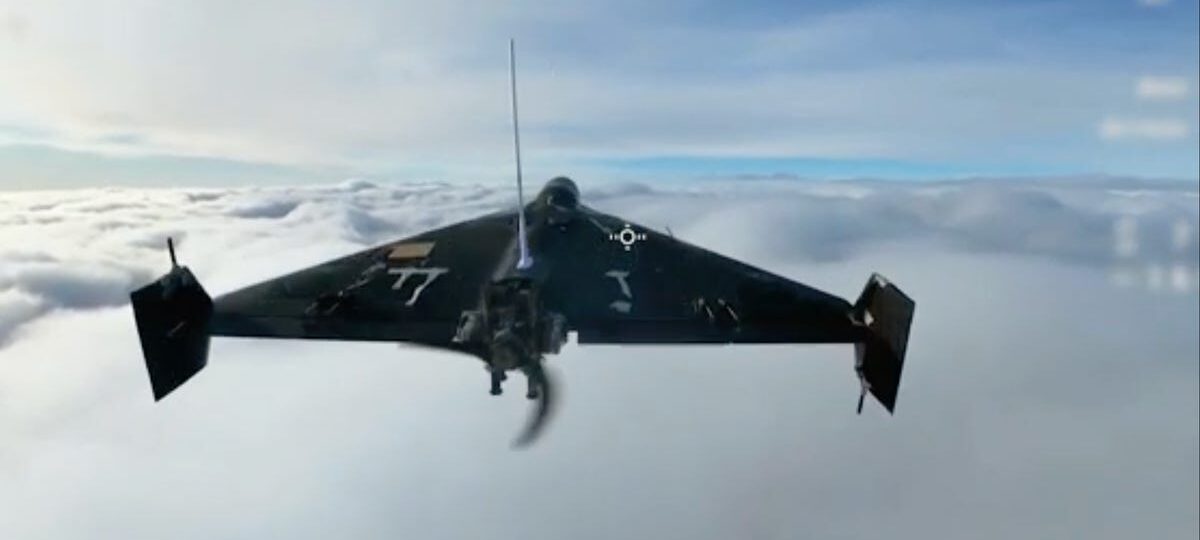
The next evolution of attack drones like Russia’s Shaheds will feature AI that allows the drone to independently recognize targets and choose to strike them, said one of Ukraine’s top drone analysts. “Analyzing targets by priority, selecting a target, and autonomously deciding to attack are undoubtedly the near future for the entire class of strike UAVs,” wrote Serhii “Flash” Beskrestnov, an advisor to Ukraine’s defense ministry on drone warfare, on Wednesday.
His post was centered on the Shahed, a fixed-wing loitering munition designed by Iran but co-opted by Russia.
Every month, the Kremlin manufactures thousands of its own versions of Shaheds, dubbed Gerans, which it launches in waves of hundreds at Ukrainian cities.
Russia typically pre-programs the flight paths of these drones, but has continually equipped them with upgrades such as anti-jamming tools, rear-facing cameras to detect and avoid interceptors, and components that allow human operators to pilot them remotely.
Beskrestnov, who is widely recognized in Ukraine for his analysis of drone wreckage and footage, said Russia already possesses the technology for drones to identify and highlight targets through advanced video cameras made in China. “The camera can find a target and keep it in focus.
That’s nothing unusual anymore,” Beskrestnov wrote.
However, the next stage of AI assistance — getting a model to automatically select a target and decide to launch an attack — is still “only going through the first stages of combat testing” in the war from both Ukraine and Russia, he added.
Terminal guidance for the drone, or having the AI steer the loitering munition to its target, is more difficult for fixed-wing platforms such as the Shahed, Beskrestnov wrote. “But it has already been implemented both in our UAVs and in those of the enemy,” he added. “For terminal guidance to work on a Shahed, such a function must be implemented in the flight controller’s interface.
Technically, this is possible.” Beskrestnov said Russian forces had already been posting videos of their drones using artificial intelligence to recognize targets and assist with attacks.
He also posted footage that appears to be shot from a drone flying over a compound that had come under attack.
Several buildings and vehicles are highlighted in colored boxes in the footage, indicating AI-assisted target recognition.
It’s unclear who the drone belonged to and where the footage was shot.
Business Insider could not independently verify the authenticity of the footage.
Combined, the three AI elements mentioned by Beskrestnov would allow a drone to operate independently in combat, a precursor to what military analysts and top commanders around the world have said is the future of drone warfare: swarm technology.
AI also makes it much harder to stop a drone with electronic warfare, which has typically relied on severing the radio link between the system and its operator or spoofing its satellite navigation signals.
Ukraine has already been reported to be implementing AI-assisted targeting and terminal guidance on some of its fixed-wing drones.
More recently, it’s been using mid-range attack drones, designed to fly between 30 and 300 km, to strike logistics routes and command posts in the heavily jammed rear of Russia’s front lines.
Discover more from NAIRAVOICE.COM.NG
Subscribe to get the latest posts sent to your email.