Netflix’s The Mosquito Bowl isn’t exactly reinventing the wheel when it comes to either war movies or sports films – or movies based on true stories more generally, for that matter – although it does make some very surprising choices at times. As the title suggests, The Mosquito Bowl is based on the real-life event of the same name, wherein American soldiers, on the precipice of the Battle of Okinawa during World War 2, briefly set their weapons aside and played a game of football.
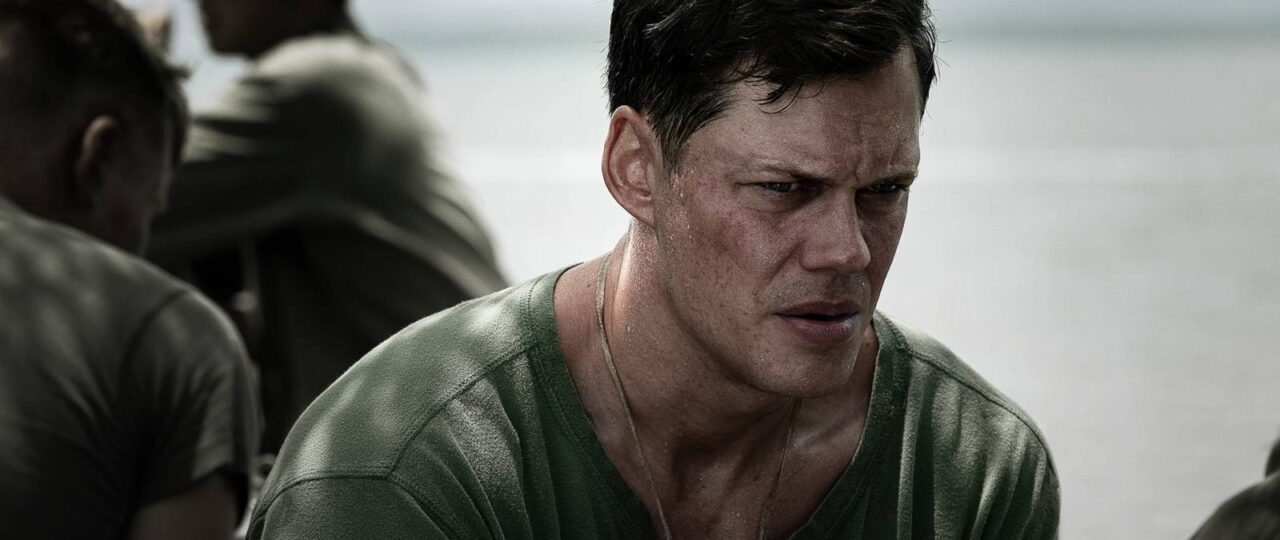
This wasn’t just a random recreational choice, though. Multiple major football stars had been drafted, several of whom ended up together in the war. The biggest names, at least in terms of this movie, were John McLaughry (Nicholas Galitzine), Bob Bauman (Bill Skarsgård), Tony Butkovich (Ray Nicholson), and David Schreiner (Tom Francis). Devastatingly, of the 65 young men who played in the game, 15 ultimately died in the battle that followed.
That is, in part, what The Mosquito Bowl centers on, although surprisingly little in the movie actually involves football; even the Mosquito Bowl itself takes up a very small fraction of the two-hour-and-seven-minute runtime. Instead, the movie primarily focuses on the brutalities of war and the way in which it claims young lives, which is an admirable endeavor. However, one has to wonder whether, at times, The Mosquito Bowl takes things too far. It leans much more heavily into gruesome imagery and gory, horrifying scenes than a complex, thoughtful unpacking of the incredibly fraught nuances of war.
The Mosquito Bowl Packs A Punch, But Often Hits Too Hard
The Mosquito Bowl begins with a quote by Herbert Hoover that reads, “Older men declare war. But it is youth that must fight and die. And it is youth who must inherit the tribulation, the sorrow, and the triumphs that are the aftermath of war.“ That seemed like a promising start, as it suggests the narrative to follow will, at least in part, offer a critical commentary on the culture and casualties of war. While that quote does come to define the narrative, the critique or simply the observation that follows is a bit lacking.
Attempting to capture the atrocities of war and depict them accurately, rather than in a way that is sugar-coated for broader audiences, is certainly an admirable task, as is (as this quote hinted might be the case) asking questions about how these wars truly begin and who eventually pays the price. Yet, The Mosquito Bowl takes that to an extreme, with some scenes becoming flat-out sickening to watch.
For those hoping for a realistic depiction of war that also delivers a complex narrative and a fair bit of football, The Mosquito Bowl misses the mark.
Of course, real war is brutal, gruesome, and gory, and that shouldn’t be watered down for mass consumption. There is, however, a happy medium, in which audiences could experience more realistic horrors of war without it feeling like the movie is doing everything in its power to be as shocking, disturbing, and bloody as possible. Sadly, The Mosquito Bowl didn’t find it. Many scenes do read as little more than gratuitous violence, which undercuts what could have been a really powerful message about who truly ‘wins’ and loses in war – especially considering the greatest number of deaths in the Battle of Okinawa didn’t come from American or Japanese soldiers, but rather Japanese civilians, something that the movie itself even highlights as the credits roll.
<<img src="https://static0.srcdn.com/wordpress/wp-content/uploads/2026/10/the-mosquito-bowl-2.jpg?q=49&fit=crop&w=1300&dpr=2" />
Credit: MovieStillsDB</figure>
Therein lies a much bigger issue with The Mosquito Bowl. While the excessive gore is bad enough, it’s all the worse when coupled with a complete dehumanization of Japanese soldiers. Yes, the narrative is told from the Americans’ perspectives, and the harsh basic training sequence elucidates how these young recruits were effectively conditioned to see their Japanese opponents as subhuman, thereby making it easier to kill them. But that needn’t have translated to the movie’s handling of Japanese soldiers as well.
More often than not, the Japanese soldiers are completely stripped of their humanity, and at certain points even depicted as almost demonic beings. There is some compassion given to Japanese children and a few civilian women, although that is also undercut in yet another hyper-violent sequence.
For all of its shortcomings, though, there is plenty that The Mosquito Bowl does well. Several scenes – even harrowing, disturbing ones – contain truly beautiful shots. Early examples are the series of scenes in which the soldiers are thrown into the water and desperately try to make it to shore, as the waves and enemy gunfire crash down upon them. This sequence, in particular, is shot in a way that is incredibly immersive for audiences, almost as though they are themselves drowning.
The Mosquito Bowl also captures the emotional intensity and trauma experienced by the soldiers well, especially when the four main characters are involved. In fact, that is its greatest strength: The film is clearly dedicated to realism, and it never backs down from that (even if, arguably, it sometimes should). Ultimately, it may just be a question of what viewers want. Those looking for blood, gore, and nightmarish violence will find it here in spades.
For those hoping for a realistic depiction of war that also delivers a complex narrative and a fair bit of football, The Mosquito Bowl misses the mark. And, for this critic, the über-violence that makes up most of the runtime served only to make the movie quite unpleasant to watch. At times, in fact, it felt downright miserable.
The Mosquito Bowl releases in select US theaters on Friday, October 30, and will be available to stream on Netflix from Wednesday, November 25.
The Mosquito Bowl
Discover more from NAIRAVOICE.COM.NG
Subscribe to get the latest posts sent to your email.