
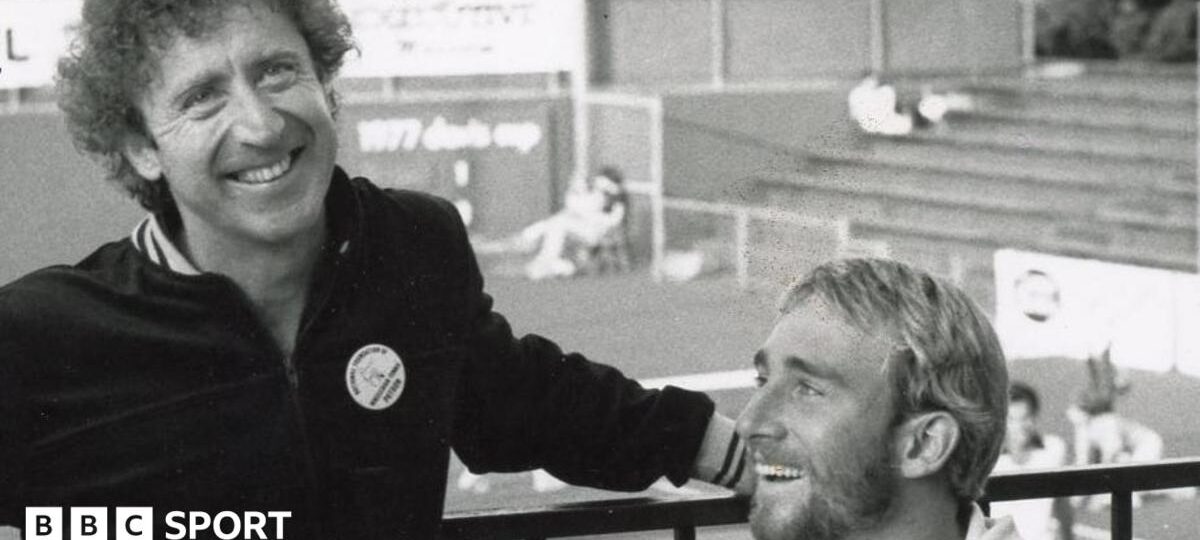
The sign on the tennis courts read ‘no bikes and no skateboards’.
How does that work, wondered young American Brad Parks, when his front wheels were like a skateboard’s and the back ones like a bike’s, and he wanted to play tennis?
And could he even get on to the court in the first place as he would need to dismantle his wheelchair to get through the gate?
But he had invented a sport and would do whatever it took to play it.
Parks was on a family picnic when he had his lightbulb moment 50 years ago.
His relatives were playing tennis in a park in Indiana and 18-year-old Parks was watching in a wheelchair having been paralysed in a freestyle skiing accident in Utah a few months earlier.
His dad called him over to join in.
“So I started hitting tennis balls,” Parks tells BBC Sport. “I was in literally a hospital wheelchair which is what they gave you back in 1976, so you couldn’t really move very well but I could hit balls. And right then I decided ‘I’m going to give it a shot.'”
He didn’t just mean in that moment. Eventually he was going to devise a whole new sport of wheelchair tennis, introduce it to the world and see it played at Grand Slams and Paralympics.
But first, he needed to find some people to play with. Perhaps even a Hollywood actor (more on that later).
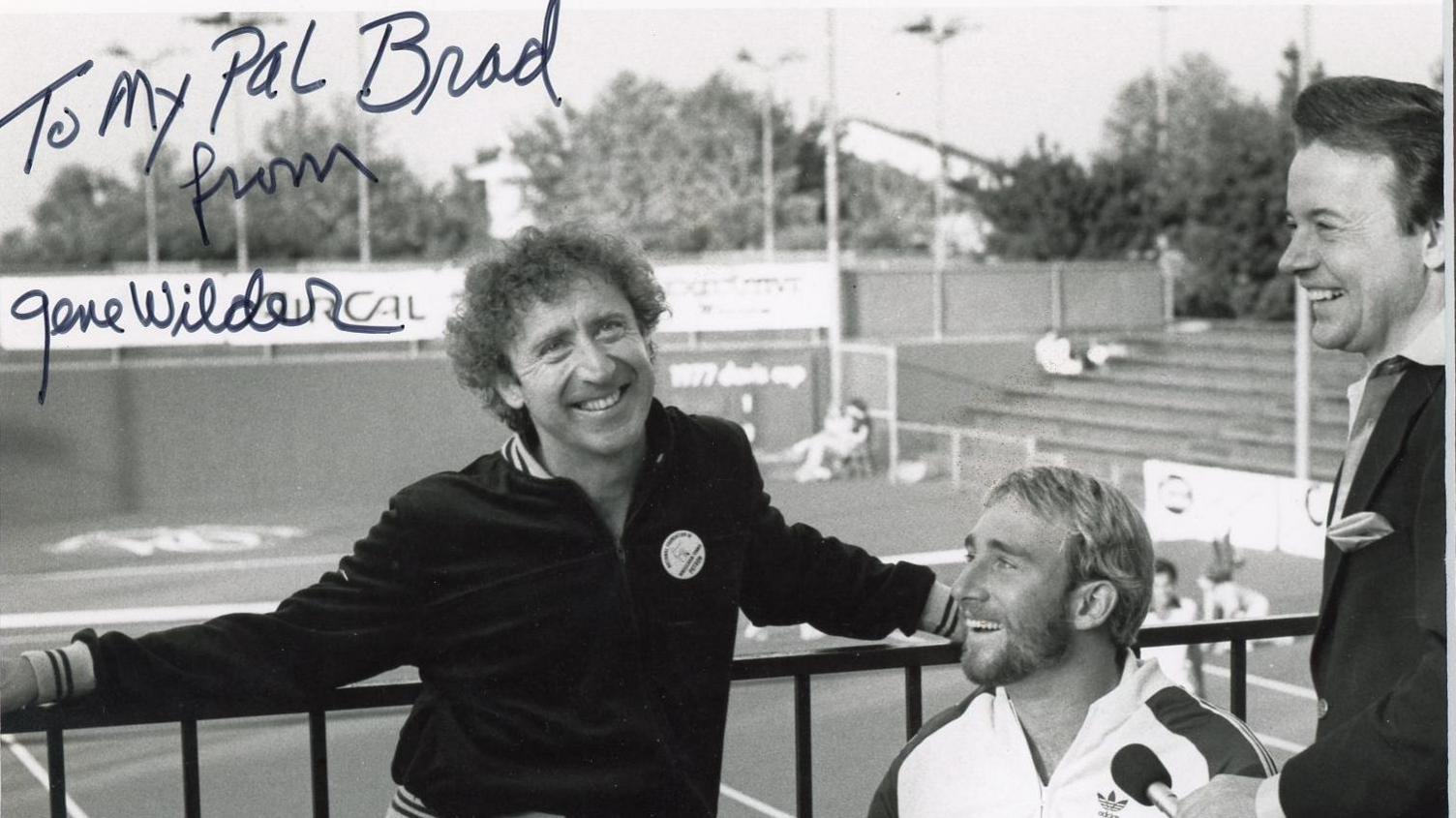 Image source, Brad Parks
Brad Parks became good friends with Gene Wilder (left) after playing tennis together
In those days, basketball was the go-to sport for wheelchair users and had been suggested to Parks while he recuperated in hospital but he had other ideas.
Before his spinal cord injury – sustained when he had over-rotated on a backflip and landed heavily on to packed snow at a freestyle skiing competition – the Californian had been wanting to improve his tennis and now he had even more reason to.
“If I’m going to be in a wheelchair the rest of my life I’ve got to be the best that I could be and I want to still live my life, I didn’t want people to feel sorry for me so I wanted to play,” he says. “So I thought well, maybe I could play tennis and then I could play with my able-bodied friends so that was my first thought.”
After that picnic, Parks started playing tennis nearly every day with friends, family and opponents that his parents found him to play. None of them used wheelchairs.
“Instantly we bonded because we figured we were the only two guys who were playing wheelchair tennis in the whole world,” says Parks.
They started experimenting with rules. Should the court be smaller, should the balls be different, should the net height change? Because they started out playing against able-bodied players, they played some early versions where the non-wheelchair player would only get one serve or have to serve underarm or have more court to cover.
But by the time they had decided to hold their first wheelchair tennis event in 1977 in Irvine, California, they had settled on keeping it very simple. The only difference between tennis and wheelchair tennis would be that the ball could bounce twice – and this remains today.
Parks won that inaugural event and dominated the nascent years of the sport, which were often played on sub-standard public courts, with dust and dirt preventing wheel-grip.
There were no umpires and tournaments were run by people who worked in rehab: “They weren’t tennis people so nobody even really knew the rules.”
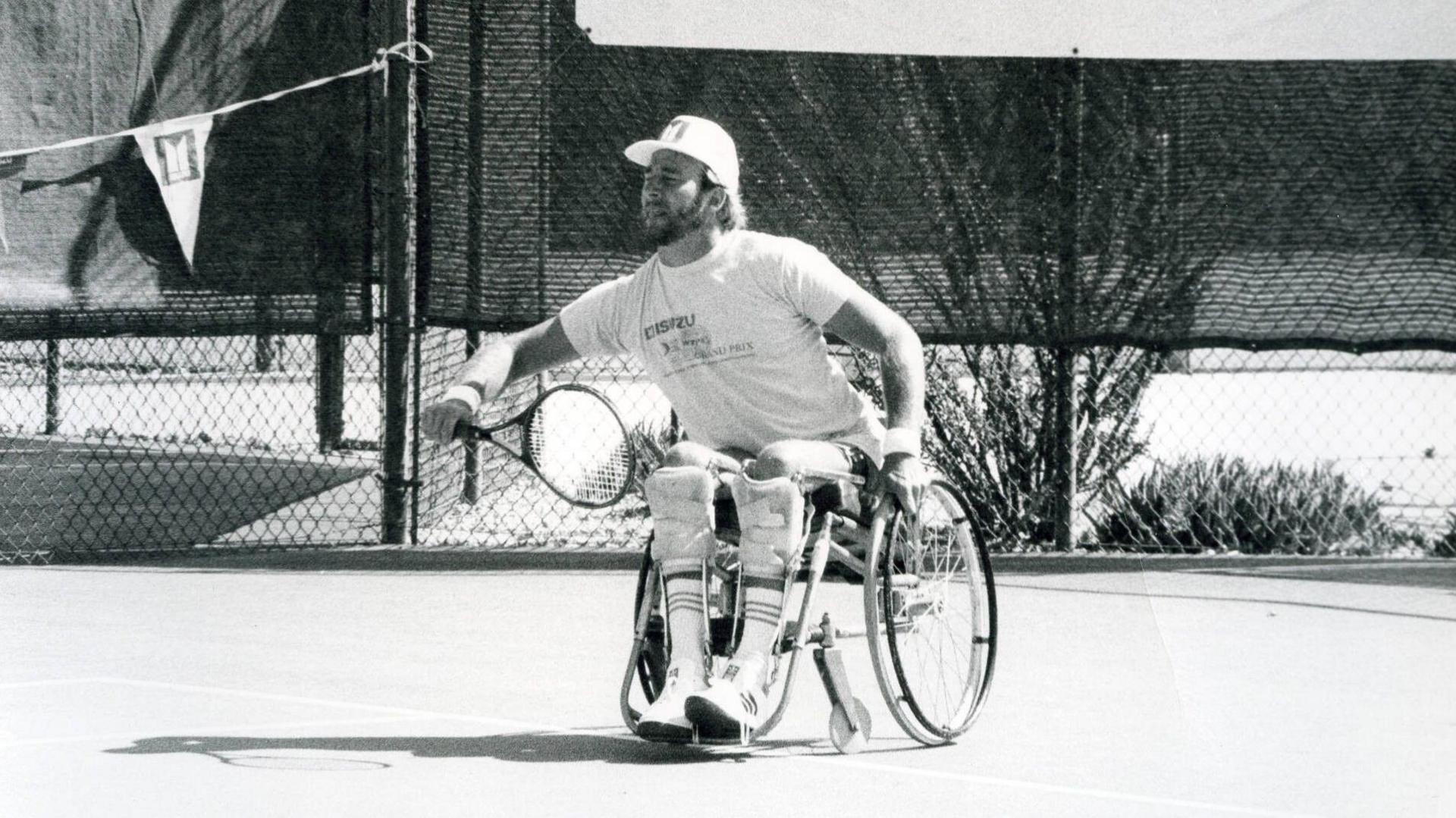 Image source, ITF
Early tournaments were held on public courts where the dust and dirt would make it hard to stop the wheelchair from sliding
There were also attitudes to overcome.
There had been progress since the photograph on display at the Wimbledon Museum where disabled man George Cayley is shown suspended from a frame in a harness playing tennis 100 years earlier, but wheelchair players were nevertheless an unusual sight.
“Nobody ever kicked me off, but I would get questioned a lot,” Parks says.
“I can remember many times going to a court, and whoever was in charge of that court would go, ‘What’s going on here?… Do the wheels damage the courts?'”
Those in power could also be dismissive. Parks recalls feeling “discouraged and disappointed” after a National Wheelchair Basketball Association commissioner told him he was wasting his time because tennis was not a feasible wheelchair sport – and that he had even written a thesis on the subject.
But Parks stuck with it, tirelessly promoting the sport via demos at hospitals, tennis clubs and even in car parks.
Several years later the commissioner would ask to sit next to him at a lunch to apologise for being wrong and to ask for Parks’ advice on how to get his sport integrated with the mainstream governing bodies in the way wheelchair tennis had by then succeeded in doing.
While the rules were simple, equipment was not so straightforward.
Minnebraker was a talented engineer and had made himself a lightweight aluminium wheelchair. It was much lighter and more mobile than hospital wheelchairs, which weighed 60lb and had side-guards and back handles that impeded a player’s swing.
Parks remembers asking to try it out.
He felt like he was “floating around” in the borrowed chair. But what struck him even more was that when he looked at Minnebraker, now sitting in Parks’ hospital chair, he saw a disabled man.
“I never saw that before because he’s in my chair … he’s not in this [other chair],” he says.
“That chair was incredible in comparison … I said ‘will you make me a chair’ and he said ‘no, but I’ll teach you to make a chair’.”
And so he did and the pair eventually went on to set up a company making them, although he remembers it taking time to convert others to move away from the “comfort blanket” of their old-style chairs.
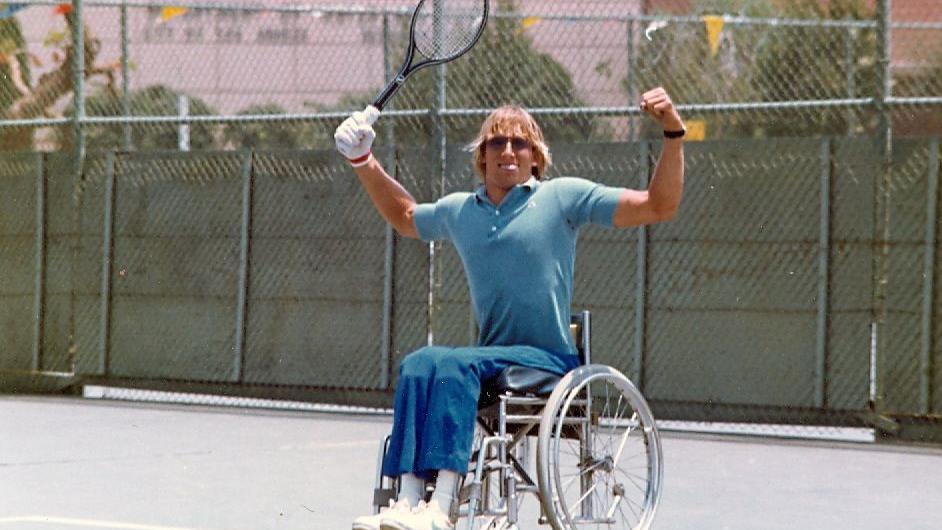 Image source, Brad Parks
The wheelchair Brad Parks started off playing tennis in is very different to the ones used in wheelchair tennis today
Progress in developing the sport was slow but sure. In 1980, Parks helped form the National Foundation of Wheelchair Tennis and a 10-tournament circuit was created. He also wrote a book – Tennis In A Wheelchair – to help players and coaches. Two years later, the first tournament outside the US was held in France.
Parks remembers the exact moment when he realised they had created something special, saying he “got shivers and probably teared up” when he looked out from the clubhouse at the 12 courts filled with players in sports wheelchairs at a tournament in Michigan in 1985.
“Everybody was dressed like a tennis player,” he says. “Everybody had two racquets. Some of them had coaches.
“I said to myself, ‘This is wheelchair tennis. Wheelchair tennis is for real, and it’s here to stay, and it’s going to be something someday.’ And it just dawned on me as I’m sitting there looking out at this. It was really a great feeling. It was really the beginning of the sport.”
It helped Parks that some famous faces were also raising the profile of his sport.
One time he was playing at a private club in New York where on the neighbouring court Hollywood actors Gene Wilder and Sidney Poitier were filming a movie.
They got chatting and agreed to play doubles, even if Wilder later revealed to Parks he’d been reluctant to play, telling him: “I’m going ‘oh no, there goes my day at tennis, I’ve got to do this charity work'”.
But it was a competitive match and they swapped numbers and Parks ended up becoming good friends and playing regularly with Wilder, who is probably best remembered for his title role in Willy Wonka & the Chocolate Factory.
Top professional players of the time also got involved at exhibitions, with Parks teaming up with American Davis Cup-winning captain Dennis Ralston at one such event and in years to come the sport was also promoted by others such as Yannick Noah, Arthur Ashe, Jimmy Connors and Martina Navratilova.
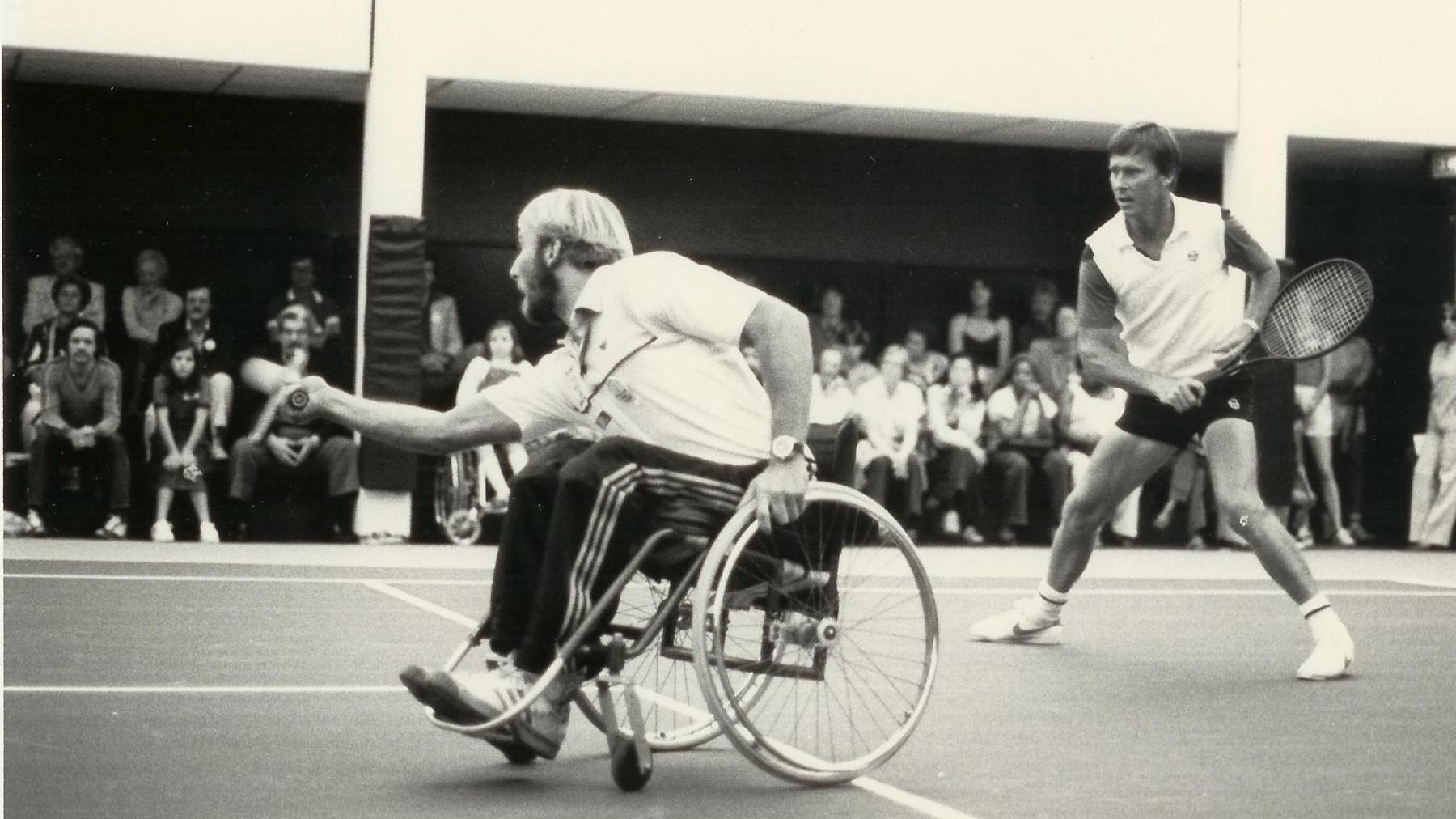 Image source, Brad Parks
Brad Parks and Dennis Ralston teamed up for doubles in an exhibition event
In 1988, the International Wheelchair Tennis Federation (IWTF) was formed, with Parks becoming its first president, and the sport joined the Paralympics in 1992.
Parks, who had previously won Paralympic gold in wheelchair racing, won the inaugural doubles with Randy Snow.
In 1998, the IWTF was fully integrated into the International Tennis Federation, a first for a disability sport and a pivotal step for the sport’s development, allowing it to thrive further as part of a fully inclusive governing body. Parks says he “would have held the sport back” if he had insisted on keeping control himself, which is what he thinks has happened in other disability sports.
The first Grand Slam to hold a wheelchair event was the Australian Open in 2002 – where it was known as the Wheelchair Classic 8s – and by 2007 all four major tennis tournaments held them. Quad events began to be introduced and by 2019 were at all Grand Slams.
These milestones were the culmination of Parks’ tireless lobbying; the debt to him was formally acknowledged in 2010 when he became the first wheelchair athlete to be inducted into tennis’ Hall of Fame.
Meanwhile, the Brad Parks Award – the highest honour in wheelchair tennis – is awarded annually to an individual or organisation for outstanding contributions to the game.
Parks, who had originally given himself a year to see if wheelchair tennis was feasible, is proud but modest about his own role 50 years on.
“I was the head of the organisation, I was the first player to really play the game but it’s hard for me to say Brad, you invented wheelchair tennis, but you know I was part of it,” he said, pointing to others like Minnebraker.
Today’s players, though, do not hold back.
“I think I’m in awe. Absolute awe,” said Britain’s 34-time Grand Slam champion Alfie Hewett.
“It [wheelchair tennis] is not about accolades and the external things. It’s actually just the life it’s given me and the purpose that it’s given me.”
And Gordon Reid, who has won 30 Grand Slam titles, added: “It’s an incredible story and that little idea that he had 50 years ago has turned into a huge worldwide sport now. So yeah, [I’m] very thankful that he had that idea back in the day.”
So much has changed since the early days, not least the chairs which are much lighter and often feature a moulded seat that is more energy efficient for turning.
And the sport continues to grow – the wheelchair event at Wimbledon, which begins on Tuesday, offers a prize pot of more than £1m, with the winners of the men’s and women’s singles earning £82,000.
Its profile is also rising and the finals are now played on the 12,345-capacity Court One, compared to the 276-seat Court 17 that hosted the first wheelchair singles final 10 years ago.
Parks says he is “very happy to see where we’re at”.
“I’m jealous in a way but in a good way because I would have loved to have been able to play in [tournaments like Wimbledon],” he said.
But that was never what his dream was about when he set out.
“I just loved to hit tennis balls, and I wanted to share the feeling of hitting a tennis ball from a wheelchair,” he said.
“The thing that I feel really, really good about is that I really wanted other people to be tennis players.
“I used to get disappointed when I thought that everybody was wheelchair basketball players. Tennis was not their main thing. And today I feel like tennis really stands on its own and they’re tennis players. They just happen to be in a wheelchair.”
Discover more from NAIRAVOICE.COM.NG
Subscribe to get the latest posts sent to your email.