
President Donald Trump’s repeated calls to acquire Greenland, reiterated most recently at a NATO summit last month in Turkey, have thrust the Arctic into the global political spotlight.
The bigger challenge, they say, isn’t acquiring more Arctic territory.
It’s that the US has spent decades underinvesting in the Arctic presence it already has. “The notion that we would take Greenland and somehow improve it is a fallacy,” Kenneth Rosen, a journalist and author of the book “Polar War,” told Business Insider. “We have not done that in Alaska.” The challenge of securing the US’s Arctic foothold has become more urgent as the Arctic itself changes. “The Arctic is no longer reliably frozen,” Klaus Dodds, a professor of geopolitics at Royal Holloway, University of London, told Business Insider last year.
As shrinking sea ice opens new shipping routes and access to energy and critical minerals, the region has become increasingly important to global security, Dodds said.
Russia began rebuilding its Arctic presence nearly two decades ago, reopening Cold War-era facilities and investing in year-round infrastructure.
During World War II, the US built roughly 300 military installations across Alaska, many of which remained active throughout the Cold War.
Many have since been abandoned or closed, leaving behind deteriorating runways, overgrown buildings, and empty airfields.
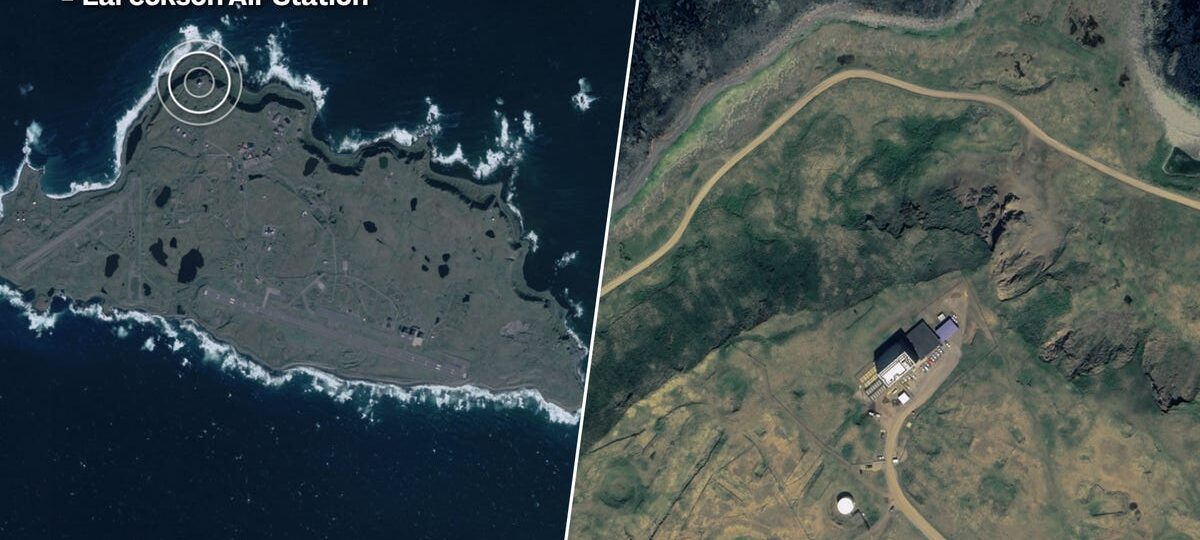
Today, the only active US military installations in the Aleutian Islands, a chain stretching southwest from mainland Alaska toward Russia, are Eareckson Air Station and a Coast Guard Marine Safety Unit at Dutch Harbor.
Beyond that, the Coast Guard maintains a limited rotational presence with patrol cutters, sometimes with only one cutter at a time. “One security cutter in the Bering Sea for all of Alaska is a joke,” Rosen told Business Insider in February for an episode of its video series “View from Above.” Climate change is making those shortcomings harder to ignore.
Thawing permafrost is destabilizing buildings and runways that were constructed on permanently frozen ground, putting additional strain on aging military infrastructure. “We have not built out enough resources even to protect the communities that live in these areas of our country,” Rosen added.
Last year, the Trump administration directed significant attention and funding toward Alaska, signing an executive order to accelerate energy and critical mineral development while backing a nearly $25 billion Coast Guard modernization package that includes funding for 17 new icebreakers, $4.3 billion for Polar Security Cutters, $3.5 billion for Arctic Security Cutters, and plans to base the first two new Arctic cutters in Alaska.
It’s a step in the right direction toward regaining the US’s Arctic foothold.
However, the gap remains wide, Rosen said.
Russia operates 42 icebreakers, including 13 heavy vessels capable of year-round operations.
The US, by comparison, is only beginning to expand infrastructure such as the deepwater port at Nome.
Although the Coast Guard has begun growing its polar fleet, it still relies on a single operational heavy icebreaker, the Polar Star.
While successive administrations have viewed the Arctic as strategically important, Trump has gone further by arguing that the US should acquire Greenland, citing concerns about Russian and Chinese activity.
However, the US already enjoys extensive military access to the island under a 1951 defense agreement with the Kingdom of Denmark. “If we want to expand our military presence, we can do that,” Rosen said. “Greenland already offers the US everything it needs for national security.” The question, he said, is why Washington has failed for decades to make greater use of those existing arrangements.
During World War II and the Cold War, the US operated about 20 military installations across the island.
Today, only Pituffik Space Base remains, and the installation has long suffered from underinvestment, Rosen said.
Once home to roughly 10,000 people during the Cold War, the base now has a permanent population of about 650 as its mission has shifted toward missile warning and space surveillance.
For Rosen, the situation in Greenland reinforces rather than undermines his argument.
If the US has not fully invested in the Arctic territory and military infrastructure it already controls, then acquiring more territory won’t solve the underlying problem. “It also fundamentally underscores the notion that Washington has given up on adaptive climate policies, favoring the potential gains from a warming planet,” Rosen told Business Insider.
Dodds echoed the idea that focusing too narrowly on Greenland risks obscuring the broader strategic picture.
Washington has also too often sidelined Indigenous communities that have lived in the Arctic for generations, Rosen said, despite their deep knowledge of operating in one of the world’s harshest environments that could improve emergency response, logistics, and long-term operations. “We need to communicate with these communities,” he said. “There are so many fundamental things that are just absent in the Arctic when it comes to the US presence.” While auditing a war college course, Rosen recalled overhearing active-duty military personnel laugh when instructors urged them to improve their skiing skills for Arctic operations.
Instead, they joked, they could just throw grenades at the snow instead. “That’s a totally negligent way of looking at the real strategic assets that come with operating in the Arctic,” Rosen said.
Some Alaska Native communities proposed a simple solution to Rosen: Leave behind equipment such as generators and vehicles after military exercises so residents could use them between deployments while giving the military pre-positioned resources for future missions.
To Rosen, rebuilding America’s Arctic presence requires more than ports, icebreakers, and military bases.
It also means treating the people who already live there as partners rather than an afterthought. “This idea that we need exert force without cooperation is wholly unsustainable,” Rosen said.
Discover more from NAIRAVOICE.COM.NG
Subscribe to get the latest posts sent to your email.