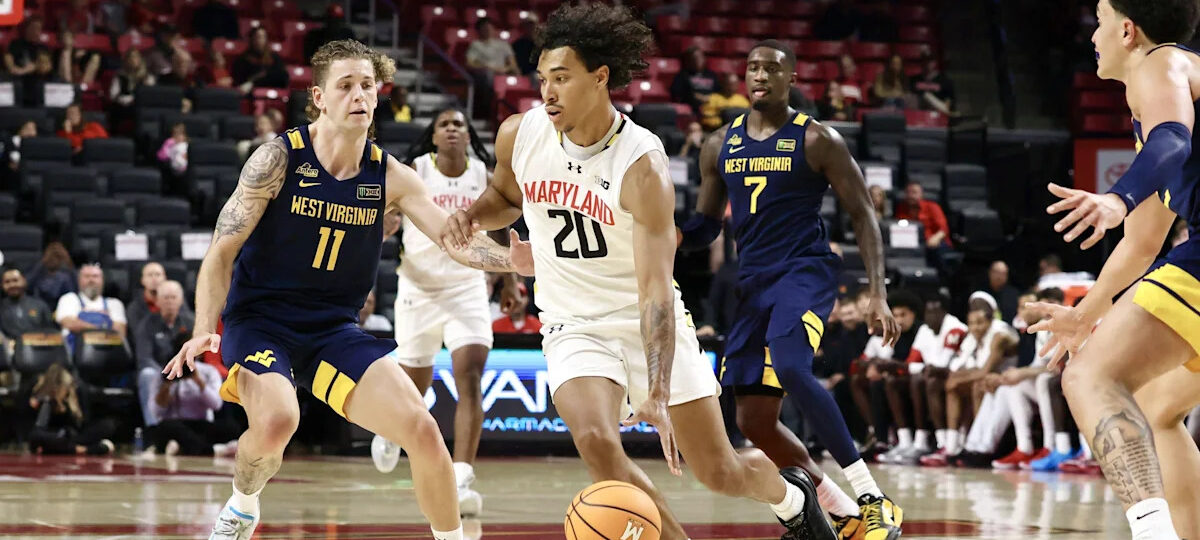
Maryland men’s basketball unofficially kicked off basketball season in Xfinity Center Sunday, taking on local foes West Virginia in its second of three preseason games.
The Terps started slowly, falling behind by as many as 19 points in the first half, before stringing together positive possessions after the break to complete the comeback with 10 minutes to go. From there, the teams went back and forth until an overtime period where the Terps kept the Mountaineers from making a field goal.
Now, a behind-closed-doors scrimmage is all that separates the Terps from their official season opener on Nov. 2 against Bucknell.
Here are three takeaways from Sunday’s matinee.
Starting in his second consecutive preseason game, Boston University transfer Mike McNair Jr. took little time to make an impression on the home crowd.
With the Terps recycling possession off an Andre Mills offensive rebound, McNair found a pocket of space beyond the arc. DJ Wagner found McNair, who shot over 44% from deep last season, and there was little doubt about what was coming next.
McNair was brought in to be a 3-point specialist for head coach Buzz Williams, whose teams are often post-oriented and in need of marksmen that can drain 25-footers without much volume.
The issue for Williams and Maryland is that it took 17 minutes after McNair opened the scoring for anyone else to make a 3-pointer.
Maryland finished the afternoon 10-of-20 from beyond the arc, with McNair responsible for three of them. Mills, meanwhile, made four 3-pointers, including two in overtime to ice the game.
Defending the 3-point shot appeared a concern for Maryland as well. The Terps frequently came unstuck with West Virginia’s switches in the first half, leaving an extra man open beyond the arc far too often. The Mountaineers made eight of their first 11 3-pointers, burying Maryland early.
It was only when the visitors missed their next 14 from beyond the arc that the Terps were able to come back and force overtime. How much of that came down to Maryland’s defensive effort is up to interpretation.
Maryland will go as far as Pharrel Payne is able to take it.
That was the case during the 2025-26 season, when Payne averaged 17.5 points and 7.2 rebounds per game in 10 games before getting injured in what became a lost season for the Terps.
It remains the case ahead of the 2026-27 season, with Payne playing 37 of 45 minutes and finishing with 26 points and a game-high 13 rebounds.
It was Payne’s steady offensive boards that kept Maryland in the game, and it was his emphatic dunk off an alley-oop from Tomislav Buljan that slammed the door on West Virginia in overtime.
“He brings so much attention offensively that everybody gets their opportunity,” Mills said.
The big man is a critical component of the Maryland offense for his ability to make his teammates better — and occasionally bail them out, too.
Baba Oladotun struggled to make inroads against West Virginia, and he dribbled himself into a corner with the Terps up a point midway through the second half. The shot clock raced towards zero as he shoveled a pass over the double-team to Payne. From 25 feet out, the big man struck nylon.
“My response when he made the three was not, ‘can you believe that,’ because I’ve seen him work,” Williams said. “He’s just taking it to a completely different level.”
Payne’s six turnovers and his 5-of-11 shooting from the free-throw line are both parts of his game that need to be ironed out. However, a big afternoon in his first game back in College Park is a promising sign for the season ahead.
While it was only an exhibition game, Maryland’s response following halftime is a sign that the team is willing to fight through hardship.
While last year’s Terps finished with their worst record in over 80 years, they displayed an ability late in the season to stay resilient and find a way to win.
With massive roster turnover, this was the first opportunity for Williams to determine whether this year’s Terps team — which is on pace to perform far better — had the same traits.
“He was really just asking us, like, what’s our, what’s going to be our response,” McNair said. “How do we respond to adversity? Do we back down? Are we going to fight back? Just, just who are we as a team? Where are we as a group?”
The Terps answered those questions with a ferocious effort early in the second half.
“We had energy in the first half, but like we came out [of halftime] with even more. We focused on the details even more,” Mills said. “I think that from the first half to the second half, it was like night and day for sure.”
Against a physical team that is also projected to finish around the NCAA tournament bubble, Maryland found a way. As the Terps continue to gel, they can take comfort in knowing that they have the ability to turn games around — an ability that could prove to make the difference in March.
Discover more from NAIRAVOICE.COM.NG
Subscribe to get the latest posts sent to your email.