
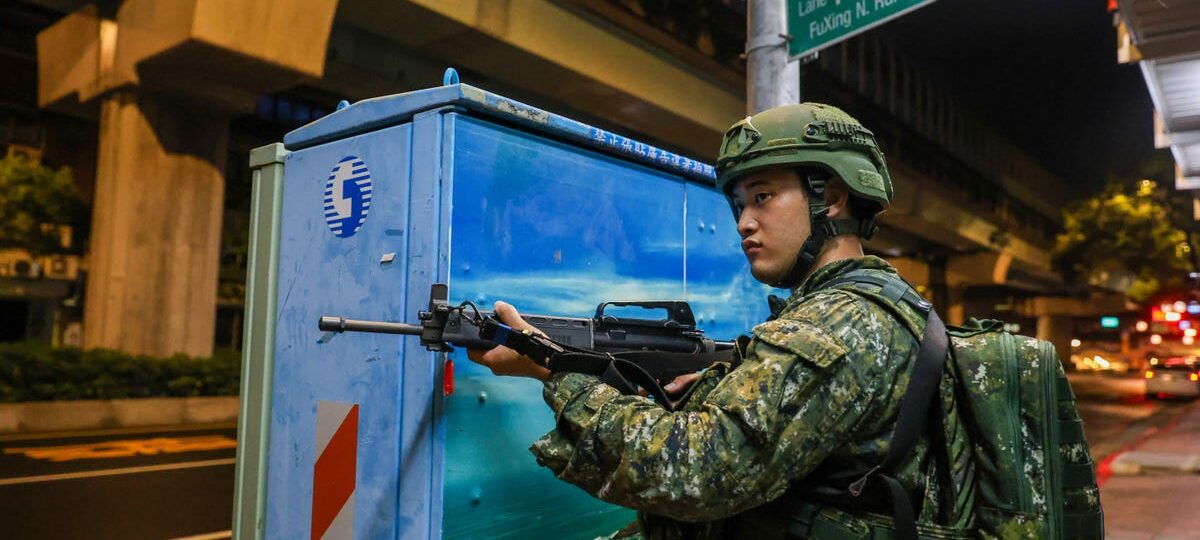
TAIPEI — Gunshots rang out at midnight as Taiwanese infantry, hidden on rooftops and in alleyways, opened fire with blanks along the streets of northern Taipei.
They weren’t fighting for the beaches; instead, they were defending a six-lane road, split down the middle by elevated metro tracks, leading to Songshan Airport, the capital’s closest airfield.
By the sixth night of Taiwan’s annual Han Kuang exercise, the simulated fighting had moved inland, including into the heart of Taipei.
That progression offered a revealing glimpse at how Taiwan is preparing for war with China.
Taiwan’s defense ministry stayed relatively quiet about operational details during the 10 days of military drills, and the 40 or so journalists and observers at the Songshan drill, for example, couldn’t reach a clear consensus about where the simulated enemy was coming from.
Authorities provided little on-the-record detail about the specific capabilities they hoped to test or the lessons they aimed to draw from this year’s Han Kuang exercise, but the nature of the drills, the sequence of events, and their locations offered clues about how Taiwan suspects mainland China might attack and how the island intends to fight back.
The Han Kuang exercise involved numerous drills across the island, some undisclosed until after they happened.
When reporters were given advanced notice about where a drill was taking place, they weren’t told until the night before.
Taiwan’s defense ministry did not respond to queries about the planning or objectives of the drills.
Still, some themes were obvious, including an emphasis on ambush tactics and dispersed operations.
Taiwanese forces drilled using barricades and narrow streets to set up kill boxes at urban intersections, firing on enemy forces from multiple directions.
Other exercises tested backup plans for units suffering heavy casualties.
One drill saw military police infantry, responsible for guarding Taiwan’s leadership, take the Taipei subway to regroup and set up a temporary headquarters at the island’s largest trade show center.
Heavily outmanned and outgunned by China, Taiwan has been pivoting toward what it calls the “porcupine strategy.” Instead of seeking to match China force-for-force, the island plans to rely on asymmetric warfare to make itself prohbitively costly for Beijing to capture.
Taiwan’s 108 M1A2T Abrams tanks, for example, could be used in ambushes on roads and highways against the more numerous, lighter-armored vehicles China could send across the strait.
One drill saw a platoon of Abrams hiding in a construction yard near the main international airport, where they practiced refueling next to a temple.
Lin Ping-yu, a former Taiwanese special forces paratrooper who is now a New Taipei City councilor, said the Han Kuang has recently shifted from a staged format to “genuine operational verification” for individual brigades and units. “This is a critical transition for enhancing Taiwan’s warfighting capabilities,” Lin told Business Insider.
Past Han Kuangs featured scripted scenarios, such as a large beach landing in 2023, in which some Taiwanese troops played People’s Liberation Army amphibious attackers.
More recent versions of the exercise, though, have been focused on small skirmishes across its cities. “From a capability standpoint, having small units operate in a more decentralized and independent way is exactly the kind of thing Taiwan’s military has been emphasizing in its asymmetric force development in recent years,” said Tristan Tang, a Taiwan-based nonresident fellow with the National Bureau of Asian Research, a US think tank.
Tang said Taiwan appears to be preparing for a wide range of contingencies, from counterattacks on beaches and airfield defense to naval escort drills focused on breaking blockades.
Taiwan has said it aims to make the Han Kuang more realistic, repeatedly stressing the drills would be “unscripted,” an approach common in Western militaries.
To that end, Taiwanese junior commanders were tasked with giving “back briefs,” or relaying their own interpretation of orders to superiors to make it clear they understood their mission.
The practice, rooted in US military doctrine, debuted at the Han Kuang this year.
Tang, who designs a high-profile war game centered on a PLA attack on Taiwan, said such practices are vital to a viable defense. “In a cross-strait conflict, the PLA would likely use large numbers of ballistic and cruise missiles, along with long-range rocket fires, in the opening phase,” he said.
Such attacks could disrupt Taiwan’s communications and command-and-control structure, Tang said, forcing individual units to continue operating and carrying out their missions while cut off from senior leadership.
The sequence of the drills was also revealing.
The Han Kuang began around Taiwan’s outer defenses.
Early days saw Taiwanese artillery, infantry, and armored forces deployed to Kinmen, Matsu, and Penghu, situated between Taiwan and mainland China.
The Penghu archipelago is particularly significant, with a port, an airport, and enough space for radar and troops, allowing it to serve as a forward base for an invading force if captured.
The first evening of the Han Kuang saw Taiwan’s president, Lai Ching-te, and his staff participate in an evacuation drill to prepare for decapitation strikes.
Meanwhile, army, military police, and navy forces worked together to blockade the Tamsui River, a waterway that cuts into the heart of Taipei, and lay fortifications on bridges spanning the estuary.
In the east, the island spent this early period requisitioning civilian factories, vehicles, and volunteers to move matériel and set up alternative ammunition-producing facilities to prepare for the fight.
Days later, the artillery and air battle was well underway.
Air force personnel practiced rapid runway repair at Hsinchu Air Base — Taiwan’s closest military airfield to China — training to keep its Dassault Aviation Mirage 2000-5 fighters flying through a PLA bombardment.
Taiwan’s navy and coast guard, which fields 12 frigates that can be packed with anti-ship missiles, ran a joint littoral drill with medium-range strike drones, FPV attack quadcopters, missile boats, and special forces in inflatable boats.
Taiwan has talked openly about building a “drone hellscape,” a term coined by US Pacific Command chief Adm.
Sam Paparo, on the strait, flooding it with hostile uncrewed aerial and seaborne systems to make a crossing extremely costly for Chinese forces.
As the Han Kuang progressed, the drills moved farther inland, including a counter-sabotage operation at an oil refinery in Taoyuan, a city just west of Taipei.
There, chemical troops called in by refinery staff set up a decontamination station for injured workers affected by simulated toxic gases released by enemy infiltration teams. “Dealing with that kind of threat would also require Taiwan to send out small units, probably squad- or platoon-sized task forces rather than company-sized formations,” Tang said.
Tang said that this year’s logistics drills saw Taiwan move more forces to the capital area than before.
Last year, only one marine brigade practiced redeploying from the south to defend the Taipei area.
This year, Taiwan also moved elements of two other commands from the east and south, he said.
The new posture is noteworthy, the analyst said. “First, it makes a successful PLA surprise attack against northern Taiwan more difficult,” he said. “Second, it fits with Taiwan’s growing emphasis on defense in depth, using both space and forces to delay and deny a PLA advance.” Even if Beijing were to establish a foothold on the island, the density of Taiwan’s forces engaged in asymmetric combat would make taking the capital a far more “difficult fight,” Tang said.
By the last few days of the Han Kuang, the simulations had moved into the capital proper.
Troops laid down barricades just a mile from the presidential office, deploying infantry fighting vehicles to engage incoming hostile forces crossing from New Taipei City.
Richard Chou, a retired colonel who served in Taiwan’s air defense units, told Business Insider that local forces had to “transition from assuming all threats can be stopped at sea.” Even if beachheads or river entry points are breached, Taiwan must make sure its key infrastructure and urban centers are difficult to knock out of commission, he said.
The tail end of the military drills also coincided with air raid alerts that required people to take shelter indoors for 30 minutes, with retail businesses closing and subway stations grinding to a halt.
City governments throttled mobile internet to simulate a communications attack.
By that point, the Han Kuang had progressed from defending Taiwan’s outer territories and coastline to fighting in its cities while civilians sheltered and critical communications came under attack.
Lin, the city councilor, said changes to the Han Kuang in recent years show that Taiwan is working on its military culture, which “urgently needs to evolve.” He said that the island had spent too many years relaxing its war preparations, while Beijing grew more hostile and boasted of leaps in its military technology.
It was only last year that Taiwan said it was fully committing to an “unscripted” Han Kuang. “We are now at a pivotal moment to reclaim these core military capabilities, and conducting more rigorous exercises will help the military rebuild its operational edge,” Lin said.
Discover more from NAIRAVOICE.COM.NG
Subscribe to get the latest posts sent to your email.