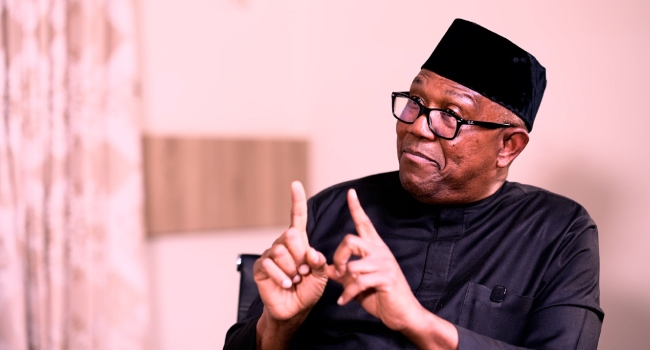

The Presidential candidate of the Nigeria Democratic Congress (NDC), Peter Obi, has defended and explained his plan to transform Nigeria from what he described as a consumption-driven economy into a production-led one, saying agriculture, manufacturing and support for small businesses would form the foundation of economic growth if elected president.
Speaking during an exclusive interview on Sunday Politics, Obi said Nigeria possessed the land, resources and human capital to become one of the world’s leading food producers and exporters but had failed to harness its potential.
According to him, economic growth, job creation and poverty reduction could only be achieved by producing more locally rather than relying on imports.
“The only way to pull Nigeria out of poverty, or even genuinely grow GDP, is through production, not consumption. That production starts with agriculture, which gives you the food you need, raw materials for your factories, and jobs. That’s a win-win,” he said.
Obi said Nigeria could produce enough food to feed itself and generate more revenue from agriculture than from crude oil if the right investments were made.
“This country can produce enough of what we can eat, and we can actually make more money from agriculture than we make from oil because, as it is today, we have vast uncultivated land,” the former governor said.
He pointed to rice as an example, saying Nigeria’s current production levels were far below what was possible.
The NDC chieftain said Nigeria produces fewer than 10 million tonnes of unmilled rice annually, blaming years of cheap food imports for undermining local farmers.
“We’ve used cheap importation to kill our farmers. We can do more,” he said.
To illustrate Nigeria’s untapped potential, Obi compared the country with Bangladesh.
He noted that despite having a much smaller land mass, Bangladesh now produces between 15 and 16 million tonnes of unmilled rice annually, making it one of the world’s largest producers.
“Bangladesh today produces about 15 to 16 million tonnes of unmilled rice… they are now the third or fourth largest producer globally,” he said.
He argued that if Bangladesh could achieve such output despite its limited land area, Nigeria – with its vast arable land – could do even more.
Obi also cited the Netherlands as an example of how agriculture could drive national prosperity.
According to him, the European country earns more than €120 billion annually from agricultural exports despite occupying a land area significantly smaller than Nigeria’s Niger State.
“The Netherlands earns over €120 billion—about $130 billion—from agricultural exports every year. That’s three times what we earn from oil,” he said.
He added that countries such as Morocco, Ethiopia and Kenya had built thriving export industries around agriculture.
Morocco, he said, exports agricultural products to Europe, while Ethiopia earns over $1 billion annually from coffee exports and Kenya generates hundreds of millions of dollars exporting flowers.
“Around Valentine’s Day, planes are flying out with flowers we could be cultivating ourselves,” he said.
Obi maintained that restoring security would be essential to unlocking Nigeria’s agricultural potential. He said vast stretches of fertile land across the country remained underutilised because of insecurity.
Using Niger State as an example, he described it as one of Nigeria’s greatest agricultural assets.
“Niger State today is virtually occupied by terrorists, yet it has vast, fertile, cultivable land. If you put resources behind it, you can turn it around,” Obi said.
He also referred to Sambisa Forest, arguing that the area should be viewed not only through the lens of insecurity but also for its economic potential once peace is restored.
“Sambisa is about 60,000 square kilometres, twice the size of Belgium… Belgium feeds itself and exports food,” he said.
The NDC presidential candidate also highlighted Taraba State and the Mambilla Plateau, saying the area was suitable for cultivating tea and coffee capable of competing globally.
The former Anambra State governor said agriculture alone would not transform the economy unless linked to manufacturing.
He explained that increased agricultural production would supply raw materials to local industries, strengthen exports and create millions of jobs.
“From there you move into manufacturing,” he said.
According to Obi, Nigeria needs to develop a strong industrial base rather than exporting raw materials.
“To build a strong economy, you need a strong manufacturing base, and you must export,” he said.
Backing Small Businesses
Obi stressed that the government should create the conditions for businesses to thrive rather than becoming a producer itself.
“I never said government would produce. We will encourage the private sector, entrepreneurship, and small businesses,” Obi said.
He argued that small businesses remain the largest employers in successful economies around the world.
Drawing lessons from Indonesia, Obi said about 90 per cent of jobs there come from small businesses supported by affordable government-backed financing.
“How can you run a small business with no government support, no training, and interest rates at 35 per cent? It’s impossible,” he said.
He also referenced China, saying that roughly 60 per cent of jobs nationwide – and up to 80 per cent in urban areas – are created by small businesses.
The former governor said Nigeria must provide affordable financing, training and a stable business environment to unlock similar growth.
Asked whether he would ban food imports, Obi said such a move would only happen after domestic production had increased sufficiently.
“Not without first building up local production and employment,” he said.
He pointed to countries including India and Vietnam, which successfully transitioned from food importers to major rice producers.
Obi acknowledged that transforming Nigeria’s economy would not happen overnight but insisted visible progress would restore public confidence.
“People always say you can’t do it – but let’s start, let people see it. Nobody achieves anything overnight. Rome wasn’t built in a day, but people saw its foundation and saw it going up,” he explained.
He said genuine progress, rather than slogans, would inspire hope among Nigerians.
“What drives a process is hope; hope gives people faith.”
Obi maintained that with secure farmlands, a revitalised manufacturing sector, affordable financing for businesses and consistent government support, Nigeria could build a productive economy capable of creating jobs, reducing poverty and competing in global export markets.
Discover more from NAIRAVOICE.COM.NG
Subscribe to get the latest posts sent to your email.