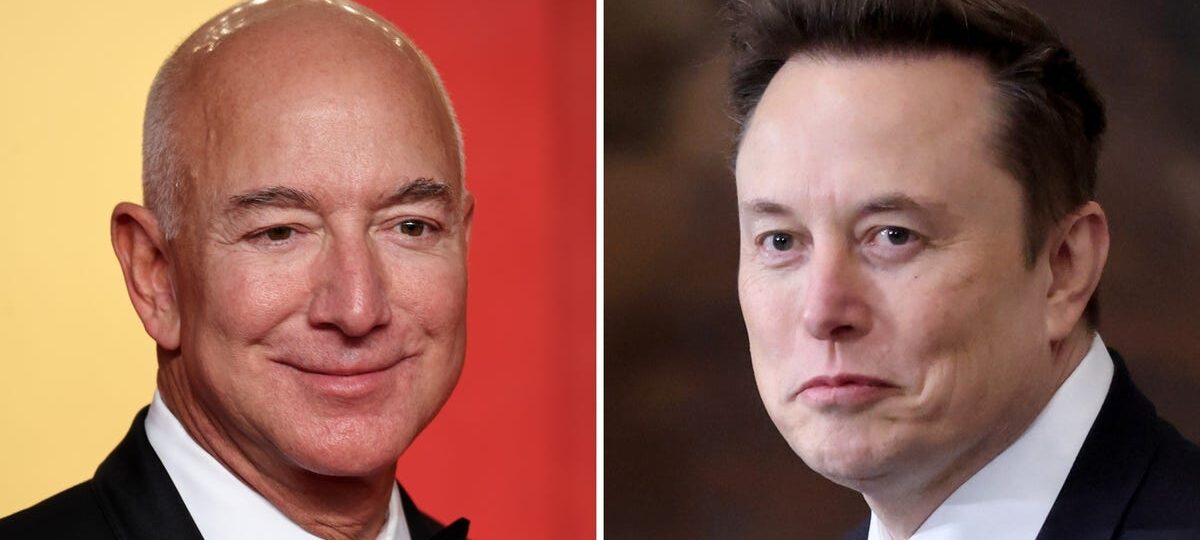
SpaceX’s record-breaking IPO has turned former employees into millionaires — and left alums of a rival rocket company with a serious case of FOMO.
Three ex-employees of Jeff Bezos’ rocket maker Blue Origin told Business Insider that the company’s unusual approach to equity left them with stock options that are essentially worthless.
Meanwhile, they’ve watched SpaceX’s dizzying rise to a $2 trillion-plus valuation provide a massive windfall for early hires — from engineers to welders to cafeteria workers — who received stock options during their time at Elon Musk’s company.
Business Insider reviewed documents detailing Blue Origin’s historic stock options program, which promised a payout only if the company went public or was sold — and, crucially, expired if those events didn’t happen within 10 years.
That is an unusual structure for large private tech companies, with other pre-IPO startups like SpaceX, Stripe, and OpenAI allowing current and former employees to sell their vested stock through periodic share sales.
Blue Origin introduced a new options plan for current employees in April, which offers additional ways to cash out.
Two former Blue Origin employees said that, in their experience, Bezos’ company generally offered higher salaries, more work-life balance, and better job security for engineers than SpaceX during the late 2010s.
One former Blue Origin employee said they turned down an offer to join SpaceX in 2020, potentially missing out on life-changing wealth. “If I had taken that equity, I would be a millionaire now,” they said. “But I don’t regret that for a second.” Blue Origin declined to comment.
Blue Origin introduced a stock equity plan in early 2016.
Employees commonly move between the two companies, and equity plans are often used to help with retention.
In a previously unreported email to employees in February 2016, Bezos warned that the options could be “worth a lot in the future, or not much at all,” and added he “wouldn’t recommend” employees changing their financial plans on the expectation of a major payout. “For me, the right mental model is to view them as long-term lottery tickets that might pay off if a series of things go right,” Bezos wrote.
A decade later, Bezos’ warning has come to pass.
Blue Origin’s equity program was structured so that employees could exercise their options only through a “liquidity event,” defined as an IPO or a sale of the company, according to internal documents.
Plus, all options would expire 10 years after the first stock options began to vest, a deadline that, for some, has now passed.
One former employee, who joined Blue Origin from SpaceX, said that it was clear to them that Bezos was unlikely to sell Blue Origin or take it public.
Their SpaceX position is worth tens of millions of dollars as of the recent IPO, while their Blue Origin options are worth nothing. “You technically hold this document, but it would almost be like telling someone, ‘Hey, you have the rights to buy the house in your neighborhood next to you if the sun doesn’t rise tomorrow,'” the employee added.
The ex-employees all said they joined Blue Origin knowing they could not count on the options paying out, but also said that it provided far less of an incentive than SpaceX’s equity scheme, which allowed employees to exercise their options and sell their holdings regularly. “You could call Blue Origin options a lottery ticket, but it’s more like a scratcher, whereas I think SpaceX is like playing red or black on roulette,” said the former Blue employee who turned down SpaceX.
SpaceX employees received stock options when they joined the company, at their annual reviews, and when they were promoted, the former SpaceX and Blue Origin employee said, adding that SpaceX also introduced “retention incentive packages” that awarded new options when employee stock vested to encourage them to stay.
Critically, SpaceX’s equity scheme wasn’t tied exclusively to a hypothetical future IPO.
Current and former employees were allowed to sell a portion of their holdings to the company or investors in private liquidity events usually held twice a year.
Similar employee share sales are common at major pre-public tech firms, with OpenAI, Anthropic, and Stripe all reportedly allowing current and former employees to sell millions of dollars’ worth of shares over the past year. “They made equity a big part of their compensation package.
It was a big deal, especially as the stock started to grow — it became a more important thing to people,” the former SpaceX employee said.
The divergence between the two companies’ stock option plans is now painfully large.
A SpaceX employee who received 9,000 stock options when they joined the company in 2016 and held them without selling would today be worth at least $1.35 million, while a Blue Origin employee with the same number of stock options would have earned nothing from them.
The Blue Origin alumnus who turned down SpaceX told Business Insider that the stock options were a big part of the recruitment pitch when they joined the company in the late 2010s, and they did not realize the opportunities to exercise them would be so restrictive until after they started.
Former employees recalled that discussions over the differences between Blue Origin and SpaceX’s equity plans among employees were fueled by the high number of workers moving between the two companies. “After a couple of years at Blue, I met some welders who were decamillionaires from previously working at SpaceX.
They worked at Blue Origin part-time and had these beautiful houses in the Pacific Northwest, and I was like, ‘Man, that’s awesome,'” one of the ex-Blue Origin employees told Business Insider.
They said that they had been offered a role at SpaceX after working at Blue Origin for several years, but turned it down for family reasons.
Another former Blue Origin employee, who joined the company in 2018, said that new employees regularly arrived from Musk’s rocket company. “I do remember quite a few conversations with those people along the lines of ‘Yeah, if I had not left, I’d be a millionaire,'” they said.
In recent years, SpaceX has pulled well ahead of its rival in the race to build a sustainable business, with the company’s Falcon 9 rocket regularly carrying satellites into orbit and its Starlink internet service growing at a rapid speed.
The former Blue Origin employee who turned down SpaceX said they felt the company’s approach to equity gave them little incentive to work the long hours needed to keep pace with Musk’s rocket company. “I would’ve worked way harder if I had skin in the game, if I knew that those options were going to be worth something,” they added.
In April, Blue Origin unveiled a new stock option plan for employees.
Ars Technica’s Eric Berger reported that this new program would include more opportunities for employees to exercise their stock options in liquidity events, including potential external funding rounds and company-sponsored tender offers — a model more in line with SpaceX and other tech firms.
It comes at a critical moment for Blue Origin.
The company’s huge New Glenn rocket, which rivals SpaceX’s Starship and is a key part of NASA’s plan to return to the moon, blew up on the launch pad last month.
Blue Origin’s employees now face the grueling task of rebuilding, while watching their counterparts at SpaceX buy second homes and yachts with their newfound fortunes.
Do you work at SpaceX or Blue Origin and have information to share?
Contact this reporter at tcarter.41 on Signal or tcarter@businessinsider.com.
Discover more from NAIRAVOICE.COM.NG
Subscribe to get the latest posts sent to your email.