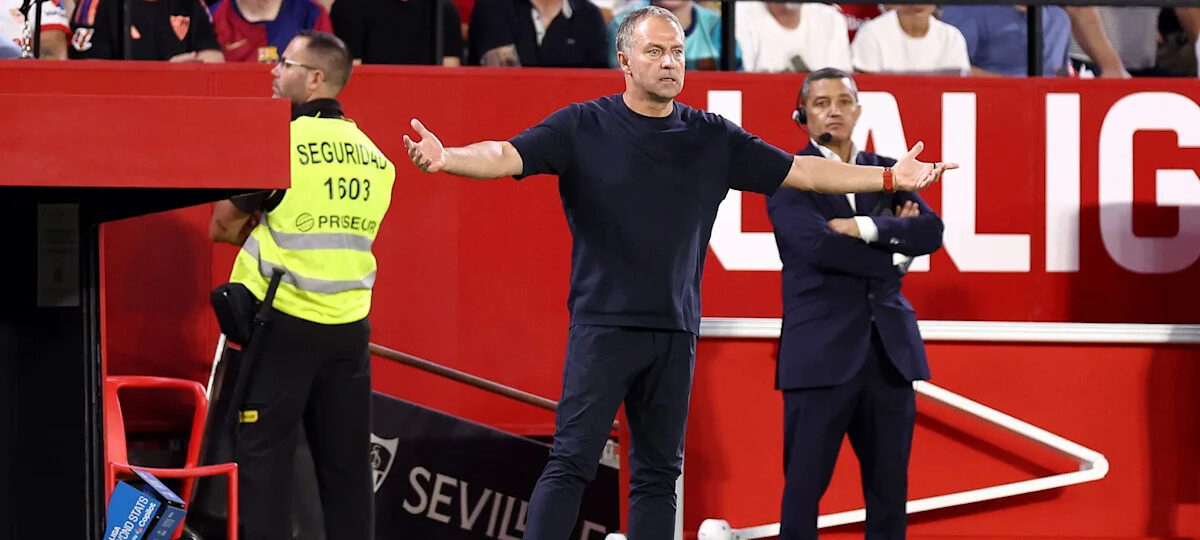

Barcelona’s perfect start to the season has not happened by accident, as Hansi Flick has refined several aspects this season, with the German introducing a series of principles that have helped create a more competitive and flexible squad.
Indeed, Flick already had a clear footballing identity when he took charge, guiding the club to five trophies during his managerial career.
This season, however, Flick has been able to work with a squad assembled alongside sporting director Deco that offers greater depth, versatility and competition for places.
The results have been clear. Barcelona have won all eight of their matches across La Liga and the Champions League, while Flick has shown a willingness to make decisions that might have been more difficult to imagine last season.
On that note, here are the seven changes shaping Flick’s Barcelona.
Fewer guaranteed starters
One of the biggest changes has been the reduction in the number of players who can consider themselves automatic starters.

Only Raphinha and Lamine Yamal have featured in all matches this season. (Photo by Fran Santiago/Getty Images)
Only Raphinha and Lamine Yamal have featured in all eight matches so far. Even some of Barcelona’s most important players have already experienced rotation because of fitness, workload or tactical decisions.
Joan Garcia has been unavailable through injury, while Pedri missed the beginning of the opening league game against Elche. Pau Cubarsi has also missed matches, including the recent meeting with Racing Santander.
Simply put, Flick has not been afraid to change his starting XI either, as Barcelona have generally made between three and five changes from one game to the next.
There were three changes against Athletic Club and Rayo Vallecano, four against Valencia, Racing and Sevilla, and five for the Champions League fixtures against Feyenoord and Levante.
That level of rotation has created genuine competition while allowing Flick to manage a demanding schedule.
Greater competition and positional versatility
Competition for places has increased across the Barcelona squad, but versatility has become just as important as individual quality.
On that note, Eric Garcia is a clear example. He has moved between right-back and centre-back depending on what the team has required, while Xavi Espart has also demonstrated his ability to switch from right-back to the left side.
Gerard Martin has even been used centrally in defence.
Then there is Raphinha, whose move into a central attacking role began as a solution to Barcelona’s lack of a traditional centre-forward. It has since become one of Flick’s most successful tactical decisions.
The Brazilian has adapted to the role while continuing to contribute goals, pressing and defensive work, giving Flick another way of structuring his attack.
Flick is prepared to make drastic decisions

Flick is not afraid of making tough decisions. (Photo by Fran Santiago/Getty Images)
Flick has also shown that reputation does not guarantee minutes.
The German has admitted that some decisions were difficult but necessary, with goalkeeper rotation providing one example, as Dominik Livakovic and Wojciech Szczesny have shared opportunities despite the experience and status of the latter.
Furthermore, Gavi has also found himself further down the pecking order at times.
The midfielder had played only 29 minutes across one of his last four La Liga appearances, which shows just how difficult it has become to guarantee a place in Flick’s midfield.
Jules Kounde is another example. Despite being one of Barcelona’s most established defenders, he was left out of the starting XI for three consecutive matches.
The Dani Olmo-Fermin Lopez rotation is deliberate
The competition between Dani Olmo and Fermin Lopez has developed into one of the clearest rotation patterns in the Barcelona squad.
Aside from the opening match, Flick has alternated between the two in the attacking midfield role with remarkable consistency.
Fermin started against Athletic Club, before Olmo took over against Rayo Vallecano. Fermin then returned against Valencia, with Olmo starting against Feyenoord.
The same pattern continued with Fermin against Levante, Olmo against Racing Santander and Fermin against Sevilla.
Rather than allowing one player to dominate the position, Flick is keeping both involved and forcing them to maintain a high level whenever they receive an opportunity.
Two attacking partnerships

Flick’s rotation of Fermin and Olmo has been brilliant. (Photo by Alex Caparros/Getty Images)
Notably, the rotation does not stop with Olmo and Fermin, as Flick has also developed complementary partnerships between the attacking midfield position and the left wing.
Fermin and Anthony Gordon have repeatedly operated together, while Olmo has been paired with Karim Adeyemi.
Those combinations have appeared in the last five matches in a clear sequence: Fermin-Gordon against Valencia, Olmo-Adeyemi against Feyenoord, Fermin-Gordon against Levante, Olmo-Adeyemi against Racing and Fermin-Gordon against Sevilla.
It gives Barcelona different profiles on the left while ensuring that the players around the attacking midfielder can adapt to the characteristics of whoever starts.
Good performances are being rewarded
As such, Flick has also demonstrated that strong performances can change the pecking order, where Xavi Espart and Joao Cancelo provide a useful example.
Cancelo initially found himself behind the young Espart, who had made an impressive start despite being a natural right-back operating on the left.
Rather than immediately restoring Cancelo to his previous position because of his experience, Flick allowed Espart to keep his opportunity.
Cancelo eventually reclaimed his place after an excellent performance against Racing Santander, where he scored twice. He then retained his involvement against Sevilla.
In simple terms, performances can earn players opportunities, regardless of age or previous status.
Physical preparation is a major priority

Barcelona have put much emphasis on physical preparation. (Photo by Alex Caparros/Getty Images)
The final change concerns an area that is less visible during matches but has become increasingly important under Flick: physical preparation.
A much greater emphasis is placed on this aspect compared with last season, with the arrival of Benjamin Kugel viewed as an important part of the work being done behind the scenes.
Kugel’s role has focused on ensuring the Barcelona squad can cope with Flick’s demanding style, which requires intense pressing, repeated high-speed actions and the ability to maintain physical levels throughout congested periods.
Raphinha has already acknowledged the impact of that work, both individually and across the squad.
That matters because Flick’s approach depends heavily on intensity.
Barcelona need players capable of pressing immediately after losing possession, covering large spaces and repeating those actions throughout a long season.
Flick has created a different environment
The most interesting aspect of Flick’s third season is that his changes have not centred on one major tactical revolution. Instead, he has adjusted the way the squad is managed.
Fewer guaranteed starters, more positional flexibility, sharper competition, planned rotation and a greater emphasis on physical preparation have created a Barcelona squad in which opportunities have to be earned.
The early results are difficult to ignore, as Barcelona have won all eight games and have been able to rotate without losing their attacking identity.
There will inevitably be tougher periods once injuries, European football and fixture congestion begin to test the squad.
However, Flick has already established a clear principle at Barcelona that nobody is completely protected from competition, and the players who respond best to that competition will be the ones who get to stay on the pitch.
Discover more from NAIRAVOICE.COM.NG
Subscribe to get the latest posts sent to your email.