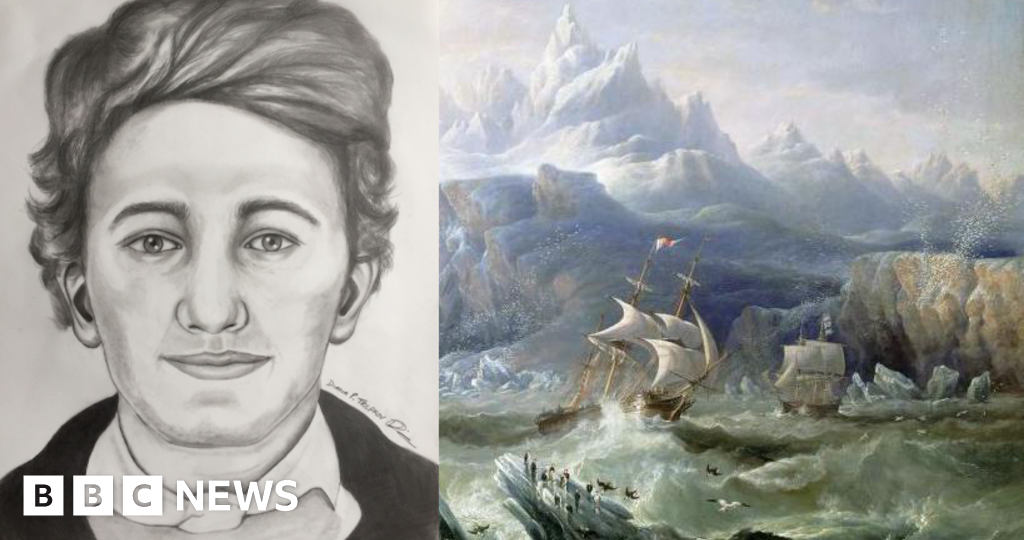

 Diana Trepkov, Investigative Forensic Artist / History/Universal Images Group via Getty Images
The remains of sailors who died on an ill-fated Arctic expedition have been identified by researchers using DNA testing.
The Victorian-era HMS Erebus, built in Pembroke Dock in 1826, became part of nautical folklore after it vanished in the mid-19th Century.
All of the sailors on board died after the ship became stuck in ice, with some resorting to cannibalism during desperate attempts at survival.
Now, three sailors aboard the ship have been identified and living descendants contacted by researchers at the University of Waterloo, in Canada.
And previously unseen artefacts from the wreck – including a bowl and a boot worn by an officer – will go on display at Pembroke Dock Heritage Centre.
What was HMS Erebus?
HMS Erebus, captained by Sir John Franklin, set sail in 1845.
Accompanied by HMS Terror, it was searching for the fabled Northwest Passage.
Alongside Sir John were 128 seafarers, all of them aiming to find the elusive sea route linking the Atlantic to the Pacific via the Arctic seas off northern Canada.
But tragedy struck when both ships became imprisoned in ice in freezing temperatures in 1846.
After being stuck for two years, and with 24 already dead, 105 survivors tried to save themselves by walking across the frozen sea while pulling heavy sleds in -20C temperatures.
Nobody survived and HMS Erebus’s exact fate remained unknown until 2014, when its wreckage was uncovered in the icy waters of northern Canada.
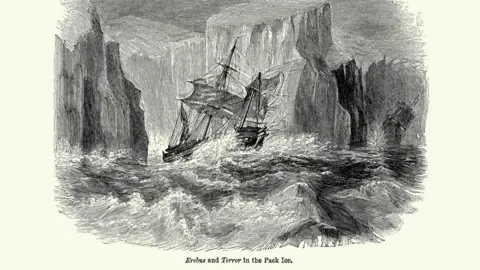 Getty Images
Dr Douglas Stenton, from the University of Waterloo who has excavated the remains of the sailors, said the circumstances they faced were dismal.
“We can’t imagine that all 105 of those men were healthy enough to pull those very heavy sleds. They were almost 30 kilometres (19 miles) from shore, so the ability to get fresh food wasn’t plentiful.
“Something went seriously wrong. Was it lead poisoning? Was it scurvy? Was it beriberi (disease)? We don’t know exactly.”
A previous study of more than 400 bones, by Dr Stenton’s late colleague Dr Anne Keenleyside, found evidence of cannibalism on some bodies.
‘A path to their deaths’
The university’s newest research has matched DNA from remains with living descendants. Researchers have been in contact with 130 families in seven countries.
This has enabled them to identify three more crew members from Erebus, including Able Seaman William Orren, cabin boy David Young and a steward named John Bridgens.
Harry Peglar, a captain from HMS Terror, has also been identified.
There was no evidence of cannibalism on their remains.
When they left their ships, Dr Stenton said the sailors “stepped onto a path that would lead to their own deaths and in a sense into obscurity”.
“The families of the modern-day descendants don’t really have much information about what happened to them,” he said.
“I think it’s very fitting that the descendants of the men who never made it home are helping to write this new chapter about the expedition.”
The researchers have also helped create a facial likeness of David Young, the cabin boy.
“When you combine the forensic facial reconstructions…with the DNA work, I think it brings people into the story in a way that they can relate to it. The general public certainly, but also the family members,” said Dr Stenton.
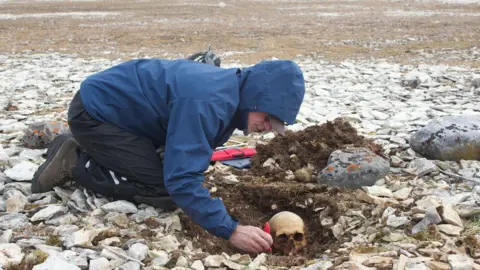 University of Waterloo
Several artefacts retrieved from the ship’s wreck are now due to go on display for the very first time at Pembroke Dock Heritage Centre.
The rare items, which have been loaned by the Royal Navy Museum, include a bowl and dinner plate, a boot and belt buckle and an ointment pot.
“We’ve had to purchase a hermetically sealed case, which makes sure the humidity is correct because they are very delicate,” said Tim Payne, trustee of the heritage centre.
“To have things like a shoe worn by an officer on board HMS Erebus is incredible.”
Ship identified in Franklin search
DNA test helps identify sailor from doomed Arctic expedition
The new exhibition will open at Pembroke Dock Heritage Centre on 8 June, 200 years after Erebus was launched from the dockyard there in June 1826.
Four descendants of Erebus crew members, including a relative of Captain Franklin, will be at the exhibition launch, as well as a relative of David Young.
“One of our local supporter’s great, great, great uncle was indeed the cabin boy on board HMS Erebus.
“He offered to loan his family’s Arctic Medal, which we have in the exhibition,” said Tim.
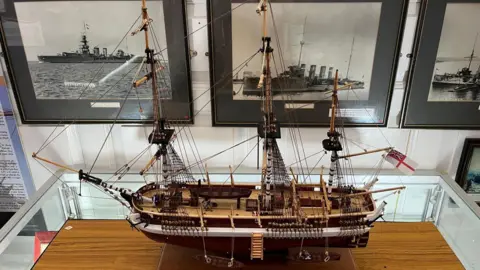 Pembroke Dock Heritage Centre
HMS Erebus was originally built by the Royal Navy as a bombship – a specialist vessel with a reinforced frame designed to withstand the shock of firing large guns.
Though relatively small, Erebus was very powerful which made her ideal for polar explorations where she would be buffeted by sea ice.
She and her crews contributed to important scientific discoveries on several successful missions to the Antarctic in 1841 to 1843, before meeting a tragic and grim end in the frozen waters of the Arctic circle.
Tim said the story still captured people’s imaginations today.
“(Pembroke Dock) launched that ship on 7 June 1826 and in 2014 it was rediscovered. I think that brings it home, that local aspect here from Pembroke Dock, and tells that wonderful history that we’ve had.”
HMS Erebus: From Dockyard to Discovery runs at Pembroke Dock Heritage Centre from 8 June to the end of October.
Metal detectorist finds WW2 soldier’s silver cigarette case hundreds of miles from where he died
Author of Rivals told writers to stop making her ‘macho men’ cry
Fears for pop-up campsites amid ‘ridiculous’ new rules
Discover more from NAIRAVOICE.COM.NG
Subscribe to get the latest posts sent to your email.