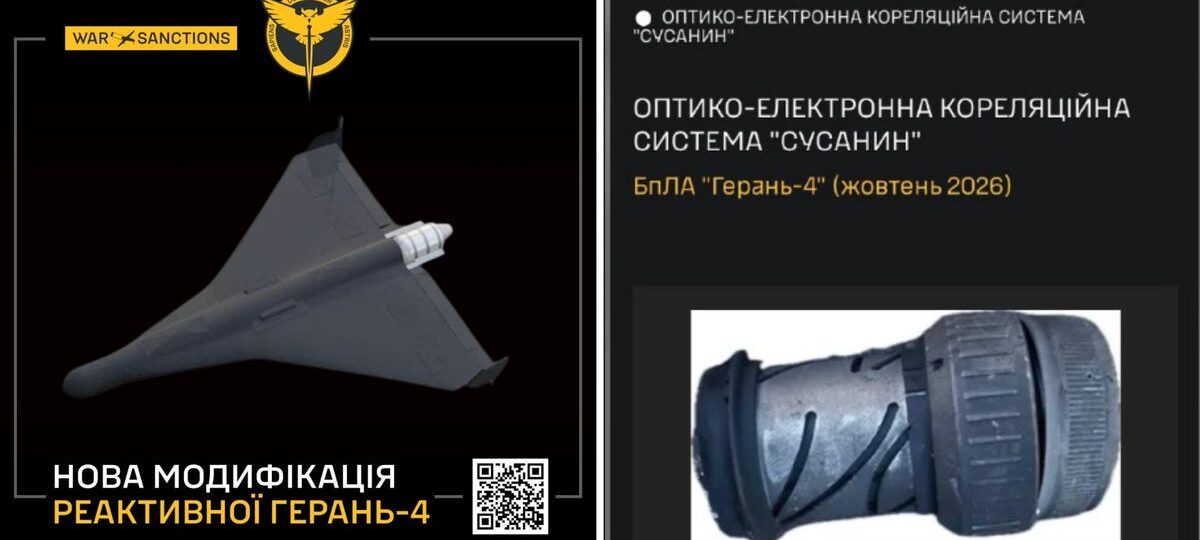
Last week, Ukraine’s defense intelligence directorate put out a call for information on a device newly found in Russia’s latest killer drones.
The “Susanin,” a small cylinder with a camera lens, is an optical system that enables Russia’s long-range drones to navigate Ukraine’s skies without relying on satellite or radio signals.
Should Moscow deploy them at scale, the modules would introduce a major new challenge for Kyiv, allowing Russian one-way drones to bypass jamming — a key pillar of Ukraine’s air defense network.
Per the intelligence directorate, or GUR, the Kremlin has been fitting them onto the turbojet Geran-4 and Geran-5 K5, which fly at 280 mph or faster and are seeing growing use by Russia this year.
These drones are already significantly harder for Ukraine to destroy by force, since they outpace typical Ukrainian interceptor drones.
The Susanin works by storing images of Ukraine’s terrain on the drone, then, while in flight, using a downward-facing camera to observe the ground and compare the live feed to the pre-saved imagery.
Using these comparisons, the drone can independently determine its position and how to reach its target. “Even Google Earth imagery is sufficient for basic orientation,” wrote Serhii “Flash” Beskrestnov, a prominent drone analyst connected with Ukraine’s military, on Sunday.
Beskrestnov warned that Russia would likely continue actively developing Susanin systems for its drones by next year. “Our enemy already uses such systems on small Molniya, V2U, and Lancet drones,” he added.
The technology is similar to what some cruise missiles use to reach their targets in jammed environments.
The Tomahawk, for example, features what analysts call Digital Scene Matching Area Correlation to snap photos of landmarks under the missile and compare them to satellite imagery stored onboard.
Higher-end Russian cruise missiles, such as the Kh-101, use a Russian version of this tech called Otblesk-U.
But the Kh-101 is estimated to cost $2.4 million each, while its long-range drones cost just a fraction of that: The delta-wing Geran-4 is priced at an estimated $50,000 to $70,000 apiece, while the Geran-5 is believed to cost about $100,000 to $115,000 each.
Russia has been producing these drones at a much faster pace, launching over 3,500 jet attack drones at Ukraine in September alone.
Kyrylo Liukov, who leads the uncrewed technologies department at the Serhiy Prytula Charity Foundation, told Business Insider that it’s “quite possible” Russia could scale up its use of navigation systems like the Susanin. “Russia is already using this navigation system for medium- and deep-strike operations,” said Liukov, adding that its deployment on Geran-4s and Geran-5s has been increasing recently.
Still, Liukov said these systems have their limits.
The Susanin is only useful for pre-programmed drone attacks by itself, and wouldn’t be able to help the drone find a moving Ukrainian armored vehicle or mobile missile launcher. “In other words, these are predominantly planned, static targets,” said Liukov, whose organization raises funds for Ukraine’s military and drone manufacturers.
But pre-arranged flights fit well into Moscow’s strategy with Gerans, which are launched in large numbers to overwhelm Ukrainian air defenses and wreak havoc on its cities.
If a Russian turbojet drone is using a Susanin system, Ukraine’s only way to counter it, for now, is to use physical force, Liukov said.
Ukraine’s options in this area remain limited, with its military still in the early stages of introducing advanced interceptor drones capable of catching turbojet Gerans.
Another way is to launch rare and expensive anti-air missiles, which are typically reserved for Russia’s more powerful cruise or ballistic missiles.
One possible solution Ukraine could eventually explore, Liukov said, is to blind the Susanin’s camera.
The camera’s view of Ukrainian terrain could also be obscured by clouds, rain, or fog, he said. “For high-quality route recognition using Susanin, a flight altitude relative to speed is required that will allow for accurate orientation using the captured images, as well as favorable weather conditions,” Liukov said.
Discover more from NAIRAVOICE.COM.NG
Subscribe to get the latest posts sent to your email.