Curiously, the Cybercab does not have the standard LATCH anchors for child seats. Instead, they can only be attached using the seat belt. Tesla executives, including Musk, have talked a lot about how much they focus on taking out unnecessary parts to cut down on costs, though I’ll admit I wasn’t expecting the company to ditch child seat anchors — especially given Musk’s obsession with making more babies.
All children under 18 must be accompanied by an adult in both vehicles, according to Tesla. But something is making Tesla hesitate on allowing young children in the Cybercab for now.
While the goal of an autonomous vehicle is to avoid crashing, even the most capable ones on the road today do wind up in collisions.
Here’s what happens when the Cybercab gets in a crash: The airbags will inflate, the doors will unlock, the hazard warning lights and interior lights will turn on, the high voltage battery is disabled, the windows go to the “vent” position, the Cybercab will apply the brakes to come to a stop and park, and the infotainment system will start up a two-way connection with Tesla’s rider support team.
Unlocking the doors is notable because Tesla has come under fire for its reliance on electronic door latches, both in its home market of the United States and in its largest market, China. Just last month, Tesla agreed to recall 3 million cars in China, alongside a number of other automakers, as a result of an investigation into electronic door latches that could trap people following a crash.
Speaking of doors, another recent criticism of Tesla is that its interior manual door releases are too hard to find in an emergency. These are necessary because the electronic door latches are the main method of getting in and out of the company’s vehicles, activated either by pushing a button or using a smartphone.
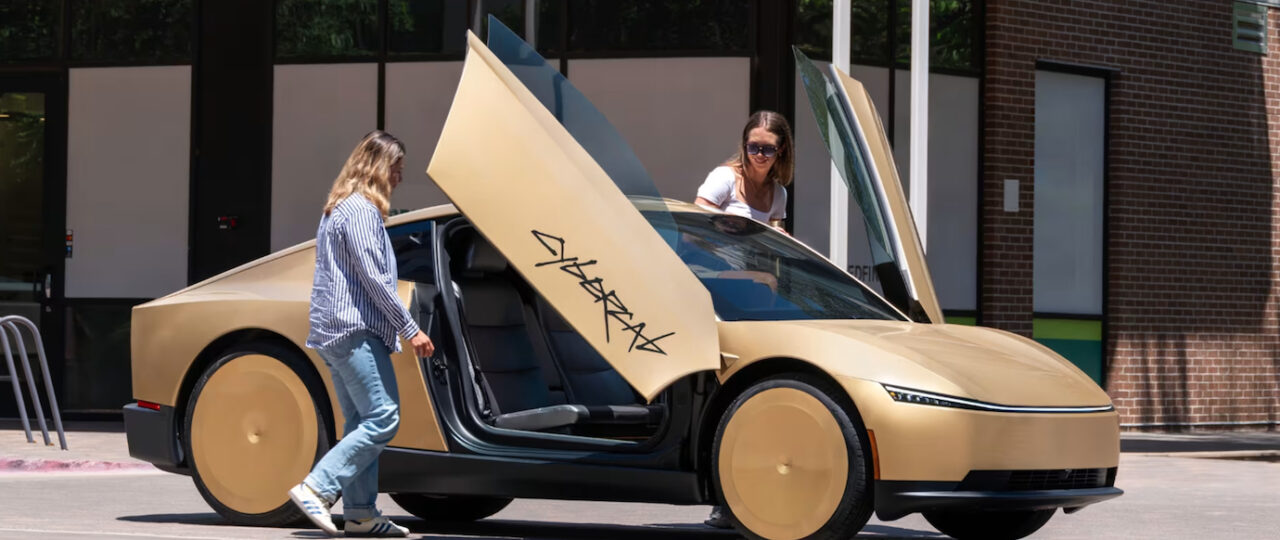
The Cybercab uses electronic door latches, which allow the doors to open automatically at the start or end of a ride. There is also a small button on the exterior of the car that riders can use to open the doors. But inside, the manual release is thankfully in a very obvious spot on the armrest of each door.
Tesla is using a brake-by-wire system in the Cybercab, again largely (it seems) for the purposes of cutting costs. Instead of using a hydraulic system that pumps fluid through lines to control brake pressure, Tesla has electronic actuators controlling the brake calipers.
“Having electric brakes avoids the complexity of a hydraulic system: no need to rout plumbing all around the car,” Musk wrote in a post.
The company was already the first major automaker to use steer-by-wire on its Cybertruck, severing the physical connection between the steering wheel and the front wheels.
For some reason, the windows of the Cybercab “cannot be fully opened at this time.” Tesla doesn’t explain why in the documentation it released this week.
According to influencer Jeremy Judkins, the USB-C outlets in the Cybercab put out 90W of power — roughly four times more than you’d typically find inside a car.
Discover more from NAIRAVOICE.COM.NG
Subscribe to get the latest posts sent to your email.