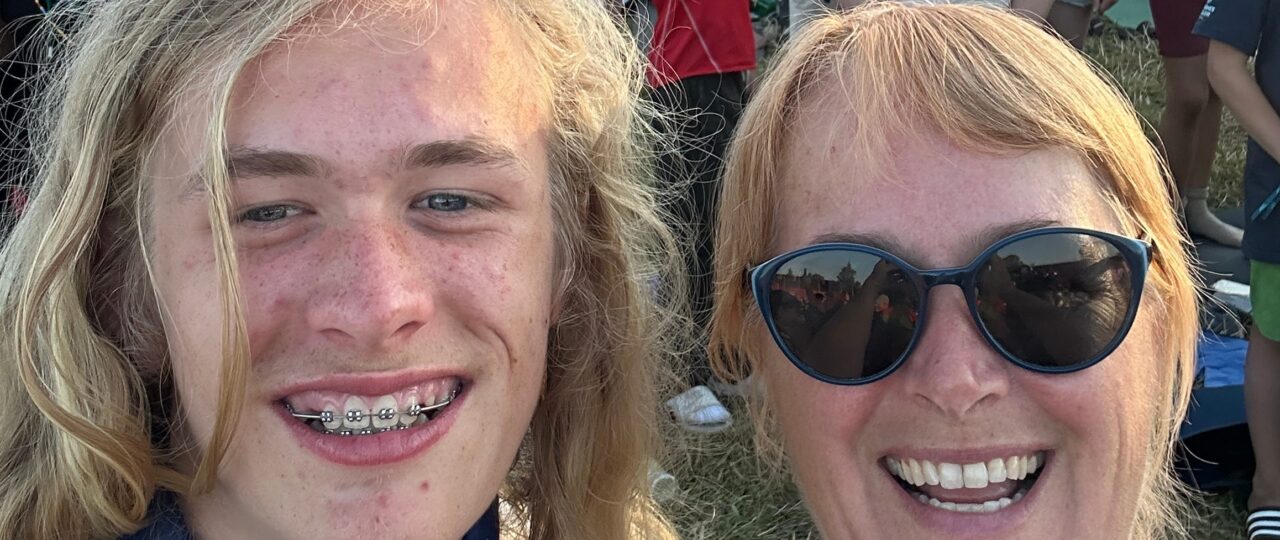

- Carrie Kirby, a mother of three in California, enrolled her 16-year-old in a Scout camp in Norway.
- In the US, she wanted her kids to grow up with freedom and independence, but accepted that it wasn’t safe enough.
- Her perspective shifted after a trip to Norway. Instead of saying no to everything, she now asks one question.
I was desperate to show up at camp to surprise my son on his 16th birthday. But I was sure I wouldn’t be allowed to set foot on the grounds.
After all, in two decades as an adult volunteer in both Girl Scouts and Scouting America — the organization formerly known as Boy Scouts — I knew the drill: Any adult who wanted to be among kids would need to be background-checked, fingerprinted, and cross-checked against a master list. They couldn’t just have people showing up randomly.
And this wasn’t just any Scout camp. It was Norway’s national scouting jamboree, a 10,000-person event that drew visiting Scouts from multiple countries, including the California contingent that my son had joined.
The answer I received via email: “Just come … no security. Lots of families just wandering around visiting.”
I found this situation idyllic — yet hard to believe
I’ve always wanted to raise my three kids with more freedom and independence than most 21st-century youth in the US are allowed. But I’d accepted that the world just isn’t safe enough anymore for kids to have the type of independence I enjoyed growing up in the 1970s and ’80s.
My son had the opportunity to visit this Norwegian event through his Scouting America troop, which had connected with a larger group of scouts who regularly travel internationally. My parents and I went to Norway with him, but we didn’t attend the camp.
When I arrived in Gjøvik, the town near the jamboree, I saw that the porous borders of the youth encampment worked in both directions. The bus stop in town was swarming with boys and girls wearing kerchiefs indicating they were part of the jamboree. Only the younger kids were accompanied by adults.
Some middle school-aged Scouts from my son’s contingent recognized me and guided me to the right bus.
I was surprised the American kids could handle this level of freedom. Despite having grown up in our Bay Area suburb where even teens are often driven everywhere by adults, they had clearly mastered the bus system and had no fear about moving alone through a foreign country. On the bus, they told me what they’d been up to in town: They’d collected recyclables throughout the camp, cashed them in at a recycling machine, and used the proceeds to get McDonald’s.
My son was delighted to see me, but we didn’t have long to catch up. His group needed to take their camp photo. To pose, the kids all scrambled onto a platform they’d constructed from logs, sticks, and lashings.
I felt nervous watching them all balance on the homemade structure. In my experience at scout camps at home, kids are required to wear helmets and harnesses if they get that high off the ground.
My eyebrows rose higher when my son told me about his favorite part of the jamboree: camping overnight in the woods away from the camp, with no adults present.
In both Girl Scouts and Scouting America, kids can’t go anywhere without adult chaperones. When I brought my daughter’s troop of high school seniors to New York City, even the 18-year-olds weren’t supposed to venture out alone, based on the organization’s safety rules.
The kids in my son’s overnight group ranged in age from about 14 to 17. And they were perfectly fine — although they got soaking wet because they’d opted to play capture the flag instead of setting up the tarps.
“That was a learning experience,” my son, James, said. They weren’t told to set up their tarps and had to deal with the consequences of not getting around to it.
The visit changed my point of view as a mom
By the time we left Gjøvik the next day, my view of raising kids in the 21st century had changed irrevocably. I no longer wished we still lived in a world safe enough for kids to move about independently, developing self-confidence and competence as they go.
Instead, I understood that everything I wished for today’s kids is still possible. And it’s not just that Norway is so much safer than the United States. It’s that the Norwegian adults I met valued kids’ need for freedom and autonomy more than they worried about their safety.
It’s an experience I won’t forget as I move forward with parenting my son and his older sisters into adulthood. I’m now less likely to try to talk them out of staying out all night or taking off on an outdoor adventure with friends.
Instead of saying no, I’m asking what preparations they’ve made. I’m making sure they know what to do if anything goes wrong.
Am I still worrying? You bet. But I’m trying to worry more quietly—and to let the kids have their experiences.
Read the original article on Business Insider
Discover more from NAIRAVOICE.COM.NG
Subscribe to get the latest posts sent to your email.