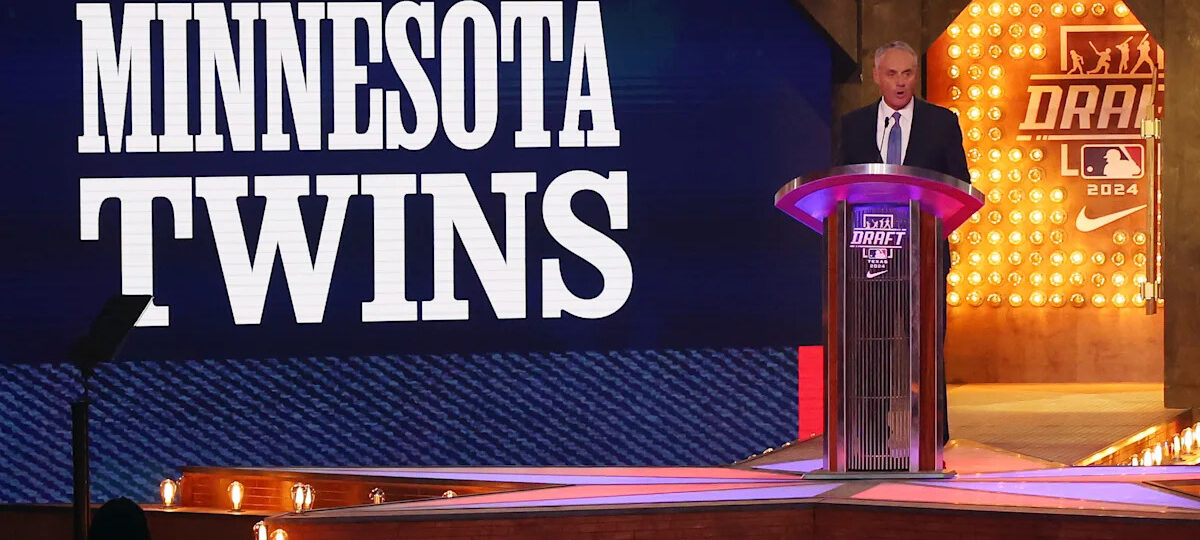
After an up-and-down first half by the Minnesota Twins that still has them in the thick of the playoff race, it is nearly time for the All-Star Break and the 2026 MLB Draft! The Twins will have a busy first day in the draft with the third overall pick and five total day one selections. You can read Twinkie Town’s Aidan O’Brien’s breakdown of the top three prospects in this year’s draft.
The 2026 MLB Draft begins today at 12 PM CDT in Philadelphia to kick off All-Star Week. There’s a bit of a different schedule this year, with rounds 1-4 taking place today, including all compensatory and competitive balance rounds. Rounds 5-20 will begin on Sunday at 10:30 AM CDT.
Because MLB likes to make things extra confusing, the broadcast will also be different this year and will have the first round split between two different broadcast partners and the entirety of day one split into three. Picks 1-10 can be seen on NBC and Peacock after which the broadcast will shift to MLB Network, MLB.com, MLB.TV, and MLB+ for picks 11-40. The rest of day one (picks 41-135) and all of day two will lose the MLB Network component.
Follow along on this post for the next few days. We’ll track each of the first-round picks and break down all of the Twins picks that they make along the way.
After the consensus top two went with the first two picks, the Twins go with Lackey, the consensus third prospect. With Ryan Jeffers likely in his final year with the team, Lackey’s experience, athleticism, and defensive acumen should allow him to rise through the ranks quickly. There’s agreement among scouts that he can stick at catcher, but even in the rare situation where he can’t, his bat alone is still among the best in draft. Also of note: this is the Twins’ first first-round catcher since one first ballot Hall of Famer, Joseph Patrick Mauer. No pressure, Lackey.
MLB Pipeline Scouting Report (#3 Overall Prospect)
A late bloomer as a Georgia high schooler, Lackey didn’t receive any NCAA Division I offers until his senior year in 2023, and he didn’t draw much attention from scouts because he attended few showcase events. Now he’s the best catching prospect in the 2026 Draft and poised to join Jason Varitek, Matt Wieters, Joey Bart and Kevin Parada as first-round backstops out of Georgia Tech. He has dramatically improved each season with the Yellow Jackets, batted .397/.519/.772 as a junior and won’t last longer than the top three or four picks.
Lackey’s right-handed swing can get a little busy, but that doesn’t prevent him from making consistent contact to all fields. He’s extremely patient, rarely misses fastballs and has the plus raw power to provide 25-30 homers on an annual basis. His flat stroke produces too much groundball contact but he’s driving balls harder than ever and in the air a bit more often this spring.
Extremely athletic for a 6-foot-2, 215-pound catcher, Lackey isn’t quick out of the batter’s box but can flash plus run times once he gets going. He’s very agile behind the plate and should become a solid receiver and blocker once he improves his focus and consistency. His strong and accurate arm is another asset, and he looked capable at third base while playing 13 errorless games there in 2025.
A late bloomer as a Georgia high schooler, Lackey didn’t receive any NCAA Division I offers until his senior year in 2023, and he didn’t draw much attention from scouts because he attended few showcase events. Now he’s the best catching prospect in the 2026 Draft and poised to join Jason Varitek, Matt Wieters, Joey Bart and Kevin Parada as first-round backstops out of Georgia Tech. He has dramatically improved each season with the Yellow Jackets, batted .397/.519/.772 as a junior and won’t last longer than the top three or four picks.
Lackey’s right-handed swing can get a little busy, but that doesn’t prevent him from making consistent contact to all fields. He’s extremely patient, rarely misses fastballs and has the plus raw power to provide 25-30 homers on an annual basis. His flat stroke produces too much groundball contact but he’s driving balls harder than ever and in the air a bit more often this spring.
Extremely athletic for a 6-foot-2, 215-pound catcher, Lackey isn’t quick out of the batter’s box but can flash plus run times once he gets going. He’s very agile behind the plate and should become a solid receiver and blocker once he improves his focus and consistency. His strong and accurate arm is another asset, and he looked capable at third base while playing 13 errorless games there in 2025.
FanGraphs Scouting Report (#1 Overall Prospect)
Lackey went from having no Division I offers as an underclassman to likely being a top 10 pick after his sophomore year, and then ascended further as a junior to become arguably the best player in the entire draft. He is a complete player with a bevy of strengths and skills on both sides of the ball, and no significant weakness. Though he was already a good contact hitter as an underclassman, Lackey’s power production took a leap as a junior, as he slashed .397/.519/.772 with 20 homers, doubling his career total and continuing a four-year trend of getting markedly better. At barely 21 years old on draft day, he remains physically projectable and still might have more raw power in the tank at maturity.
Lackey is a patient hitter who is dangerous throughout the majority of the strike zone. He can access power against pitches in the middle third and above, and on both edges of the plate, with enough strength to do oppo damage against fastballs away from him. Lackey has now posted consecutive seasons with a 90% contact rate against fastballs even though he uses a pretty big leg kick, including with two strikes. He’s strong enough to hit for some power even when his footwork is ill-timed, and he might be an even better contact hitter with a more focused two-strike approach than what he’s currently doing. He isn’t a clinical sweet-spot hitter, and his power might play down a bit as he mishits some infield contact that he must then attempt to beat out with his impressive speed (he’ll run sub-4.3 on occasion).
The sum total of Lackey’s parts on offense (above-average contact, plate discipline, and potentially power) is more than enough to clear the bar at catcher, and he also makes an impact on defense. He’s a pretty good pitch framer for his age (and should continue to improve with added strength) and has one hell of an arm, winging accurate throws from all kinds of odd platforms and angles when it’s called for. He’ll frequently pop sub-1.9, a plus-plus arm that is Lackey’s loudest tool. He projects as a top 10 catcher and multi-time All-Star.
Lackey went from having no Division I offers as an underclassman to likely being a top 10 pick after his sophomore year, and then ascended further as a junior to become arguably the best player in the entire draft. He is a complete player with a bevy of strengths and skills on both sides of the ball, and no significant weakness. Though he was already a good contact hitter as an underclassman, Lackey’s power production took a leap as a junior, as he slashed .397/.519/.772 with 20 homers, doubling his career total and continuing a four-year trend of getting markedly better. At barely 21 years old on draft day, he remains physically projectable and still might have more raw power in the tank at maturity.
Lackey is a patient hitter who is dangerous throughout the majority of the strike zone. He can access power against pitches in the middle third and above, and on both edges of the plate, with enough strength to do oppo damage against fastballs away from him. Lackey has now posted consecutive seasons with a 90% contact rate against fastballs even though he uses a pretty big leg kick, including with two strikes. He’s strong enough to hit for some power even when his footwork is ill-timed, and he might be an even better contact hitter with a more focused two-strike approach than what he’s currently doing. He isn’t a clinical sweet-spot hitter, and his power might play down a bit as he mishits some infield contact that he must then attempt to beat out with his impressive speed (he’ll run sub-4.3 on occasion).
The sum total of Lackey’s parts on offense (above-average contact, plate discipline, and potentially power) is more than enough to clear the bar at catcher, and he also makes an impact on defense. He’s a pretty good pitch framer for his age (and should continue to improve with added strength) and has one hell of an arm, winging accurate throws from all kinds of odd platforms and angles when it’s called for. He’ll frequently pop sub-1.9, a plus-plus arm that is Lackey’s loudest tool. He projects as a top 10 catcher and multi-time All-Star.
MLB Pipeline Scouting Report (#73 Overall Prospect)
Few players in this Draft can match his combination of raw power and arm strength.
At 6-foot-4 and 240 pounds and with a right-handed stroke geared to crush balls in the air to his pull side, Tinney is designed to hit home runs. He generates high-end exit velocities, but there are concerns about his hitting ability and how much of his double-plus raw pop he’ll be able to get to in pro ball. He takes a lot of offspeed pitches for strikes and swings through a lot of offerings of all types in the zone, though he mitigates his excessive strikeouts with a healthy amount of walks.
Tinney can flash well-above-average arm strength, though it plays more as plus and he needs to improve his transfer and the accuracy of his throws. He lacks quickness and agility behind the plate, though he has become a better receiver and framer this spring and perhaps can become average in both regards. His best-case scenario is that he becomes a larger version of Hunter Goodman.
Few players in this Draft can match his combination of raw power and arm strength.
At 6-foot-4 and 240 pounds and with a right-handed stroke geared to crush balls in the air to his pull side, Tinney is designed to hit home runs. He generates high-end exit velocities, but there are concerns about his hitting ability and how much of his double-plus raw pop he’ll be able to get to in pro ball. He takes a lot of offspeed pitches for strikes and swings through a lot of offerings of all types in the zone, though he mitigates his excessive strikeouts with a healthy amount of walks.
Tinney can flash well-above-average arm strength, though it plays more as plus and he needs to improve his transfer and the accuracy of his throws. He lacks quickness and agility behind the plate, though he has become a better receiver and framer this spring and perhaps can become average in both regards. His best-case scenario is that he becomes a larger version of Hunter Goodman.
FanGraphs Scouting Report (#58 Overall Prospect)
Tinney is a monstrous 6-foot-3 catcher who had a power-hitting breakout as a sophomore at Notre Dame before entering the transfer portal and heading to Austin. He had a comparable junior year, with a .326/.483/.688 line, 22 homers, and some absurd peak exit velos (116 mph max, 112 EV90), plus-plus on the big league scale. He isn’t a skilled hitter and swings over the top of a lot of softer stuff, with a 73% contact rate and 23.1% strikeout rate as a junior. He’s always been able to throw and leverage his size as a ball-blocker, but Tinney’s receiving and framing improved in 2026, and he now more comfortably projects as a viable defensive catcher. His toolset reads more like that of a bat-first backup catcher, except with much more power than is typical for that role.
Tinney is a monstrous 6-foot-3 catcher who had a power-hitting breakout as a sophomore at Notre Dame before entering the transfer portal and heading to Austin. He had a comparable junior year, with a .326/.483/.688 line, 22 homers, and some absurd peak exit velos (116 mph max, 112 EV90), plus-plus on the big league scale. He isn’t a skilled hitter and swings over the top of a lot of softer stuff, with a 73% contact rate and 23.1% strikeout rate as a junior. He’s always been able to throw and leverage his size as a ball-blocker, but Tinney’s receiving and framing improved in 2026, and he now more comfortably projects as a viable defensive catcher. His toolset reads more like that of a bat-first backup catcher, except with much more power than is typical for that role.
MLB Pipeline Scouting Report (#123 Overall Prospect)
From a size and pure stuff standpoint, Renfrow’s name belongs in the early rounds with some of the top college arms in the class. The 6-foot-3 right-hander can run his fastball up to 97 mph, sitting around 94, and it plays really well at the top of the zone. At times, Renfrow will show distinct upper-80s sliders and cutters, with the former featuring harder break with more depth than the shorter cutter, though they routinely blend together. He can fold in an 80-mph 12-to-6 curve effectively and will flash a solid, average mid-80s changeup, though he doesn’t incorporate the cambio as frequently as his other offerings.
Enjoying this article? Support our work with a small crypto donation.While Renfrow has limited the walks this spring, it has been more control over command. When he’s locked in, like he was in a late April start against North Carolina State, tossing eight shutout innings and fanning nine, he misses bats with all of his repertoire. Often this year, however, he’s missed with his fastball in the zone too much, and it’s gotten hit. That’s made him a bit of an enigma, with his ceiling perhaps being in the second round, where former Hokies right-hander Drue Hackenberg went in 2023 after a comparable inconsistent season.
From a size and pure stuff standpoint, Renfrow’s name belongs in the early rounds with some of the top college arms in the class. The 6-foot-3 right-hander can run his fastball up to 97 mph, sitting around 94, and it plays really well at the top of the zone. At times, Renfrow will show distinct upper-80s sliders and cutters, with the former featuring harder break with more depth than the shorter cutter, though they routinely blend together. He can fold in an 80-mph 12-to-6 curve effectively and will flash a solid, average mid-80s changeup, though he doesn’t incorporate the cambio as frequently as his other offerings.
While Renfrow has limited the walks this spring, it has been more control over command. When he’s locked in, like he was in a late April start against North Carolina State, tossing eight shutout innings and fanning nine, he misses bats with all of his repertoire. Often this year, however, he’s missed with his fastball in the zone too much, and it’s gotten hit. That’s made him a bit of an enigma, with his ceiling perhaps being in the second round, where former Hokies right-hander Drue Hackenberg went in 2023 after a comparable inconsistent season.
Low-maintenance delivery, although he has the inverted-W arm action. Up to 95, sits 92-94 without great shape. Changeup flashes, average strike-stealing curve, don’t see the slider/cutter as a bat-misser. Good strike-thrower, control over command. Needs something to tick up in pro ball, or he’s going to be more of a middle-relief prospect. I’m a little lower on him than the models seem to be.
Low-maintenance delivery, although he has the inverted-W arm action. Up to 95, sits 92-94 without great shape. Changeup flashes, average strike-stealing curve, don’t see the slider/cutter as a bat-misser. Good strike-thrower, control over command. Needs something to tick up in pro ball, or he’s going to be more of a middle-relief prospect. I’m a little lower on him than the models seem to be.
MLB Pipeline Scouting Report (#87 Overall Prospect)
Coming out of the same Grandview HS program that produced Gausman, Wachsmann is a 6-foot-4 right-hander who can light up the radar gun but is still a bit raw as a complete pitcher. He routinely gets his fastball up to 97 mph and can comfortably sit in the mid-90s. He does have both a curve and a slider, with the former the better of his two breaking balls, occasionally flashing plus. That pitch was improving as the spring wore on, though evaluating his ability to spin the ball is still more projection than anything else. He’ll flash a changeup that could be average in time to round out his arsenal.
Like with a lot of prep throwers over pitchers, Waschmann is control over command, with more of a fringy feel for the strike zone. Teams that are interested will be buying the arm strength and velocity to go along with the projectable and athletic frame. They’ll also have to contend with a commitment to Wake Forest.
Coming out of the same Grandview HS program that produced Gausman, Wachsmann is a 6-foot-4 right-hander who can light up the radar gun but is still a bit raw as a complete pitcher. He routinely gets his fastball up to 97 mph and can comfortably sit in the mid-90s. He does have both a curve and a slider, with the former the better of his two breaking balls, occasionally flashing plus. That pitch was improving as the spring wore on, though evaluating his ability to spin the ball is still more projection than anything else. He’ll flash a changeup that could be average in time to round out his arsenal.
Like with a lot of prep throwers over pitchers, Waschmann is control over command, with more of a fringy feel for the strike zone. Teams that are interested will be buying the arm strength and velocity to go along with the projectable and athletic frame. They’ll also have to contend with a commitment to Wake Forest.
FanGraphs Scouting Report (#54 Overall Prospect)
Wachsmann had a growth spurt in the middle of high school and shot up from 5-foot-10 to 6-foot-5 in a relatively short span of time. His velocity grew, too, and he was creeping into the mid-90s and paving over Colorado high schoolers as an underclassman before struggling some during the summer against better hitters. He sustained upper-90s velo this spring and had the best mound session at the Combine, where he touched 100 with his final pitch.
Wachsmann is raw. He has a cutter, slider, and changeup right now, and they’re all of variable quality. He threw one breaking ball at 2,900 rpm at the Combine and the next was 2,300. There’s a lot of work to do here but also very exciting raw material, as Wachsmann has prototypical size, premium arm strength, and flashes plus secondary stuff.
Wachsmann had a growth spurt in the middle of high school and shot up from 5-foot-10 to 6-foot-5 in a relatively short span of time. His velocity grew, too, and he was creeping into the mid-90s and paving over Colorado high schoolers as an underclassman before struggling some during the summer against better hitters. He sustained upper-90s velo this spring and had the best mound session at the Combine, where he touched 100 with his final pitch.
Wachsmann is raw. He has a cutter, slider, and changeup right now, and they’re all of variable quality. He threw one breaking ball at 2,900 rpm at the Combine and the next was 2,300. There’s a lot of work to do here but also very exciting raw material, as Wachsmann has prototypical size, premium arm strength, and flashes plus secondary stuff.
MLB Pipeline Scouting Report (#107 Overall Prospect)
At his best, LaPour works at 95-98 mph and reaches 101 with heavy sink on his fastball, though it’s not as dominant as its velocity might indicate because its shape and command are ordinary. His mid-80s slider can be a plus pitch with two-plane depth at its best, though it breaks so much that he struggles to land it for strikes and rarely uses it when behind in the count. His fading upper-80s changeup is a more reliable offering and he also has tinkered with an upper-80s cutter.
Built like a linebacker, LaPour has a physical 6-foot-4 frame and has learned to repeat his simple delivery well enough to develop average control. His biggest proponents see a durable three-pitch starter who might have snuck into the first round with a healthy junior season. Other evaluators think he doesn’t miss enough bats and may be better suited for the bullpen, where his bulldog mentality would fit nicely.
At his best, LaPour works at 95-98 mph and reaches 101 with heavy sink on his fastball, though it’s not as dominant as its velocity might indicate because its shape and command are ordinary. His mid-80s slider can be a plus pitch with two-plane depth at its best, though it breaks so much that he struggles to land it for strikes and rarely uses it when behind in the count. His fading upper-80s changeup is a more reliable offering and he also has tinkered with an upper-80s cutter.
Built like a linebacker, LaPour has a physical 6-foot-4 frame and has learned to repeat his simple delivery well enough to develop average control. His biggest proponents see a durable three-pitch starter who might have snuck into the first round with a healthy junior season. Other evaluators think he doesn’t miss enough bats and may be better suited for the bullpen, where his bulldog mentality would fit nicely.
After missing most of the year, LaPour was healthy right at the very end of TCU’s season. He’s an average athlete with a large frame, more powerful than loose, with a clean enough arm stroke to start. He doesn’t get a ton of extension and isn’t especially deceptive. LaPour sits in the mid-90s and can touch 99, which he often does after giving up a knock. He shows some feel for moving the fastball, and can miss bats up in the zone with it. He doesn’t have great feel for spin, and the length on his curveball was more challenging for hitters than the slider, which is fairly firm in the upper 80s but isn’t especially sharp. He missed a few bats with his changeup, but he slows his body on the pitch in a way that hitters have no trouble picking up. Good arm strength and a four-pitch foundation make LaPour an intriguing prospect, though there are enough questions regarding his secondaries to consider him a likely reliever at the end of the day.
After missing most of the year, LaPour was healthy right at the very end of TCU’s season. He’s an average athlete with a large frame, more powerful than loose, with a clean enough arm stroke to start. He doesn’t get a ton of extension and isn’t especially deceptive. LaPour sits in the mid-90s and can touch 99, which he often does after giving up a knock. He shows some feel for moving the fastball, and can miss bats up in the zone with it. He doesn’t have great feel for spin, and the length on his curveball was more challenging for hitters than the slider, which is fairly firm in the upper 80s but isn’t especially sharp. He missed a few bats with his changeup, but he slows his body on the pitch in a way that hitters have no trouble picking up. Good arm strength and a four-pitch foundation make LaPour an intriguing prospect, though there are enough questions regarding his secondaries to consider him a likely reliever at the end of the day.
Acquired from CLE in Patrick Bailey trade
Acquired from BAL in Shane Baz trade
Acquired from PIT in Jacob Gonzalez trade
Note: picks 29-37 are all technically Competitive Balance Round A picks, which you can read about here. NYY and PHI pick in this round because of their pick penalties, not because they got extra picks. As a result of the same rule, LAD’s and TOR’s first selections technically fall in the second round. CB-A picks are considered first round selections since they take place prior to the start of round two and are the only draft picks eligible to be traded.
Discover more from NAIRAVOICE.COM.NG
Subscribe to get the latest posts sent to your email.