
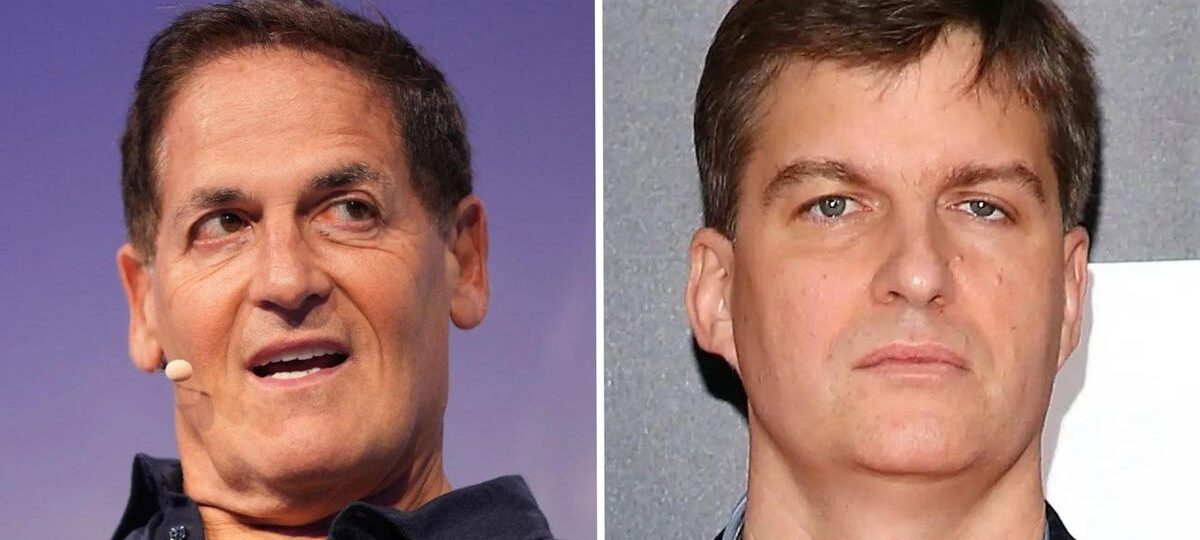
Mark Cuban and Michael Burry just sounded the alarm on Nvidia’s sprawling web of AI deals.
Cuban struck a worried tone on X after another user wrote that Nvidia, by financing its customers’ purchases of its graphics chips for their data center buildouts, is acting as a “backstop” and making itself vulnerable to an AI downturn. “This is so analogous to the dot com burst,” the tech billionaire and former “Shark Tank” investor wrote in a Tuesday post. “But instead of IPOs, Nvidia is the ‘ipo,’ funding everyone and anyone.” Cuban was referring to the popularity of going public during the internet bubble as a way for startups to raise cash and secure rich valuations — and saying that Nvidia has replaced the stock market in that role during this tech boom. “One breakthrough in another chip provider, or a misstep, and it all could crumble,” he wrote on X. “It’s truly scary.” As far as Nvidia subsidizing everyone.
But that feeds the credit problem, far beyond oracle.
You never know where an exogenous change is going to come from.
This is so analogous to the dot com burst.
But instead of IPOs, Nvidia is the “ipo” , funding… Nvidia has struck deals worth hundreds of billions of dollars with numerous players in the AI ecosystem, including OpenAI, Microsoft, CoreWeave, and SK Hynix.
Cuban seems concerned that the chipmaker is so deeply intertwined with its customers that if it runs into problems, the damage could spread far and fast, creating painful and widespread fallout.
Nvidia CEO Jensen Huang himself, speaking during a company meeting in November, acknowledged Nvidia’s linchpin role by pointing to online memes about the company propping up the AI boom, the stock market, and the global economy. “We’re basically holding the planet together — and it’s not untrue,” Huang said.
Shares of Nvidia were trading 2% lower on Wednesday, leaving them down 18% from their May peak.
But they’re still up around 13-fold since the start of 2023.
Nvidia didn’t immediately respond to a request for comment from Business Insider.
Burry, the investor of “The Big Short” fame, issued a similar warning to Cuban in a late Tuesday post on X. “There is a reason $NVDA’s 5 year credit default swaps are going parabolic,” he wrote, attaching a chart showing the price of buying insurance against Nvidia defaulting on its debts has roughly doubled within the past two months. “All this overreaching by #nvda to push the circular spending to biblical proportions,” he added, suggesting that markets are pricing in a greater risk of Nvidia failing to meet its financial commitments because it’s overextending itself with too many deals.
Burry’s iconic “Big Short” centered on buying credit default swaps to bet against subprime mortgage bonds during the mid-2000s housing bubble.
The instruments surged in value once mortgage defaults began spiking, resulting in a huge windfall for Burry and his clients.
Both Cuban and Burry have taken aim at aspects of the AI boom in recent weeks.
Cuban cautioned on a podcast that companies are overbuilding AI infrastructure that will become more efficient over time, resulting in excess capacity.
He quipped that a lot of the buildings will be converted into pickleball courts.
Similarly, Burry has said that tech giants are overinvesting in microchips and data centers that will quickly become obsolete, dragging out depreciation to inflate their earnings, and signing “give-and-take” deals to keep fueling hype around AI.
Burry, who pivoted from running a hedge fund to writing about his personal portfolio last winter, wrote in January that he was short Nvidia because it was “entirely dependent on hyperscaler spending, and I do not see how that math works.” In a July 24 post, Burry wrote that he bolstered his Nvidia short and holds bearish puts on the stock “in good size.” He believes that much of its demand doesn’t stem from end customers, much of it is financed and kept off its balance sheet, and “future revenues are majority financed in a circular arrangement,” he wrote.
Discover more from NAIRAVOICE.COM.NG
Subscribe to get the latest posts sent to your email.