
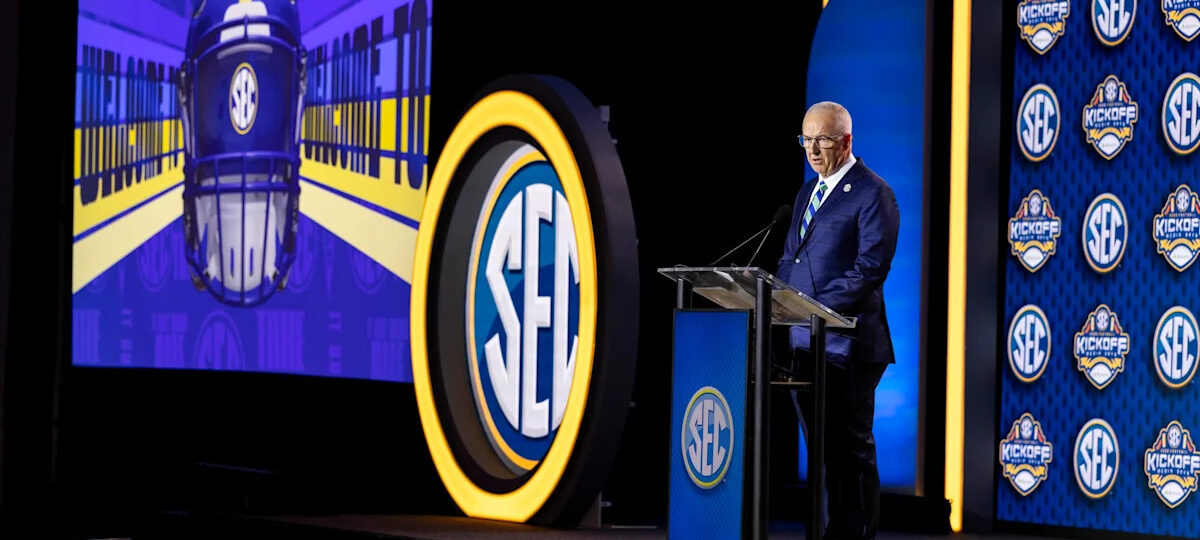
Happy Thursday, everyone. Senators are still working on the Protect College Sports Act. The SEC and Big Ten continue to push for higher caps, which would make it even more difficult for schools in other leagues to compete.
A pair of documents outlining concessions the lawmakers have made in the negotiations were headlined by a $20 million-plus “retention pool” that schools could use to keep players from leaving. It would amount to a doubling of the revenue-sharing “salary cap,” which is currently set at $21.3 million for this school year.
The conferences are seeking answers on whether the increase in revenue share would impact rules governing third-party payments to players, the likes of which are largely blamed for spiraling roster costs.
There’s also the question of whether such an increase would comport with the House settlement — the $2.8 billion lawsuit settlement that dictates rules around revenue sharing. Jeffrey Kessler, the plaintiffs’ attorney, has said he would need to see the language before weighing in on whether it impacts the settlement.
Absent from the documents was any mention of rewrites regarding antitrust protection or preemption of state laws. Those have been core requests surrounding legislation from virtually all the conferences and NCAA since Congress began this process.
Earlier this month, the SEC and Big Ten put out a paper outlining 10 “Common Sense Improvements” for the PCSA. The first two— and three of the 10 — entries on their list dealt with those two issues.
A pair of documents outlining concessions the lawmakers have made in the negotiations were headlined by a $20 million-plus “retention pool” that schools could use to keep players from leaving. It would amount to a doubling of the revenue-sharing “salary cap,” which is currently set at $21.3 million for this school year.
The conferences are seeking answers on whether the increase in revenue share would impact rules governing third-party payments to players, the likes of which are largely blamed for spiraling roster costs.
There’s also the question of whether such an increase would comport with the House settlement — the $2.8 billion lawsuit settlement that dictates rules around revenue sharing. Jeffrey Kessler, the plaintiffs’ attorney, has said he would need to see the language before weighing in on whether it impacts the settlement.
Absent from the documents was any mention of rewrites regarding antitrust protection or preemption of state laws. Those have been core requests surrounding legislation from virtually all the conferences and NCAA since Congress began this process.
Earlier this month, the SEC and Big Ten put out a paper outlining 10 “Common Sense Improvements” for the PCSA. The first two— and three of the 10 — entries on their list dealt with those two issues.
An additional pool for retention only is an interesting concept. The problem is, as Stewart Mandel notes, any cap that is agreed to will immediately be ignored by some. And who is going to do anything about it when it happens?
The next day, while talking with Ohio State athletic director Ross Bjork, I asked him if anyone had explained to him what would happen if, under this bill, Ohio State went over the revenue-sharing cap by $2 million? Would the university get fined by the federal government?
“We haven’t gotten any clarity on that,” he said. “Does it go to some local federal prosecutor? We don’t know.”
Fantastic.
You may be familiar with the number $20.5 million. That’s the max schools could pay their athletes directly during the first year post-House settlement. (It goes up to $21.3 million in 2026-27.) A lot of smart administrators with good intentions somehow convinced themselves a year ago the dawn of rev-share would rein in roster cuts. Everyone agreed to follow the rules. No more name, image and likeness deals disguised as pay-for-play.
You can guess how that went. The same people who spent years begging for “guardrails” blew right through them. Top-end rosters went from $20 million to $30 million last year to $40 million to $50 million this year. The schools devised ways to funnel third-party sponsorship and media dollars from their corporate partners into thousands of “above-the-cap” NIL deals, then got mad when the doomed-from-the-start College Sports Commission either denied them or never got to them.
“Do I think the cap should be higher?” Ohio State coach Ryan Day said Wednesday. “Absolutely.”
The next day, while talking with Ohio State athletic director Ross Bjork, I asked him if anyone had explained to him what would happen if, under this bill, Ohio State went over the revenue-sharing cap by $2 million? Would the university get fined by the federal government?
“We haven’t gotten any clarity on that,” he said. “Does it go to some local federal prosecutor? We don’t know.”
You may be familiar with the number $20.5 million. That’s the max schools could pay their athletes directly during the first year post-House settlement. (It goes up to $21.3 million in 2026-27.) A lot of smart administrators with good intentions somehow convinced themselves a year ago the dawn of rev-share would rein in roster cuts. Everyone agreed to follow the rules. No more name, image and likeness deals disguised as pay-for-play.
You can guess how that went. The same people who spent years begging for “guardrails” blew right through them. Top-end rosters went from $20 million to $30 million last year to $40 million to $50 million this year. The schools devised ways to funnel third-party sponsorship and media dollars from their corporate partners into thousands of “above-the-cap” NIL deals, then got mad when the doomed-from-the-start College Sports Commission either denied them or never got to them.
“Do I think the cap should be higher?” Ohio State coach Ryan Day said Wednesday. “Absolutely.”
Rich Eisen probably had it right. The super league is coming.
Jeremiah Smith made waves yesterday when he said that he wanted to come to Alabama but Saban didn’t recruit him.
“Growing up, my dream school was Alabama when Nick Saban was there. They wasn’t recruiting me, though,” Smith said. “It is what it is, but I always wanted to go to Alabama.”
Alabama had become a destination for several South Florida stars before Smith. He pointed to Amari Cooper (2012 four-star), Calvin Ridley (2015 five-star) and Jerry Jeudy (2017 five-star) as examples of elite wide receivers from the area who played in Tuscaloosa.
But it wasn’t in the cards for Smith. He said his early commitment to Ohio State caused Alabama to bow out of his recruitment long before signing day.
“I think I committed to Ohio State too early,” he said. “That’s why they stopped. They thought there was no chance.”
Enjoying this article? Support our work with a small crypto donation.
“Growing up, my dream school was Alabama when Nick Saban was there. They wasn’t recruiting me, though,” Smith said. “It is what it is, but I always wanted to go to Alabama.”
Alabama had become a destination for several South Florida stars before Smith. He pointed to Amari Cooper (2012 four-star), Calvin Ridley (2015 five-star) and Jerry Jeudy (2017 five-star) as examples of elite wide receivers from the area who played in Tuscaloosa.
But it wasn’t in the cards for Smith. He said his early commitment to Ohio State caused Alabama to bow out of his recruitment long before signing day.
“I think I committed to Ohio State too early,” he said. “That’s why they stopped. They thought there was no chance.”
We also don’t know what kind of NIL deal Smith had agreed to with Ohio State. That may well have been a reason for Saban to back off.
Damien Harris thinks Alabama’s running backs need an attitude adjustment.
“For the backs, this is a mentality thing,” Harris said. “All of these guys are talented. We saw spurts of Daniel Hill last year. We know EJ Crowell, a phenomenal running back recruit coming out of high school. These guys need to run the ball with a mentality we haven’t really seen in a few years from that position. There’s a toughness, there’s a physicality, there’s a purpose that you have to run with that’s outside of just your talent. That’s what needs to be brought out of these guys.”
Reps and experience will help developing running backs. Especially to help slow the game down. But …
“This is an attitude-having position,” Harris said. “It’s similar to offensive line, it’s similar to defensive line, linebacker. You have to play, you have to be nasty to play this position.”
“For the backs, this is a mentality thing,” Harris said. “All of these guys are talented. We saw spurts of Daniel Hill last year. We know EJ Crowell, a phenomenal running back recruit coming out of high school. These guys need to run the ball with a mentality we haven’t really seen in a few years from that position. There’s a toughness, there’s a physicality, there’s a purpose that you have to run with that’s outside of just your talent. That’s what needs to be brought out of these guys.”
Reps and experience will help developing running backs. Especially to help slow the game down. But …
“This is an attitude-having position,” Harris said. “It’s similar to offensive line, it’s similar to defensive line, linebacker. You have to play, you have to be nasty to play this position.”
Ken Roberts wrote about why each Alabama home game is interesting.
Sept. 19 brings Alabama’s biggest nonconference opponent of the season: Florida State.
The game is a rare matchup in Tuscaloosa. It will mark the Seminoles‘ first visit to Bryant-Denny Stadium since 1974. It also offers a chance for revenge after Florida State defeated Alabama 31-17 in the 2025 season opener in Tallahassee, Florida.
While Alabama fans hope the Seminoles won’t have much to celebrate, there’s a good chance Florida State’s trademark “War Chant” and accompanying tomahawk chop will make an appearance inside Bryant-Denny Stadium.
Sept. 19 brings Alabama’s biggest nonconference opponent of the season: Florida State.
The game is a rare matchup in Tuscaloosa. It will mark the Seminoles‘ first visit to Bryant-Denny Stadium since 1974. It also offers a chance for revenge after Florida State defeated Alabama 31-17 in the 2025 season opener in Tallahassee, Florida.
While Alabama fans hope the Seminoles won’t have much to celebrate, there’s a good chance Florida State’s trademark “War Chant” and accompanying tomahawk chop will make an appearance inside Bryant-Denny Stadium.
Last, Hunter De Siver wrote about the edge rushers.
Pierre and Latham are still at Alabama for the 2026 season, but the same cannot be said about Russaw, who is at Ohio State. While Latham was above Pierre on the depth chart to start last season, that isn’t the case anymore, as Pierre was named to the Preseason All-SEC Third Team and has expectations to lead UA’s pass-rush.
Justin Hill will be the primary backup for Pierre following an impressive freshman campaign. He saw time on defense and special teams while playing in all 15 games, totaling 10 tackles, including 2.5 for loss, plus a pass breakup. His role seemed to increase with each contest, and on A-Day, he logged four tackles, including two for loss.
Pierre and Latham are still at Alabama for the 2026 season, but the same cannot be said about Russaw, who is at Ohio State. While Latham was above Pierre on the depth chart to start last season, that isn’t the case anymore, as Pierre was named to the Preseason All-SEC Third Team and has expectations to lead UA’s pass-rush.
Justin Hill will be the primary backup for Pierre following an impressive freshman campaign. He saw time on defense and special teams while playing in all 15 games, totaling 10 tackles, including 2.5 for loss, plus a pass breakup. His role seemed to increase with each contest, and on A-Day, he logged four tackles, including two for loss.
That’s about it for now. Have a great day.
Discover more from NAIRAVOICE.COM.NG
Subscribe to get the latest posts sent to your email.