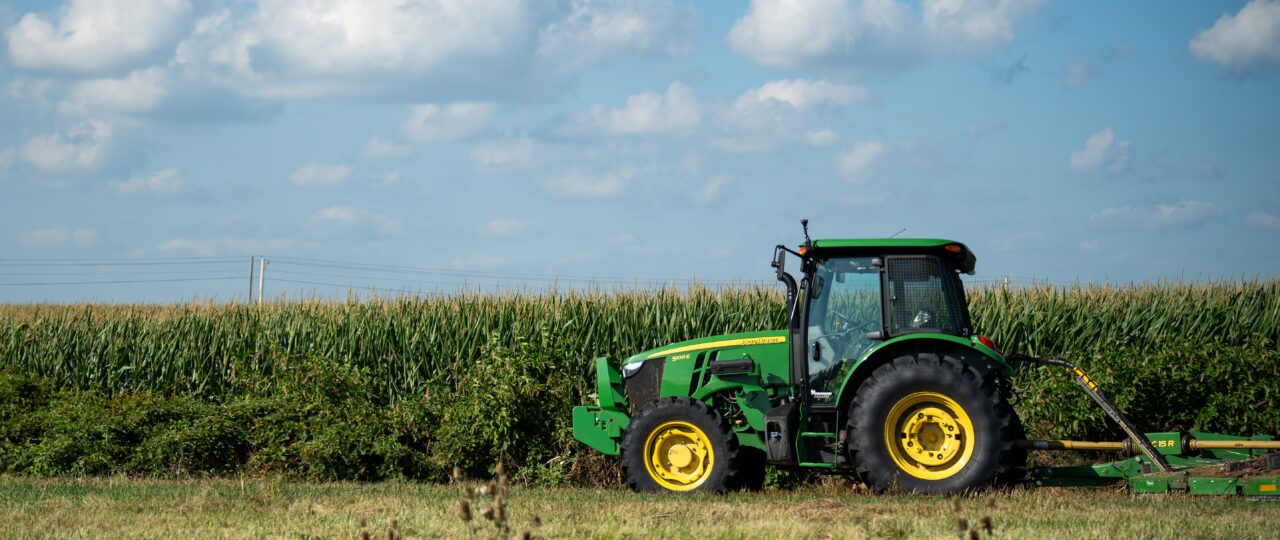

- John Deere’s AI assistant, unveiled in September, helps farmers analyze data quickly.
- JD is embedded in John Deere’s Operations Center, a digital farm management system.
- Farmers are warming to AI, but accuracy and data privacy remain concerns.
John Deere says its new AI assistant, JD, can do it in minutes.
The agricultural manufacturing company announced the tool in September at the Farm Progress Show in Iowa. JD is integrated within John Deere’s Operations Center, which is a digital farm management system that connects farmers’ field and machine data into one platform. Farmers can ask JD questions on their mobile devices, such as the best time to harvest based on past trends, or which sprayer covers the most acres per hour.
Melissa Neuendorf, the principal product manager for customer AI solutions at John Deere, told Business Insider that JD came about because farmers consistently said they were struggling to manage their abundant data.
“We’re now at a point where farmers have so much data that they have a difficult time finding the insights manually themselves,” Neuendorf said.
While smaller agricultural tech companies such as OneSoil, VisorPro, Arable, and AgZen are developing generative AI tools to give insights on specific equipment or crop metrics, Deere is among the first major agricultural-equipment makers to put a large language model AI assistant directly inside a platform that combines farmers’ field, machine, and operational data. JD’s launch shows how generative AI is becoming a central part of crop management.
“Prior to John Deere’s announcement, this didn’t exist in the industry,” said Matt Darr, a professor in the agricultural and biosystems engineering department at Iowa State University, who was in the room when Deere announced JD.
Why farmers are considering AI tools more than ever
Farmers have been collecting data for decades. But now, modern farm equipment is outfitted with additional technology and sensors, creating large volumes of data that are difficult to keep up with.
Neuendorf said dissecting vast datasets is complex and time-consuming, sometimes requiring weeks. That’s where AI can help farmers: “AI provides them the capability to do a lot of that analysis in minutes,” she said.
Before coming up with JD, Deere launched an AI tool last August that allowed farmers to ask questions in natural language about Deere’s help documentation and operator manuals. This replaced the manual task of farmers flipping through pages of operator manuals.
The tool received positive feedback, prompting Deere to broaden its application and launch JD to answer specific questions on the spot.
Farmers can input data into the Operations Center from non-John Deere equipment if they use machinery from other manufacturers. Then, if they query JD, it can analyze all of that data to deliver answers.
The Operations Center and JD are free to use, Neuendorf said. The AI assistant is available through an early access program, in which interested customers sign up for a waitlist and are considered for participation. John Deere will make JD broadly available in mid-November
Neuendorf told Business Insider that the feedback from farmers so far has been positive.
Neuendorf said she recently spoke to a farmer who was driving past a field and noticed it had lower weed pressure, or fewer weeds present, than other fields. Through JD, the farmer was able to open John Deere’s mobile app right away, ask the assistant about previous years, and understand how he managed the field differently.
Winning farmer trust in AI technology
A McKinsey global survey of 5,500 farmers, published in September, found that 72% expect generative AI to impact operations within five years, but only 17% use the tech right now.
One reason only a minority of farmers use AI is because they’re worried about data privacy and how their information could impact commodity prices, Darr said.
“These are competitive businesses,” Darr added. “How information is used can influence global markets and what happens to global commodity pricing.”
Katya Kheistver, the chief product and operating officer of OneSoil, an agricultural technology company, said farmers won’t trust AI if it delivers generic advice rather than insights tied to specific, real field data. Farmers often start their use of AI by checking the tech’s outputs against what they already know. The farmer “watches whether the answer lines up with reality,” and if it does so consistently, trust grows, Kheistver said.
JD meshes high-quality datasets with advanced LLMs, Darr added, which sets the AI tool apart and promises a high degree of accuracy.
Neuendorf said JD is configured to notify farmers when field data is missing, rather than making inaccurate assumptions or generating false advice.
This configuration also encourages farmers to input additional data, so JD can derive more insights and help farmers “make better decisions for the next season,” Neuendorf said.
Read the original article on Business Insider
Discover more from NAIRAVOICE.COM.NG
Subscribe to get the latest posts sent to your email.