
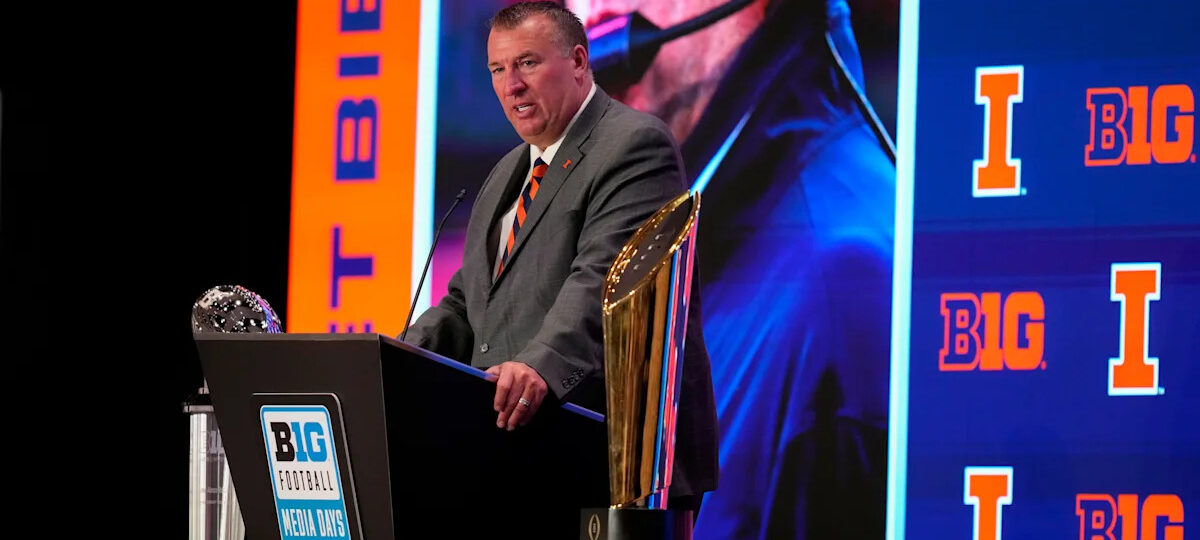

CHICAGO – It’s no secret college football doesn’t look the same as it did five years ago; however, for Illinois’ Bret Bielema and Josh Whitman, it’s a whole new ball game.
Bielema and Whitman spoke Tuesday at Big Ten Media Days about the ever-changing landscape of college football.
“NIL and revenue share,” Bielema said. “When those two things came into college football, everything changed.”
As programs across the country keep changing to respond to compensation, transfer portal movement, and revenue sharing, Illinois is entering the 2026 season embracing the new landscape.
“The rosters have changed because of those two components, the transfer rule and revenue share,” Bielema said. “It’s a different world.”
Bielema said comparisons between today’s game and previous eras have become increasingly difficult because of how fundamentally college football has evolved.
“I think anything that predates that is just a different time in college football,” he said.
The changes have also reshaped recruiting. With Illinois competing in the expanded Big Ten, Bielema believes the program now has a national reach unlike ever before.
“We’re able to go for any kid in the country,” Bielema said.
While some conferences have been slower to embrace the sport’s transformation, Bielema suggested others are trying to hold onto a model that no longer exists.
“They kinda wanna live in 2005 forever,” Bielema said in reference to the SEC.
NEW: Illinois’ Bret Bielema takes a shot at the SEC👀
“They want to live in 2005 forever.”https://t.co/UhNJxzzZXqpic.twitter.com/3FPmubTuZ6
— On3 (@On3) July 28, 2026
Illinois Athletic Director Josh Whitman echoed the need to adapt while discussing potential federal legislation to regulate college sports. While lawmakers continue to debate thoroughly on Capitol Hill, Whitman said Illinois is watching closely.
“We’re carefully monitoring how those changes are progressing through the bill,” Whitman said.
One of the most significant questions facing college sports is how schools will balance a proposed spending cap with unrestricted NIL opportunities funded by outside entities.
“If you want to talk about the cap, you also have to look at how we are managing the infusion of third-party money,” Whitman said. “You can’t raise the cap, and still have a lot of openness to outside money coming in.”
Whitman added that the Big Ten remains engaged in shaping whatever policies ultimately emerge.
“The Big Ten wants to be supportive of it,” he said.
Beyond compensation, Whitman also emphasized preserving flexibility for schools as discussions continue regarding scheduling and future governance.
“We want to maintain the ability to schedule the way we want to schedule,” Whitman said, adding that “there are other ways to get at those issues than federal law.”
Even with college athletics experiencing one of its most turbulent periods in decades, Whitman said Illinois is focused on continuing to build rather than becoming comfortable with recent success.
“There’s not an ounce of complacency in me, our coaches or our students,” Whitman said.
The growth of the Illinois program during the NIL era proves Bielema and Whitman’s points. It’s not the same sport as 10 years ago, and the Illini will try to continue that this Fall.
Discover more from NAIRAVOICE.COM.NG
Subscribe to get the latest posts sent to your email.