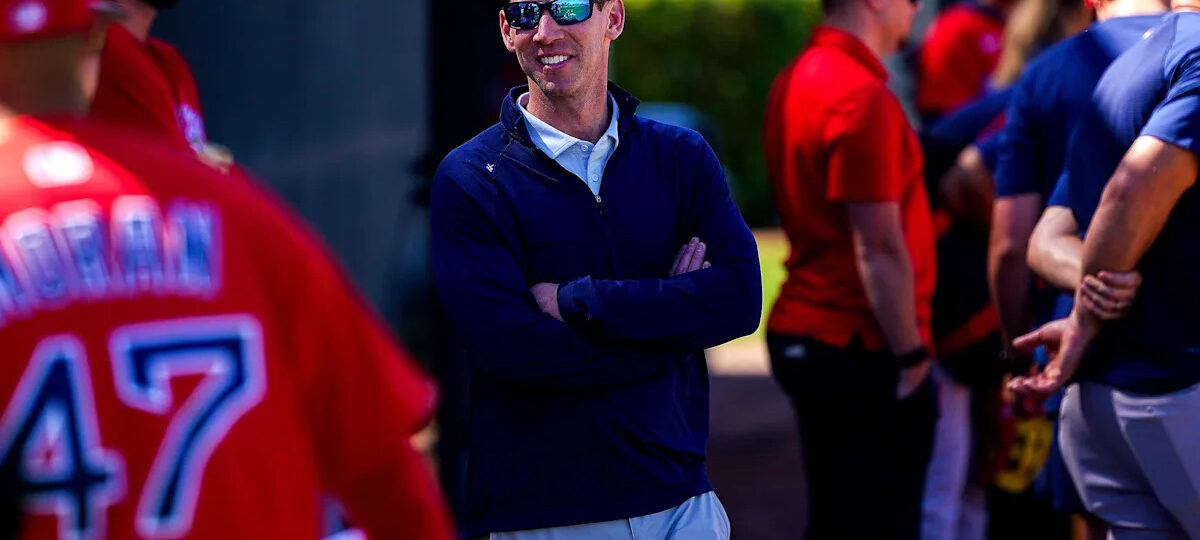
 Craig Breslow Chief Baseball Operator of the Boston Red Sox, right, looks on from his box during the game against the Minnesota Twins
For the next few weeks we’ll be doing some theorizing on optimal returns at the trade deadline as the Red Sox look to do another teardown amidst a hopeless season. Except the season might not be hopeless anymore.
The Red Sox swept the Yankees, then dropped all three at home to the Nationals—nobody is putting that one in the highlight reel—then went right back out and swept the Angels and the White Sox. And now the Mets. Now NINE wins in a row after yesterday afternoon’s victory in Queens, 17-6 in their last 23 games. 14-2 in their last 16. The standings now genuinely astound me; the trajectory of the 2026 Boston Red Sox has changed, and Craig Breslow has a decision in front of him that he probably didn’t think he’d have to make three weeks ago: does he stick to selling, or does he pivot?
Aroldis Chapman was supposed to be the headliner of the sale. Sonny Gray was supposed to be the prize contenders were lining up for. Willson Contreras was in that conversation too if this was going to be a true teardown. If Craig Breslow is pivoting to buyer mode—even lightly—all three of those conversations flip. You don’t trade your best arm, your most consistent arm in the rotation, and your thumping first baseman when you’re going for it. You keep them and find ways to add around them.
So what does Boston need? A middle infielder who can stay healthy first—this roster cannot absorb another injury to a key position. Another arm to soak up innings behind a rotation still missing both Connelly Early and Garrett Crochet, with Patrick Sandoval just making his debut in the series finale in Chicago. And bullpen reinforcement for when games actually matter. None of that is impossible, and all of it has a cost.

Houston has spent most of this decade being insufferable in the best possible way—winning the division, winning the World Series, winning everything—so it is genuinely satisfying to watch them look confused in 2026. Is this the definition of schadenfreude?
They’ve had three managers since the cheating scandal: AJ Hinch was fired within two months of the scandal breaking, just before the 2020 season got underway; Dusty Baker came in and turned them back into champions before riding off into the sunset after 2023. Now it’s Joe Espada trying to keep the lights on with what’s left. The core of that juggernaut has aged out or moved on—Jose Altuve experimenting with and failing in left field, George Springer landing in Toronto, Alex Bregman becoming a Cub (grumbles)—which means July gets interesting for a team with no clear direction. OK, Carlos Correa still has a +121 OPS coming back to Houston from Minnesota, whatever.
Jeremy Peña is the shortstop Jeff Passan links him to Boston in his deadline top 100, though not as a headliner—he appears as a name in the mix, not the centerpiece of a rumor. Worth knowing before you get too excited: Peña has spent real time on the IL each of the last few seasons, hamstrings mostly, a shoulder at various points. He’s the kind of player who doesn’t always make it through a full calendar without something going sideways. On a team that has already been doing lineup math with its middle infield (looking at you Mayer and Story, sorry), adding another guy who can’t stay on the field is the wrong move. The problem is that when he’s on, he’s a contact-hitting, elite base-running machine. His ceiling is high enough that you still make the call, but you go in with your eyes open.
Matt Chapman has emerged as one of the more intriguing position players in deadline chatter this summer—Heyman has him as a name to watch, contract and all. San Francisco is in enough turmoil right now that it’s worth paying attention to. The fit is clean: multiple Gold Gloves, real power (though that may be gone even with his incredible bat speed), proven in big markets. And then there’s the other part of this. The Red Sox traded Rafael Devers to the Giants. Buster Posey‘s team now has Devers. Boston could go right back to San Francisco and ask for their third baseman in return—which, when you say it out loud, is just kind of funny. We gave them our guy and then asked if we could have their guy. Incredible reversals for each franchise. Do it anyway.
The Sox were linked to both Matt Shaw and Nico Hoerner in the winter, but Hoerner just extended with Chicago—he’s clearly a piece the Cubs are building around. Does that push Shaw further down the depth chart and make him more available? It might, though the Cubs aren’t likely to sell any key pieces as they head to the playoffs.
—Minnesota Twins
Bringing Michael Wacha back to Boston would be kinda cute. He was a genuine workhorse here, the kind of arm that shows up every fifth day and doesn’t make your life complicated, and he’s been reliable again in Kansas City. A bulk arm who eats five or six innings, keeps you in games, and doesn’t need to be managed like a fragile artifact is exactly what this rotation needs right now, even with Payton Tolle and Jake Bennett holding down the fort. His offspeed changeup is one of the best pitches in baseball, a continued sign that an older starter found a way to stay valuable. The cost is low and the fit is obvious.
Joe Ryan is the more interesting call because there were real rumors last trade deadline that Boston was going after him and it never materialized. Minnesota would want a significant return, and Ryan has had his injury issues, but when he’s right he’s legitimately good. More to the point: Brayan Bello is in AAA. Tanner Houck just started mound work in his return from what has been a lengthy recovery. Kutter Crawford is doing whatever Kutter Crawford is doing in Florida to come back from his myriad maladies (it’s head, shoulders, knees and toes it feels like), and frankly, he’s becoming as much of an enigma as Houck. At some point, Breslow has to decide whether he’s waiting for these guys to come back and bolster depth, or whether he’s ready to win now with what’s in front of him. Ryan is the kind of acquisition that answers that question. He’s still an unquestioningly dominant pitcher, most Savant percentiles in the mid-80s to 90s: aka a lot of red.
Jack Flaherty will get some attention like he always does—his name has come up in every deadline cycle in the last few seasons—and he’s a veteran who knows how to start games and survive lineups. Brady Singer is the question mark, and that’s exactly the point. Andrew Bailey has been known to make champagne happen on a beer budget: find the right guy whose numbers don’t look like much in Cincinnati, put him in a different context, and squeeze what’s actually there. Brady Singer is an innings eater on a team that has no use for him right now. That can be useful for someone else. Though who knows if Singer’s Savant metrics—all pitches under the 7th percentile in value—leave room to squeeze anything out of.
Miami is a relief pitcher vending machine every July and this year should be no different. Anthony Bender, Lake Bachar, Pete Fairbanks, pick one or pick two—the Marlins will listen because the Marlins always listen. These are legitimate arms who can pitch in high-leverage situations without giving you a heart attack every appearance, and the cost is usually manageable because Miami is looking for depth and upside, not finished pieces. Bachar has an xBA of .198, Bender at .194—that’s legitimately impressive stuff.
Antonio Senzatela from Colorado is the one nobody is writing about (except for Passan in the top 100), which feels appropriate because the Rockies continue to go nowhere: an age-old tradition at this point. Senzatela has been better than his situation suggests. Pitching in Coors Field is hard; get him to Fenway and the numbers could look even better. His Savant still shows a good fastball with 91 run value and 88 velo!
Kirby Yates is the veteran late-inning option. The Brad Ziegler comparison comes up naturally, but it’s worth being specific: Ziegler came in 2016 because Craig Kimbrel was hurt and the back end of the pen needed emergency support. This is a completely different situation. Aroldis Chapman is healthy, is an All-Star again, and is already the anchor of this bullpen. Yates working in tandem with him would be a choice, not a patch job—two legitimate late-inning arms for a team trying to win games that matter. Yates has been effective in Anaheim—a WHIP of 1.00 suggests better stuff than his 3.35 ERA shows-and the Angels will listen. The question is whether Boston wants to pay for that or piece it together from the Marlins’ inventory. Both are defensible.
Of course, there’s another possibility. After a very mum deadline comes and goes, Breslow walks into his media availability—or joins the Zoom room—and explains that he believes in this group. That the lineup looks different when Roman Anthony gets back. That Crochet is on track. That the best moves Boston can make right now are the ones already happening inside the organization.
Every fanbase in baseball has heard this speech. Front offices give it every year when they’ve decided the asking price is too high, or the window isn’t open enough, or the prospect capital is too valuable to spend. September usually follows with the team finishing nine games out while the GM explains that the young players needed development time. This elicits such an eyeroll from this writer, but honestly, I could so see this happening with an ambivalent attitude towards the market in either direction come Deadline day.
The Red Sox have gone 14-5 in their last nineteen games and swept three consecutive series. The second half could be real. What none of us want is the version of this we’ve seen before—the team that enters the All-Star break with momentum, generates a deadline conversation, then spends August doing what Red Sox teams in recent years have done: fatigue sets in, stupid mistakes pile up, the mentality that carried them through June disappears somewhere around the end of July. Boston has very little time to show us whether this run is what it looks like. The deadline is the first real answer.
Discover more from NAIRAVOICE.COM.NG
Subscribe to get the latest posts sent to your email.