

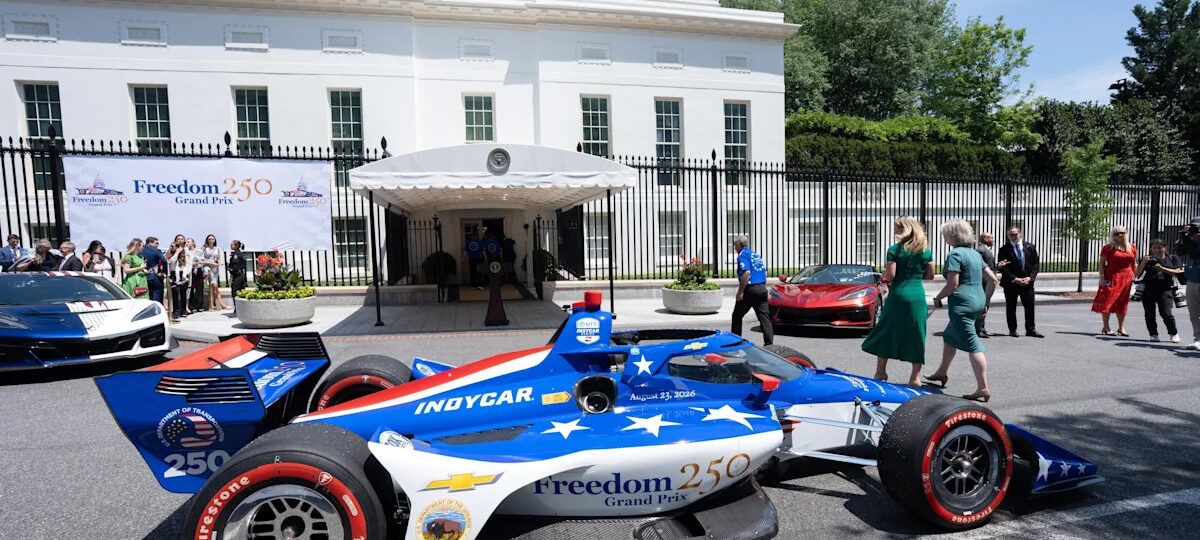

Something new is coming to the streets of Washington, D.C. this weekend.
An IndyCar race.
Back in January, the series announced a special, one-off race on the streets of the nation’s capital, the Freedom 250. Framed as part of the celebrations around the nation’s 250th anniversary, IndyCar will take to the streets around the National Mall, in a one-off event right in the heart of the city, and right in the heart of the schedule.
But how does a team prepare for an event like this, one that gets added to the schedule and presents a host of new challenges for the teams and the drivers?
To answer that question I sat down with three members of Arrow McLaren: Kyle Moyer, Scott Harner, and driver Pato O’Ward. Moyer is the team’s Director of Competition, while Harner is Arrow McLaren’s Director of Race Operations.
As for O’Ward, he is the driver of the No. 5 car, and one of the faces of IndyCar.
Here is what I learned about how a team, and a driver, prepares for a new race on the schedule.
When a race like this gets added to the schedule, there is a lot that needs to be done from a logistical standpoint.
Starting with some basic needs, such as how is everyone getting to this race, and where will everyone sleep?
“First call was our travel coordinator, Steffi [Downer]. She jumped on the detail piece of it, we were lucky enough to get a heads-up from the Penske Group as far as, you know, where things were going to happen, so we got to jump on that,” explained Harner.
“We have a great relationship with Republic Airlines that we charter with. The next call was to them so we could get arranged, being able to get in and out of there, so we could get it on their schedule. Those were really the first two key items to get checked so we can obviously have a place for everybody to stay because once something like that happens in whatever series you’re in, or whatever organization, it’s like when they drop something like that on the schedule, everybody’s diving for the same thing.
“It’s like, ‘oh, we all need rooms, we all need a way to get there’ and all that kind of stuff, so that was obviously a number one.”
After travel and lodging was secured, next on the Arrow McLaren to-do list?
Making sure everyone can eat.
“I’ll tell you what, one of the most unique things which came a little later was the fact that hospitality units, there’s no space for them. We have a caterer who takes care of, quite a few of the teams. She doesn’t have a spot to go, so that was basically like, ‘okay, what are we gonna feed everybody?’
“Penske Group, they have a relationship with a major caterer that we have to work with that’s gonna be the only one allowed to basically feed everybody.
“It seems elementary and basic, but you can’t just walk off and go get a burger, you know what I mean?
“We have to be able as an organization to be able to take care of our people, whether that’s food, like we’ve talked about logic, travel, all that stuff. It’s just the basic things that I guess you just kind of take for granted, when you just go to a race, but when we’re all coming in from out of town and everything else, it’s just trying to get those things covered, just making sure they are covered.”
There is one more component to this race weekend in Washington, D.C. that Harner and his team needed to prepare for.
The security aspect.
That meant clear backpacks for the team, and making sure every box was checked from a security standpoint.
“D.C. in itself is hugely unique to security and all the things that are gonna play into that as far as transport or parking. Getting in and out,” described Harner.
“I mean, simple things just like carrying your backpack in. That’s gonna be painful, you know? We’re getting everybody clear backpacks to meet the rules for getting in security-wise. And even Sunday is going to be worse than Friday and Saturday because Secret Service is taking over Sunday, which is going to be a whole other level of security for everybody.”
Then there is the matter of the race itself.
When IndyCar announced this race in January, it dropped a new stop on the schedule into the heart of the late-season push, turning what was a stretch of four race weekends in the month of August into a five-race stretch.
That puts a lot of pressure on a team.
Moyer is Arrow McLaren’s Director of Competition. While he laughingly described his main task as making “sure everybody shows up at the track,” he is responsible for “connecting all the dots, logistically wise, car-build wise, and engineering-wise.”
He outlined for me what is going to be tough for Arrow McLaren and the rest of the teams this weekend in Washington, D.C.
“This is a unique situation here more than anything,” described Moyer. “You’re in the middle of a five-race weekend in a row, with a new race that you’ve never been to, at a facility that you’ve never been to. And you just put that there and go ‘okay, well, that’s tough enough.’
“But then you say ‘okay, now it’s in the middle of Washington, D.C. security wise,’ it brings in a whole different aspect to the thing.”
There is another “different aspect” to this race.
The teams, and drivers, have never seen this track before.
The circuit winds around the National Mall, starting on 3rd Street SW, right by the Capitol Building. Drivers will make a left-handed turn on Pennsylvania Avenue, rocketing up to 9th Street NW, where they will make a left-handed turn and go one block before making another left, onto Constitution Avenue.
Then comes a right onto 7th Street, NW, then a left onto Independence Avenue, and then a short jog on Maryland Avenue before they turn back onto 3rd Street and return to the start/finish line.
You can see the course map here:

After walking through some of the challenges, Moyer then said this to me when we talked.
“Then you get to the actual track itself.
“We’ve never seen it.
“We’re running it in the simulator now, the drivers are running it in the simulator, but we don’t know [what to expect]. It’s a bit of a guessing game.”
Even the simulator can only do so much. As Moyer pointed out to me, with preparations still being made, it is hard to get a feel for each corner.
“When the walls, especially when it’s narrow, the concrete walls are usually painted as white. And then they come back and they put a little bit of color in them once you get to the racetrack,” described Moyer. “But as you’re sitting in that [as the] driver, you don’t see anything above the walls. They don’t see the fence, when they look down the straightaway, they see black asphalt and they see a wall or a stack of tires at the end.
“So, that’s what they see in the simulator.
“So trying to pick out where your turn points are and stuff like that, over the years, you say, ‘okay, here’s a bridge I’m gonna use. I’m gonna brake two feet after the bridge. I’m gonna turn at this corner or this curve has a black mark on it, or there’s a little bit of an entryway for a safety truck or something like that,’ they pick those things out.
“Right now we don’t know where exactly all those are, so right now it’s a little bit harder.”
Then there is the matter of the track surface. As I chatted with Moyer, I got to ask him a question I’ve never been able to ask before. While I’ve walked on some tracks such as the Miami Grand Prix or Circuit of the Americas, I’ve never driven on those.
I’ve driven these roads. They’re rather bumpy in the family SUV, so I wondered what the teams expect this weekend in D.C.
While Moyer outlined how Arrow McLaren had sent team members to check the surface, and stated that the team put it in “one of our medium track street courses” in terms of how rough and bumpy the surface is, they will not know for sure just how the surface will handle until the cars are running.
And the bigger question is this: Where will those bumps be?
“We’ve never been there, so all of a sudden, where are those bumps gonna play out?
“Is it in the braking zones?
“You might have one corner where it’s in the braking zone. You might have one where it’s an acceleration or in the middle of the corner, or if they’re just down the straightaway like Arlington, you really don’t care about them.
“So it’s just a matter of where do they show up.”
And while the simulator helps, nothing prepares you for a race more than driving the circuit itself.
Just ask O’Ward.
“I think it comes down to preference a little bit, and the simulator, in my opinion, the simulator isn’t where it needs to be for you, for you to go do it, see it, experience it, and then go to the track and expect the same thing,” described the Arrow McLaren driver.
“It’s never the same, and I like to arrive there and just feel it out in real life rather than, kind of have a set expectation of what it’s gonna be and then be like, you know, this is not what I remember it being.
“So, yeah, I think those simulators are overrated.”
As each conversation wound down, it ended in the same matter.
Shortly after 1:00 p.m. on Sunday afternoon, the checkered flag will wave, and every driver on the starting grid will have one goal.
Winning this one-of-a-kind race.
Add in the fact that the Freedom 250 comes at the end of the season, as some drivers are trying to put their best foot forward for a spot on next year’s grid, and you have the potential for, well, “mayhem,” as Moyer described it.
“My personal opinion, I sort of feel like putting the street race this late in the season when guys are not worried about points, guys aren’t worried about what’s happening for next year. All they wanna do is do good this year because they don’t have a ride or they’re trying to get a ride.
“So mayhem comes out of that a lot more,” said Moyer.
“And I think that’s what’ll happen here a bit, to be honest.
“And then at the same time, it’s a track you never come back to. Got one shot at this to have some fun.
“And so it’s gonna be, I would say, messy.”
Moyer does believe that those factors will make for a great day for the fans in the stands.
“I think that probably from a fan’s point is gonna be great because it’s gonna be nothing but action and some banging and everything. And they’re gonna see how an Indy Car can bang just like everybody else.”
In addition, IndyCar recently announced that the race distance has been extended to 250 miles, adding several more laps and a potential extra pit stop.
“Then the last factor you put in is that it’s a 250-miler,” added Moyer. “We’ve never done a street race like that, that long, most likely four stops, if you’re having a good day.
“So you put all that together on a weekend that’s shortened by a day, and again, we’re all excited about it, but it is a unique situation.
“It’ll never happen again.”
Because of that, this is a race that every team and driver wants to win.
“Obviously, you know, selfishly, no different than every other team in the paddock. That’s gonna be a one-and-done trophy,” described Harner. “Everybody wants that one, you know what I mean?
“Winning the race would be special, as an organization.”
One of the drivers with a chance to do just that agrees.
“I’m sure it’s just going to be that spectacle, that magic that you also experienced at the Indy 500,” said O’Ward to me about the Freedom 250. “It’s gonna be one of those one-offs, and that is truly gonna be remembered for many years and for decades really, because I don’t think it’s gonna happen again.
“I think it’s a one-and-done.
“So yeah, wanting to get that winner’s trophy, which I’ve heard looks crazy and super cool, I’d love to be, you know, raising that one up at the end of Sunday.”
O’Ward will get his chance to do just that later this weekend.
Along with the rest of the IndyCar grid.
Discover more from NAIRAVOICE.COM.NG
Subscribe to get the latest posts sent to your email.