Sixth in a series of Rockets player previews ahead of the 2026-27 season.
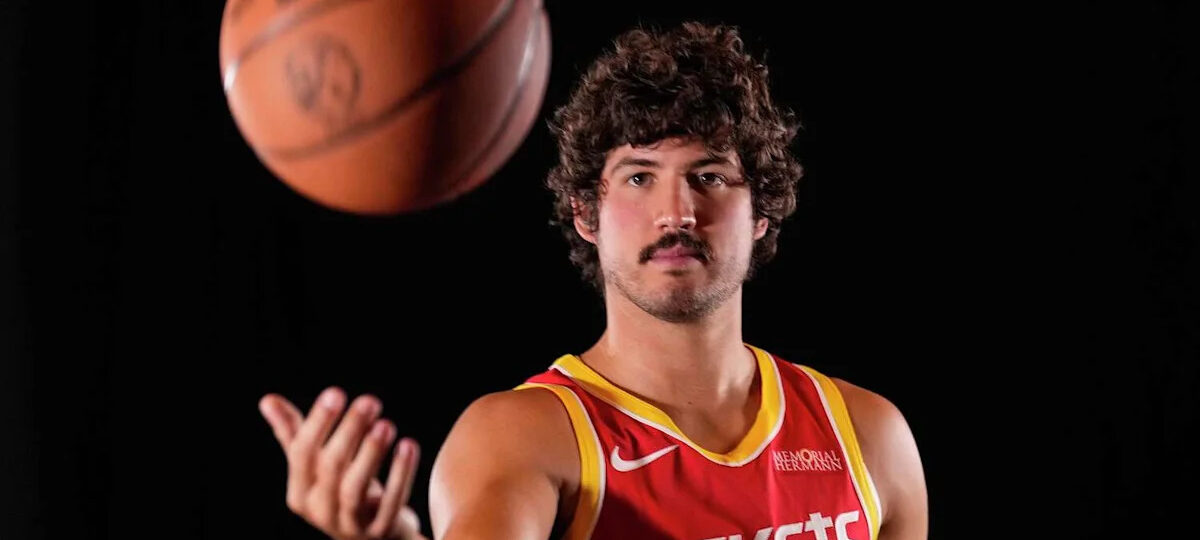
Reed Sheppard joined a different Houston Rockets team than most of his peers.
Most of the Rockets other first-round draft picks joined bad teams with low expectations and plenty of chances to make and learn from mistakes. The year before Houston selected Sheppard with the No. 3 pick, the Rockets won half their games. In his rookie season, the Rockets won 52 games and had less inclination to allow a 20-year-old guard to find his way – Sheppard spent parts of the year in the G League.
Whatever role he was expected to have entering his second season multiplied after Fred VanVleet tore his ACL on the eve of training camp last September.
With responsibility thrust upon him on a team with championship aspirations, Sheppard was imperfect, inconsistent and ultimately impressive.
He played all 82 games, starting 21, and was fifth on the team in minutes per game. He acquitted himself well, averaging 13.5 points and 3.4 assists per game with an effective field goal percentage (which adjusts for the added value of 3-pointers) in the 72nd percentile among combo guards, per Cleaning the Glass.

Houston Rockets Head Coach Ime Udoka talks with Houston Rockets guard Reed Sheppard (15) during Game 5 of a first-round NBA playoff basketball series against the Los Angeles Lakers at Cyrpto.com Arena in Los Angeles on Wednesday, April 29, 2026. Houston Rockets won the game 99-93 and will head back to Houston for Game 6. (Elizabeth Conley/Houston Chronicle)
Without VanVleet, Houston often turned to Sheppard as its point guard – he handled the ball at the second-highest rate when on the floor among Rockets who played at least 500 minutes, per DataBallr.
This came with growing pains. Sheppard wasn’t as dangerous a passer as VanVleet and didn’t limit turnovers like the veteran point guard, but he did replicate VanVleet’s ability to threaten defenses with a pull-up 3-pointer.
Sheppard’s shooting – his best trait entering the league – remained so. He led the team with seven 3-point attempts per game and shot 39.4% on them, offering much-needed spacing to an otherwise cramped Rockets offense.
Houston won Sheppard’s minutes by 3.9 points per 100 possessions when adjusting for 3-point variance, per DataBallr. But the Rockets won the non-Sheppard minutes by 6.4 points per 100 possessions – largely a product of improved rebounding on both ends without him on the court.
Sheppard struggled staying in front of his defensive assignments at times, with opposing teams at-times building their offense around targeting him. That was especially a problem when he was paired with center Alperen Sengun, a below-average defender at the rim. With both of them on the court together, other teams scored a lot.
Still, it was a promising second season, especially considering the responsibilities Sheppard shouldered. The predictive advanced metrics DARKO and EPM, which used on-off, box score and tracking data to estimate player performance, put Sheppard in the 84th percentile among guards and the 69th percentile among all players, respectively.
With VanVleet back, Sheppard will come off the bench next season. He’ll still have some point guard duties but will more often play off-the-ball, giving Houston a dangerous shooter who impressed in training camp with his ability to move around the floor and break down a defense.
Where does Sheppard slot in the rotation? He averaged 26.2 minutes per game last season. That should go down with VanVleet back and Marcus Smart on the roster.
Does Sheppard lead Houston’s bench in minutes? Or does coach Ime Udoka turn more to Smart, a strong defender and veteran point guard? Does Sheppard’s play demand increased playing time? Could the Rockets try to limit the regular season burden and injury risk for VanVleet and Smart by giving Sheppard more run?

Los Angeles Lakers forward LeBron James (23) knocks the ball away from Houston Rockets guard Reed Sheppard (15) during the second half of Game 3 of a first-round NBA playoff basketball series at Toyota Center in Houston on Friday, April 24, 2026. (Jason Fochtman/Houston Chronicle)
One where he makes Houston feel comfortable about making him the team’s point guard of the future. General manager Rafael Stone said at the end of last season that he expects Sheppard to be a really good starting point guard. There could be an opening at the position with VanVleet on an expiring contract.
The path for Sheppard to get there involves a few different steps. He’ll need to improve to being a solid defender. He’ll need to improve at attacking defenders off the dribble, creating space to either score or find teammates. He’ll need to be better at organizing a team’s offense, calling plays and knowing the flow of the game. And finally, he’ll need to take the next step as a shooter – from excellent to lethal.
Discover more from NAIRAVOICE.COM.NG
Subscribe to get the latest posts sent to your email.