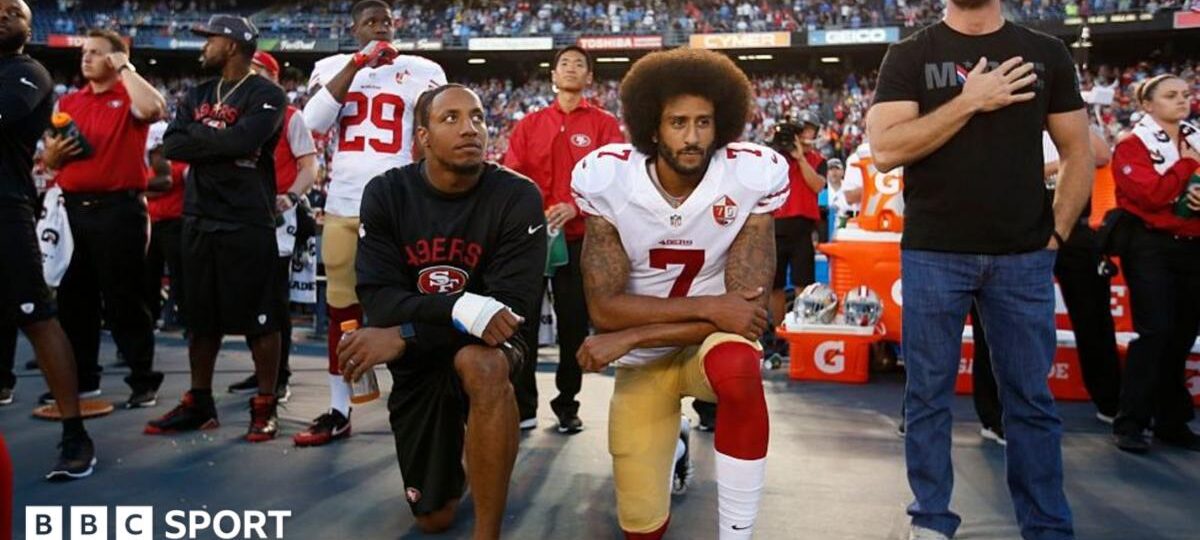
Ten years on from making the gesture that catapulted him to iconic status, but which he believes led to his exile from the sport he loved, Colin Kaepernick insists he has no regrets.
It was September 2016 when NFL star Kaepernick knelt during the US national anthem before a match as a peaceful protest against racial injustice and police brutality.
It proved both inspirational and divisive.
In his first interview with BBC Sport since then, Kaepernick reflects on his journey; his pride at seeing England footballers take the knee, athlete activism, the relationship between sport and politics, and the price he paid for being a figurehead for the civil rights movement.
“I knew the protest could potentially cost me my career,” he says. “History shows us…that is a reality for athletes.
“We also see this in broader movements, going well beyond costing someone their career, and costing people their lives. We see Malcolm X assassinated, we see MLK [Martin Luther King] assassinated, so the consequences are real.”
Having initially sat to protest against the plight of black people in the US, Kaepernick first knelt during the Star-Spangled Banner before his San Francisco 49ers team played a pre-season game. It was an act he would repeat before 11 regular-season contests that year.
At the time, he said he could not stand up for – and show pride in – a flag “for a country that oppresses black people and people of colour”, adding: “This is bigger than football and it would be selfish on my part to look the other way.”
His stance against racial inequality was seen as heroic by many, inspiring other NFL players to follow suit. But there was also condemnation from those who said it was disrespectful to the military.
Those dissenting voices included Donald Trump – then a presidential candidate.
Trump described the act as “a terrible thing” and unpatriotic. He even suggested Kaepernick should find another country to live in, adding players who refused to stand for the national anthem should be fired.
The NFL said it would fine teams whose players did not stand.
Kaepernick opted out of his contract with the 49ers in March 2017, though the club’s management later said he would have been released regardless.
Despite leading the 49ers to the 2013 Super Bowl, and throwing 16 touchdowns in his final season, one of the most talented quarterbacks in the sport never found a new team.
Speaking from New York, Kaepernick says he anticipated the reaction to taking the knee. “What I couldn’t have predicted was the people who would show up for me in significant ways, and also the people who worked against me and against the movement,” he adds.
Kaepernick eventually filed a grievance against NFL team owners, who he believed had conspired not to hire him because of his protests, reaching a financial settlement in 2019.
That year, the NFL arranged a private workout for Kaepernick, but he chose not to attend, instead holding his own session elsewhere to allow media to be present.
The NFL later admitted it was “wrong for not listening to players earlier”, and encouraged “all to speak out and peacefully protest”.
 Image source, Getty Images
Kaepernick first took the knee in protest in September 2016
‘Humbling to see England players take knee’
Following the murder of George Floyd while in police custody in Minneapolis in 2020, taking the knee became a feature of Black Lives Matter protests, and widespread across sport.
England’s men’s and women’s football teams were among those to follow suit.
“That was a surprising moment for me,” says Kaepernick.
“I did think about the protest going beyond the US and how that may show up in other countries. To be able to see the national teams going out and protesting, it was humbling. I was happy that they were doing it.
“I also know there’s still a lot of work to be done within racism in the UK and more broadly. And this is a global challenge that we are collectively fighting against.
“I was very excited to be able to see players actively calling that out, and willing to begin taking action towards addressing it.”
Despite keeping a relatively low profile for most of the past decade, Kaepernick remains a standard-bearer for the civil rights movement.
But while surveys suggest the vast majority of professional athletes intend to use their social media channels to raise awareness about racial injustice, external, he accepts the momentum behind athlete activism seems to have slowed in recent years.
It was notable that several players across five clubs chose to remain standing when Premier League players took the knee as part of October’s No Room for Racism campaign.
Anti-discrimination campaign group Kick It Out told BBC Sport the gesture “still has value in raising awareness of the structural inequalities that exist in football and society”, but added it could “understand the reasons players might become frustrated with the pace of change”.
Reports of discrimination received by the charity more than doubled in the past five years, reaching record levels last season.
“I think we’re in a moment that demands protests more than ever,” says Kaepernick.
“Why I think protests are not as loud right now [is] because of the concerted efforts that have been taken by organisations like the NFL, like the Trump administration, and corporate entities following along and capitulating in that process.
“While those things are happening, I think the reality of the state of the US, and more broadly the world, demands that we show up in a more significant way.”
‘Politics inherently part of sports’
 Image source, Getty Images
Despite backlash, Kaepernick repeated taking the knee before 11 regular-season NFL contests
Kaepernick is all too familiar with how polarising it can be to take a political stand in sport.
Opponents of taking the knee have claimed it is a political and divisive statement, and that rather than demonstrating backing for the Black Lives Matter movement, it has shown support for the organisation of the same name.
In 2018, critics encouraged people to destroy Nike goods after the sportswear giant used Kaepernick as the face of an advertising campaign featuring the caption ‘Believe in something. Even if it means sacrificing everything.’
So what does he say to those who argue that sport and politics should be kept apart?
“They ring hollow and feel very hypocritical, because politics is inherently part of sports,” he says.
“We see within [American] football, we see taxpayers funding NFL stadiums. We see our NFL owners going out and supporting political candidates… so to try to position this as if sports aren’t political, in many ways feels just laughable to me, and disconnected.
“Now, where the question comes in for people is: ‘We don’t want the athletes to be political. Everything around them can be political, but the athletes themselves, we don’t want them to have a voice in the politics, because that interrupts our entertainment and our ability to disconnect.’ For me, that’s where society has a challenge with it.”
Having encountered significant opposition from high-profile athletes during his first term, Trump seems to have encountered less challenge from the world of sport during his second, notably becoming the first sitting US president to attend the Super Bowl.
He has also appeared at golf’s Ryder Cup, and the finals of football’s Club World Cup and World Cup, though he was also booed when attending the NBA Finals in New York in June.
“It ties into the conversation of ‘are sports political?’ when he is going out and actively trying to use them to gain favour and popularity”, says Kaepernick, adding that Fifa’s controversial decision to award the US President its inaugural ‘Peace Prize’ last year was “regrettable”.
“The part that I think is great to see is when he’s showing up to these events and getting booed by the crowd, which speaks to the political environment that he’s created, that the majority of the country does not agree with…when it comes to sports, people need to continue to respond accordingly.”
‘We have a lot of work to do’
Now 38, Kaepernick has published a memoir titled The Perilous Fight, detailing his childhood in California having been adopted by a white family, encountering racism, and his education and evolution. “People saw the moment. But they didn’t see the years that made it possible”, he says. “The questions about who I was; the injustices I could no longer ignore; the voices of those who came before me that I carried into that stadium…When I took a knee, it wasn’t a sudden act. It was the result of years of becoming.”
So how did he find the process of reliving his journey?
“Are there moments that are challenging going back to? Yes. But I hope that insight helps other people navigate situations…that helps them move forward or helps them to go accomplish things.”
Kaepernick also supports community organisations via his Know Your Rights education campaign, is a philanthropist, and has written a number of children’s books.
Even now, he maintains the fitness regime he had during his time at the 49ers, just in case an unlikely opportunity to resume his NFL career arises.
Kaepernick may not have thrown a ball in anger for almost a decade, but he is widely regarded as one of the most significant athletes in modern history.
The way he used his platform to promote change has been compared to legendary boxer Muhammad Ali’s support of the anti-war movement, and US athletes Tommie Smith and John Carlos giving the Black Power Salute at the 1968 Olympics.
“To even be in the same conversation with the likes of [them], is extremely humbling,” he says. “But more importantly, I just try to stay focused on the work.
“What can we do to help people? And how do we collectively move forward as a society? And, ultimately, how we build a society that works for everybody. That feels like a very simple principle that has been lost.
“I know in the US specifically, we have a lot of work to do there. I hope we begin taking the steps to get back to a place where we are actually addressing people’s needs. And create a society that is equitable for everyone.”
Additional reporting: Pat Nathanson
Related topics
Colin Kaepernick – “I would absolutely do it again”
Discover more from NAIRAVOICE.COM.NG
Subscribe to get the latest posts sent to your email.