

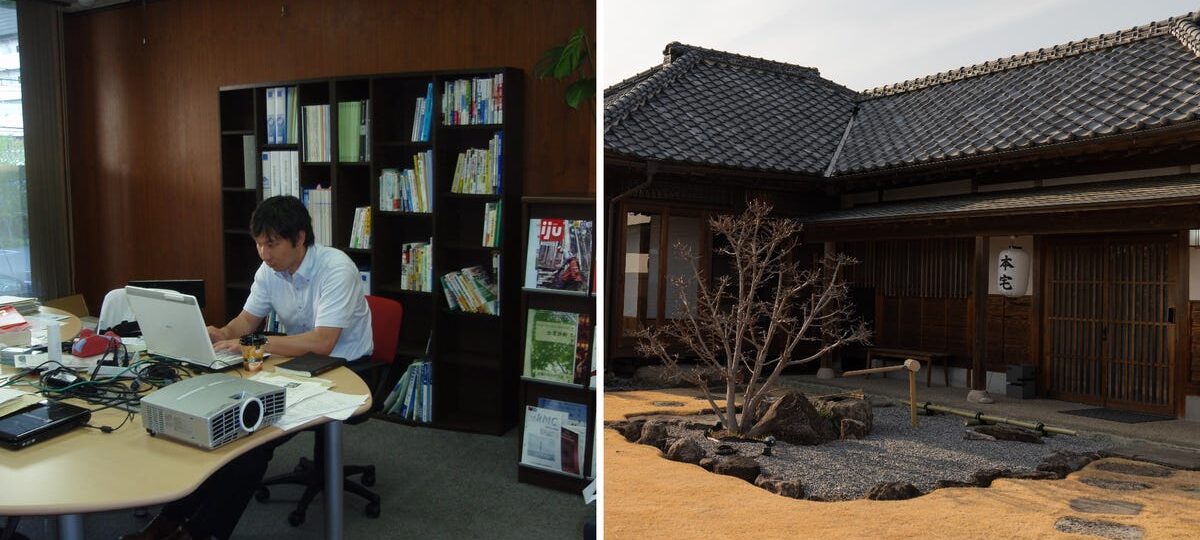
This as-told-to essay is based on a conversation with Daisuke Fujii, the cofounder of Farm & Firm Company, a Japanese consulting firm that helps farmers and rural communities generate new income through agritourism, hospitality, and business development.
It’s been edited for length and clarity.
I grew up in Saitama, about 20 miles north of Tokyo.
In elementary school, I discovered a love for all things space- and engineering-related, like planes and satellites.
At 14, I decided I wanted to be an engineer, but as one of five children, my parents couldn’t afford to pay for college.
I was accepted into the National Defense Academy of Japan, which not only had an aerospace department but also offered free tuition.
They even paid me a small amount each month, so I didn’t have to rely on my parents at all.
In 2001, a few years after graduating, I enrolled in the aerospace engineering program at the University of Texas at Austin.
While studying abroad, I worked as a research assistant, earning free tuition and a small salary.
From Texas, I saw how cities all across the United States were growing thanks to venture capital companies.
In Japan, the only cities that were growing were Tokyo and Osaka, everywhere else was seeing a population decline.
I didn’t realize it at the time, but this had a profound effect on me.
After graduating in 2002, I returned to Japan to work as a plane engineer, but due to a lack of funding, I pivoted to the automotive industry in 2004, which had ample research funding.
At a Japanese automaker, I led a major project and earned my Small and Medium Enterprise Management Consultant (Chusho Kigyo Shindanshi) certification.
Only about 4% of applicants pass the exam.
The credential is highly valued in Japan.
When I pitched a business idea to executives across several departments, they all told me it wouldn’t succeed, but I believed in it.
To me, the company had become stuck in the past, so, with my certification in hand, I decided to quit and start my own business.
I wanted to build something outside Japan’s major cities and create the kind of business clusters I’d seen in the US.
At first, I looked at aerospace, but there wasn’t enough demand to support a new business.
Instead, I turned to an industry that already existed all across Japan: agriculture.
In 2009, I founded Farm & Firm, where I worked as a consultant for farmers looking to build their own brands and sell directly to consumers.
The business expanded into food manufacturing, and I even started a farm-to-table restaurant, Shimotsuke Noen.
By 2011, the company had 10 employees, and I was supporting both private and government entities.
We now have 80 full-time employees.
That same year, the local government of Otawara City asked the company to pitch for a commissioned project on agritourism in the region.
I’d never worked in tourism before, but as I had connections with the farmers, we looked into the concept of farm stays.
Convincing the farmers took a lot of effort.
They didn’t think anyone would want to come and stay in their homes or that the local area was “worthy of tourism.” In an effort to change this way of thinking, I started Ohtawara Tourism.
I wanted to highlight the beauty of rural Japan’s everyday life We started working with group trips, mainly for students from Japan, staying at farms in and around Otawara.
The next challenge was to encourage farmers to invest in renovating their properties to elevate and expand these trips.
Luckily, an opportunity presented itself that would allow us to set a great example.
Nakagawa, a small town near Otawara City, reached out to me about an akiya — an empty home — that had belonged to a prominent local family.
It had sat vacant for years, so I transformed it into Iizukatei, a boutique hotel.
I had two goals when I took on this project.
Firstly, I wanted to draw tourism into this rural town, especially tourism from independent travelers.
Secondly, I wanted to change the locals’ way of thinking and show them that these locations and their old buildings have a lot to offer visitors.
Before the renovation, 10 to 15 international tourists visited the town each year, but now we are seeing between 400 and 500.
Because of this, more farmers are renovating their properties to turn them into real farm hotels.
The hotels have great potential, especially for farmers struggling to earn enough from agriculture.
Agritourism offers them a new stream of income and a way to keep Japan’s rural culture alive.
Changing careers was the right decision.
From junior high onwards, I had spent 15 years pursuing a single dream: to design aircraft.
Even though I fulfilled this dream, I pivoted because I believed I could make a greater contribution to society through entrepreneurship.
My career as an engineer and project manager taught me to tackle complex projects with a diverse team, to look beyond conventional assumptions and find new solutions through experimentation.
These skills have remained invaluable.
Entrepreneurship has given me opportunities and experiences I’d never have had as a salaried employee.
It’s allowed me to live according to my values and find my purpose.
Discover more from NAIRAVOICE.COM.NG
Subscribe to get the latest posts sent to your email.