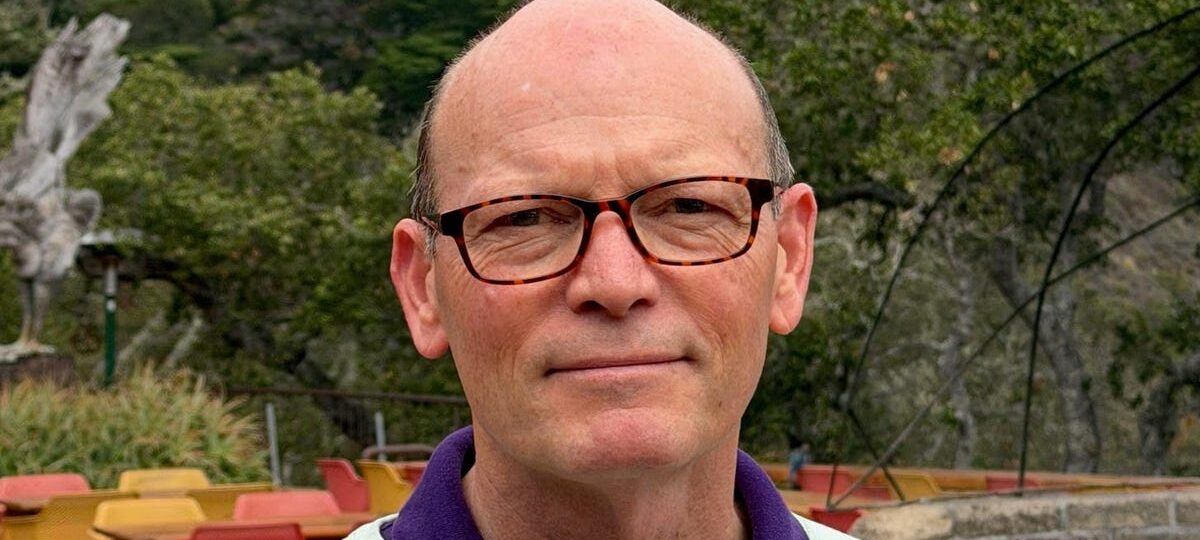
This is an as-told-essay based on a conversation with Kirk Gafill, an owner and general manager of Nepenthe, a restaurant on California’s Big Sur coast that is under an evacuation order due to the Timber Fire.
Gafill is also the president of the Big Sur Chamber of Commerce.
This story has been edited for length and clarity.
I live on property at Nepenthe, but when I first became aware of the fire on Saturday, my wife and I were at our home in Monterey Bay, where we often spend weekends.
Every fire makes you sit up and pay attention, but I was hoping it wouldn’t be very impactful and that it might take care of itself.
By mid-morning Sunday, I went down to Nepenthe.
We had very good visibility and could see that the fire was pretty active, and the air attack, or planes fighting the fire.
When a tree goes up, it’s like a Roman candle.
When the evacuation orders started coming on Sunday evening, we began to treat it as a full-blown threat.
We have workforce housing with about 30 units, so when the mandatory evacuation came in, we communicated with our staff, and most of them relocated temporarily.
Myself, my son, and a small handful of employees have stayed on the property or have been driving in, providing facility security and maintenance, and continuing preparation in the event the fire takes a turn for the worse and comes closer to us.
Every day we’re not open this time of year is a $65,000 to $70,000 loss in sales.
We are in a wait-and-see mode and evaluating when conditions will improve to the point we can reopen for guest service.
In this situation, information is the gold standard.
The first thing you want to know is how threatened you are.
Official information, particularly in the first 72 to 96 hours, is often extremely delayed, incomplete, or inconsistent.
We’re in a heavily forested area and have been through a lot of fires.
We can go a decade or more without a significant fire, and then you can have two or three years of them in a row.
We just don’t know when the “when” will be.
We do year-round fire prevention and mitigation work.
But you always find something that you haven’t done as well as you could have.
We’ve been reevaluating where grasses may have grown up in our defensible space, checking to make sure we don’t have leaf litter building up in any of our eaves or gutters, and examining all of our structures to ensure there aren’t flammables stacked up against the walls or nearby.
We have fire hydrants around the property, so we’re also making sure they have wrenches so if someone needs to attach a fire hose and use it, the wrench is there to open and close the hydrant.
If the fire becomes too intense or puts any of our staff at risk, we’ll have to walk away.
To the extent we can safely do so, we’re trying to be here to complement and support the efforts of fire services.
As a restaurant, we’re also running up against a significant amount of perishable food that we want to find a home for before it spoils.
Even though we’re not open to the public, our chef is triaging our food stock to provide to food banks or to create meals on the fly for first responders.
You try to make the best use of the time, not be caught up in the anxiety of it all, and also manage your own mental and physical health and get enough rest.
That’s always tough in the first 48 hours.
You also have to continue to reevaluate your risk management.
How long is it safe to be in an area that’s deemed to be so dangerous that you’re under mandatory evacuation?
Every day we are unable to open is a huge loss of income for employees and the business itself.
We are doing what we can to ensure we can reopen effectively and resume guest service at the earliest opportunity.
We’re in this constant balancing act of how do we deal with our perishables?
How do we handle our staffing commitments and be ready to open tomorrow if the evacuation order is lifted?
The bigger impact will depend on whether our business insurance, which should kick in after the first 48 hours and last up to 28 days, covers the losses.
This event would seem to meet the necessary stipulations, but with insurance, you never really know.
If that insurance is not applicable, it will have a severe economic impact, the severity of which depends on how long this lasts.
We’ve got Highway 1 as something of a firebreak, so right now we’re not nearly as at risk as a number of other locations, but even if a fire doesn’t impact us directly, there are indirect impacts.
On Tuesday, part of the highway closed.
That effectively shuts down our guest operations.
We’re keeping our fingers crossed that this will be measured in days, not anything longer.
One thing we feel confident about is that once highway access is restored and we’re no longer dealing with evacuation considerations, business levels will rebound very quickly.
Big Sur is still stunningly beautiful, even with the fire slopes.
In the early days, you can’t help but see the black, charred slope contrasted against the unburned, green vegetation.
But this is a very suitable landscape for quick recovery from fire.
The slopes will regrow to the point where two months from now we’ll have visitors saying, “I heard there was a fire.
Where was it?” As you get closer and closer to the point where you’re making really hard decisions, your anxiety gets pretty high.
You just try to keep calm, make the best decision you can, and make sure whatever decision you make doesn’t imperil somebody else.
And if you have to make the hard decision one way or the other, try to err on the side of safety.
You can always come back and rebuild if you have to.
You don’t want to endanger yourself or someone else.
Discover more from NAIRAVOICE.COM.NG
Subscribe to get the latest posts sent to your email.