
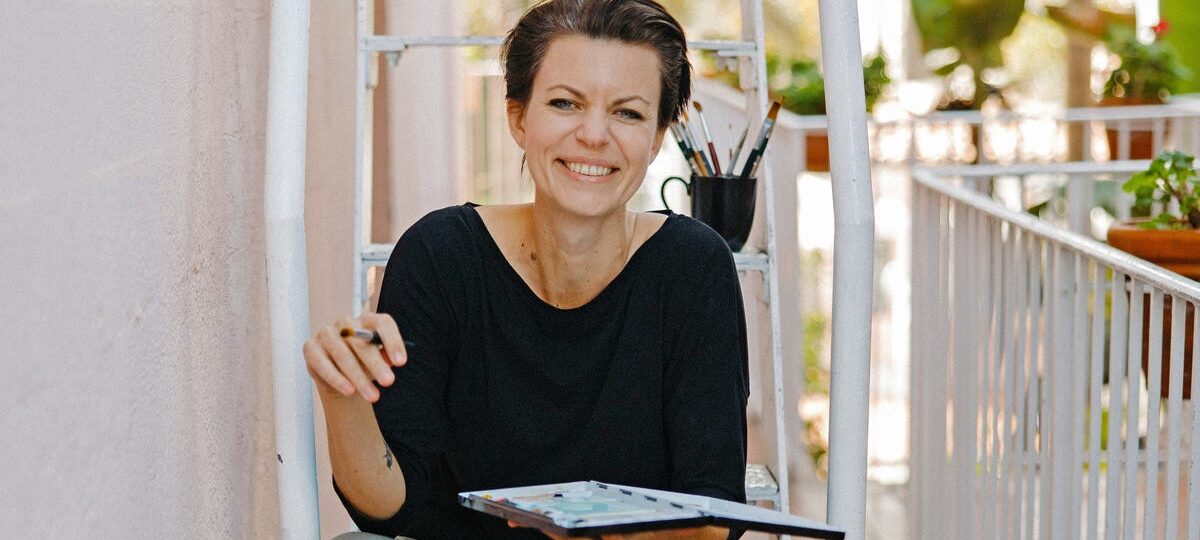
This as-told-to essay is based on a conversation with Sara Wilczynska, a 41-year-old watercolor artist and founder of Swil Arts who lives in San Diego.
Prior to her art career, she worked as a software engineer in the finance and tech industries before quitting her job at Google in 2022.
The following has been edited for length and clarity.
I started using AI pretty early on.
I founded my art studio in 2023 — after quitting my software engineer job at Google the year prior — which was when generative AI started to become more accessible and powerful.
In a way, I was growing my studio with it, and having a tech background made me more prone to experiment, be excited, and feel less scared of it.
However, I was always very clear that I never wanted AI to replace me at the core and the heart of my business.
I wanted to create and to add value to people’s lives through my creativity.
Still, I identified that there are many things involved in running a business that require time, energy, and money, which AI can really help reduce friction with.
I believe there’s a way for artists and creatives to work with AI, and it can hopefully help us redefine the value we add as artists and creatives.
I’d never use AI to generate any artwork.
I’ve always had a very clear boundary around that — I’ll never use AI for art creation, ideation, creative brainstorming, and visual storytelling.
From the beginning of my art career, I’ve used traditional media — ink, watercolor, brushes, and paper.
Even if I digitize it later in order to put it on products, the heart of it is creating everything in a traditional way with hands and traditional mediums.
I saw a lot of potential and value in the human aspect of it, like sketching on location and capturing with all the senses.
AI can process an image, but it’s not going to have that experience or perspective or interpretation or locality — all the things that a human adds.
I have a weekly newsletter where I share updates from the studio, in which I also sprinkle in what I call “California moments worth keeping.” These are different snapshots of Southern California life that I sketched, as well as a little story of the inspiration.
I wouldn’t go to AI and say, “Come up with a ‘California moment worth keeping’ for my newsletter,” because that’s not authentic.
The whole point is that it’s my lived experience.
When I’ve already captured the moment, sketched it, taken pictures of my sketches, and have the story behind it, I feel OK for AI to proofread or edit my newsletter and to suggest a better flow of sentences, because I’m not a copywriter.
I treat AI almost like a voice recorder.
Often, I’ll come up with the thoughts, topic, and content that I want to write, and speak it to my phone while I’m lying down or commuting.
My stories and content are my own, though.
I also have a few custom-trained GPTs that are very helpful for my art business.
First of all, I trained my own personal art coach.
I defined my signature style, artistic voice, and values, and once I finish an artwork, I feed it to the custom GPT and ask for feedback and criticism.
That’s been very helpful for my growth as an artist and as a creator.
I trained another AI agent to help me to filter art opportunities, like grants, residencies, and contests.
It would be a full-time job to go through and see which ones I’m eligible for and that resonate with my work.
I periodically feed my agent a list of different opportunities, and it can do the first layer of filtering because it already knows me, my business, and my criteria.
I also sometimes use AI to help me with reference photos.
If I’m doing my own art, I can usually paint on location, but if I’m working for a client, I’m sometimes unable to take my reference photos; for example, if the piece is going to be a surprise for someone, such as a house portrait, I shouldn’t go there and start photographing it.
In those cases, AI can help me figure out things like a good light source or a good architectural perspective for the limited reference photos I might be working from.
I use it for things that many business owners use it for — strategizing, long-term planning, and bookkeeping.
I might have specific questions about QuickBooks, or some legal questions about intellectual property.
I also use it for research and fact-checking.
When I work on a project where the storytelling and meaning are very important, it’s good to validate botanical, symbolic, architectural, geographical, or historical details.
Since I’m not a photographer and don’t have professional equipment, I also use it for mock-ups and fixing photos.
In the past, I’d use Photoshop, but it’s easier to talk to AI and give it a prompt to put the product against a nice background and fix the lighting.
I’ve developed quite a lot of patience with the iterative process of prompting — and I sometimes even create my prompts with AI.
My process has definitely changed and is evolving as the tools are too.
When I first started using AI, it was super crappy and hallucinated much more.
It wasn’t reliable, and it would go into stupid loops.
It’s only in the last six to 12 months that it can actually do things quite well and reliably.
Because of my technical background, I take a balanced approach and have a healthy skepticism about AI.
I don’t want to glorify it, while also not scapegoating it as the most terrible thing ever.
Exercise, rest, daily walks, and being in nature help me keep my nervous system regulated, which helps counterbalance the pull of technology.
I definitely have some worries or concerns about AI on a broader scale, such as the environmental impact, which I hope is getting more and more scrutinized by the right people.
With the pace of development of AI, I’m sometimes worried that ethical or legal considerations aren’t developing at the same pace, in terms of consent, training, copyright, and how AI is used for things like deepfakes.
My tech background makes me really understand and keep treating it as a tool that, like any tool, can be used either constructively or harmfully; it’s not inherently good or bad.
It’s very fast evolving, so I keep asking myself whether the way I’m using it is consistent with my values as a person and with my values as a business, and I continue reevaluating and being accountable and flexible.
Maybe I’m optimistic, or naive, but I want to believe that technology and human creativity can coexist, and that AI is going to bring artistic practices to the next level and not become a replacement for artists, long-term.
Do you have a story to share about how you do or don’t use AI in your work and personal life?
Contact this reporter at janezhang@businessinsider.com.
Discover more from NAIRAVOICE.COM.NG
Subscribe to get the latest posts sent to your email.