

 BBC
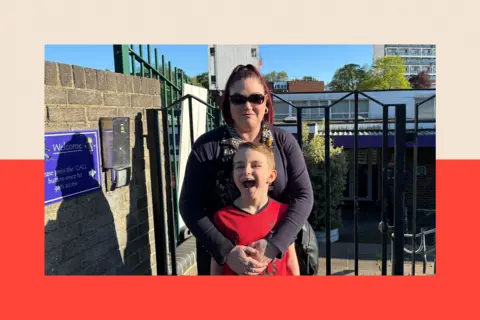
BBCNine-year-old Blake is trying to climb over the locked gates of his former primary school, St Dominic’s in Hackney, when we meet him. It closed last year due to falling pupil numbers. The playground is overgrown, and the modular buildings stand quiet and empty.
When the school closed, Blake found the loss of his community particularly difficult. He is autistic and has ADHD. This means he can find a change in routine and managing his emotions more challenging.
His mum Christina says he’s still struggling with the closure.
“When he started his new school he started getting up four to seven times a night because of the anxiety of being in a new school with new people he doesn’t know,” she says. “He was just like a little nervous wreck.”
Now, she says his emotions are “playing up more”, and he sees his new school as “not my school”. Though he has made some new friends, “he’s scared to open up again in case that friend gets taken away”.
More than 100 state-funded schools in England have closed over the past five years, which many analysts suggest is largely driven by declining birth rates.
A recent National Audit Office (NAO) report says pupil numbers have fallen by 3% since 2018-19, and are projected to fall a further 7% in the next five years. It’s a similar picture in Scotland, Wales and Northern Ireland, where education is devolved.
Analysis by the BBC’s data journalism team suggests pupils requiring special educational needs (SEN) provision – the official term in school census reporting – have been disproportionately affected by these school closures.
In the schools that closed between 2020 and 2025, nearly 30% of children had special educational needs, compared with a rate of approximately 20% in the wider school population.
Even excluding special schools, pupil referral units, alternative provisions and studio schools (small vocational schools), there is still a higher rate of SEN pupils at the closed schools.
We raised these figures with the Department for Education (DfE). In response, the DfE says it is helping schools across England to repurpose space for school-based nurseries and children with SEND – a broader definition covering all special educational needs and disabilities. It will introduce new guidelines for local leaders to respond to the changing demand in the autumn.
The government set out major reforms to the SEND system in England in February, including plans for better inclusion in mainstream schools, earlier support, and taking away the fight for support many families go through.
But many parents are anxious about what these reforms will mean. Though everyone involved agrees the system isn’t working, parents worry about the consequences of changing it.
So, why might there be higher proportions of children with SEN in the schools that are closing? And what will that mean for SEND provision going forward?
What the fall in pupil numbers means
A rapid drop in pupil numbers is having a direct impact on the financial sustainability of schools, according to Luke Sibieta of the Institute for Fiscal Studies (IFS) think tank.
The number of primary pupils in England has fallen by 150,000 since 2019, a decline soon expected to be seen in secondary schools too. Sibieta says this has been driven by fewer children being born. In total the DfE projects there will be 400,000 fewer pupils by 2030.
“That has led to fewer pupils in primary schools, and that’s making it harder for primary schools to fill the quota of the number of pupils they need to be financially sustainable,” Sibieta explains.
Nationally, unfilled school places rose from 10% to 14% in the last five years, according to the NAO.
Sibieta notes that school funding is mainly per-pupil, meaning when there are fewer pupils, a school gets less money. This means that if a school’s roll drops low enough, it will no longer be financially sustainable.
And when schools close, the data suggests children with SEN are disproportionately affected.
Our analysis of DfE data suggests that around 120 state-funded primary and secondary schools in England permanently closed their doors between 2020 and 2025. About 29% of those attending the schools had an education health and care plan or other SEN support, compared with the current national average of 20%.
In total, across the period between 2020 and 2025, we found more than 2,000 children with special educational needs were in schools that went on to close.
Our data doesn’t show why schools with more pupils with SEND are closing. But Jon Andrews, head of analysis at the Education Policy Institute think tank, says that the most popular schools are usually the ones with the best exam and Ofsted results.
Andrews thinks it’s “reasonable to assume” that schools facing closure will have high numbers of SEND pupils and those from disadvantaged backgrounds – as these pupils typically perform less well on attainment measures, the most popular schools tend to have fewer of them.
So, Andrews thinks it is plausible that when the birth rate falls, it is likely to be the less popular schools with higher SEND and disadvantaged pupil numbers who will find it hardest to fill their places, and end up closing.
The National Foundation For Educational Research (NFER) charity suggests that parents of children with SEND are often attracted to schools with strong reputations for inclusion.
A survey by the Sutton Trust published in March found 41% of primary and secondary school leaders believe some schools actively discourage applications from pupils with SEND.
Andrews has a further concern. With pupil numbers declining and budgets tightening, schools may be forced to cut staff. That may first include teaching assistants and other support staff – the kind of staff that are disproportionately helping SEND pupils.
“So the school may still be there, but they won’t necessarily get the support that they once had.”
This is something former headteacher Jo Riley had to deal with, before her school Randal Cremer Primary School in Hackney closed. Falling pupil numbers meant that “when people left – we didn’t replace them”.
The drop in funding at a school with falling pupil numbers makes it “more difficult to put the intervention and support in place that you would like to” for SEND pupils, she says.
Sibieta says falling overall pupil numbers could mean less pressure on the national education budget if there are fewer pupils to pay for, and this may open an opportunity to spend more on SEND.
“But, at an individual school level, it might work a bit differently,” he says. “If schools are losing money from falling pupil numbers, they might have less money to spend on other services they provide, such as teaching assistants that can help children with special educational needs.”
The impact
When another school in Hackney, Baden Powell school, closed, the pupils moved to Nightingale school around the corner.
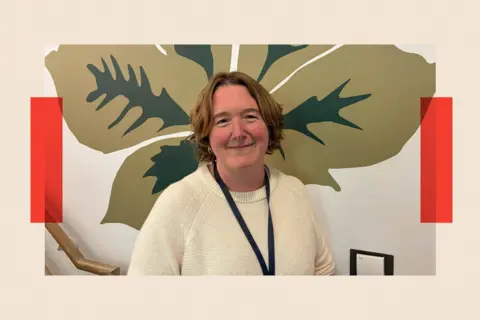
Headteacher Abigail Hopper prides herself on Nightingale’s inclusion, but providing for lots of SEND children – 42% of her pupils – means it can be “really hard” to also balance attainment performance pressures, she says, when the school’s overall results take a hit.
Some may argue that transitioning to a new school could give children better opportunities.
When the children moved from Baden Powell to Nightingale, they joined their new classmates in their very modern primary school building, which has a climbing wall, cookery and art rooms, and a rooftop sensory garden.
Hopper says her team, and the Baden Powell staff worked hard to ensure the children’s transition to Nightingale school was smooth.
Welcoming them meant inviting them to the summer fayre before they joined, lots of discussions, a special scrapbook – and “one of the biggest things that they were excited about was our school guinea pigs. So we got a couple of extra guinea pigs and said, well, these are your ones.”

But NFER research suggests that increasing proportions of pupils with SEND are becoming concentrated in a small number of mainstream schools in England, which it says places growing pressure on those schools and raises questions about fairness.
Despite taking in the pupils of Baden Powell, Nightingale school is still just over 80% full. Per-pupil funding makes this a challenge, Hopper argues.
She says this is particularly the case when it comes to children with SEND and those who receive the Pupil Premium grant, which provides funding to improve educational outcomes for disadvantaged pupils.
“I was talking to another head just this morning about her budgets and falling roll, and she was saying that the kind of things that have to go are residentials, trips, additional supporting adults, music lessons, which are the kind of things that disadvantaged kids won’t get elsewhere.”
As we were shown around an empty Baden Powell school, Jason Marantz, director of education and inclusion at Hackney Council, described feeling a “mixture of emotions” about closing schools.
The empty school is currently being renovated to become a second site for oversubscribed Ickburgh, a council-maintained specialist school in Hackney.
Looking at goodbye messages from the children on the wall is “really sad to see”, he says.
But, he feels comforted knowing that the building will be used to cater for children with some of the most complex needs in the borough.
Headteacher Joe Sieber says he’s currently turning two to three families away due to being oversubscribed, so these additional 50 places will make a difference.
Fighting for support
Overall SEND numbers in England have risen from around 1.2 million a decade ago to 1.7 million today.
Across the SEND system, families often say they have to fight for support.
Data from the Local Government Ombudsman seen exclusively by BBC News shows large rises in both the number of complaints about SEN provision and in the number of them they upheld. More than 1,000 complaints in England were upheld in 2024-25, up from about 50 in 2014-15.
A recent analysis of these complaints by academics at Manchester University found common themes – families navigating delays, uncertainty, and gaps in support. But it also found hard-pressed councils trying to do the right thing in difficult circumstances – often as a result of issues such as budget cuts and specialist skill shortages.
It’s in this climate, that Monkseaton Middle School near Whitley Bay, North Tyneside, was earmarked for closure. The council proposed shutting the school late last year – a mainstream setting for nine-to-13‑year‑olds where nearly half of pupils have SEND.
Parents, governors and staff campaigned to keep the school open and came up with a fully costed plan to extend the age range from a middle school (finishing in Year 8) until the end of Year 11.

But while individual schools like Monkseaton have managed to resist closure, the broader challenge persists. So, what changes are needed across the system to ensure that children with SEND aren’t the ones who bear the brunt, and could shrinking rolls also present an opportunity?
Daniel Kebede, general secretary of the National Education Union (NEU), argues that falling pupil numbers are an opportunity for the government.
“We have a unique opportunity now to bring our class sizes down,” he says. At the moment, he adds, these are some of the highest of the member countries of the Organisation for Economic Co-operation and Development (OECD).
“If we brought those class sizes down to a European average, class sizes of around 20, you could cater for more children with additional needs in a mainstream setting.”
He wants education spending to return to at least 5% of GDP. It is currently 4.1%.
So looking ahead, this could leave the government with a potential choice, Luke Sibieta of the IFS says.
“Do you want to make savings from falling pupil numbers, or do you want to maintain spending the way it is, and have lower class sizes?”
For Iain Mansfield, at Policy Exchange think tank, there’s also a third option.
He does not agree that smaller class sizes is a good response to falling pupil numbers – arguing that research suggests this only has an impact if numbers drop below 20 per class.
Instead, he thinks more money should be invested in early years and further education – to reduce the nearly a million young people not in education, employment or training.
On the falling roll, Mansfield says the DfE should be doing “more thinking”, though you “can’t hold back the tide” when a school’s numbers have reduced too dramatically to keep it open.
“But given that kids with SEND are typically more vulnerable and find adjustment less easy than other children, they are particularly at risk from the challenges this poses.”
In the meantime, many parents worry about the government’s SEND reforms and the implications of fewer pupils qualifying for EHCPs – the route to legally enforceable help.
The DfE says it is proud of its “once-in-a-generation SEND reforms backed by £4bn”, which it says will raise the number of specialists on the ground and roll out training for all teachers so that every child gets the right support, in their local school. It also says parents will never be left without a route to challenging decisions about their child’s legal support.
For Blake and his mum, the closure of St Dominic’s still hurts.
Blake says he misses his best friend and the teachers, and how the staff would let him draw when he needed to calm down.
Most of all, he misses his happy place, and how well everyone there understood him.
Additional reporting by Nicola Dowling
How cameras are being used to tackle abuse in nurseries
The city caught in the middle of the big energy shift debate
Am I part of the luckiest generation in history?

BBC InDepth is the home on the website and app for the best analysis, with fresh perspectives that challenge assumptions and deep reporting on the biggest issues of the day. Emma Barnett and John Simpson bring their pick of the most thought-provoking deep reads and analysis, every Saturday. Sign up for the newsletter here
Discover more from NAIRAVOICE.COM.NG
Subscribe to get the latest posts sent to your email.