

Craig Garrett had no idea his 5-year-old daughter was talking to what he described as an AI chatbot at school every day.
That was until the Brooklyn-based book editor attended a meeting held by his school district, where he said educators revealed the extent of AI use in his daughter’s classroom. “I was kind of horrified and shocked and disappointed,” Garrett told Business Insider. “The whole notion of a 5-year-old plugged into a tablet with their headphones on and a microphone, and speaking to this animated character that’s talking to them like it’s their friend is just deeply wrong.” That meeting, which took place in May last year, “radicalized” many of the parents in the room, Garrett said.
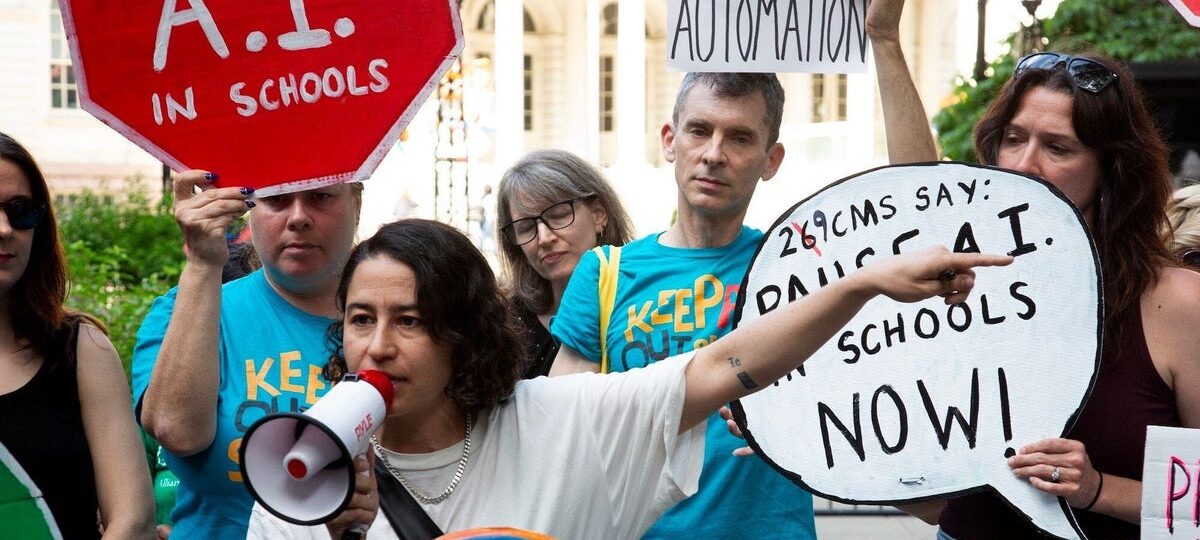
It led him to join the AIM coalition, a group of New York City parents opposed to AI in the classroom.
Those concerned parents are often the loudest voices in the room, but they aren’t the only concerned parents, and they aren’t the only voices.
There is a cohort on the other side that believes students preparing to enter the workforce need to be taught to use AI, or else be left behind. “In the last six months alone, the references to having AI skills in job postings in the United States have more than doubled,” Keri Rodrigues, the founding president of the National Parents Union, which has a chapter in New York City and which supports AI use in schools, told Business Insider. “Parents want their kids to understand how to utilize this technology.” These two groups of parents, representing opposite sides of the debate, engaged in a monthslong effort to lobby Mayor Zohran Mamdani’s administration, which this week ultimately sided — at least for now — with the anti-AI contingent.
Mamdani announced on Wednesday that his administration would impose a one-year moratorium on student-facing AI platforms in New York City public schools for students in elementary and middle school.
Under the new restrictions, Amira, the program Garrett’s daughter was using, will have its AI features turned off.
A spokesperson for New York City Public Schools said in a statement that the school system “engaged with various stakeholders — educators, students, parents, advocates, union partners, experts, and other community members” to shape the policy.
The AIM coalition had two meetings with NYCPS Chancellor Kevin Samuels in recent months, members said.
Parents in the AIM coalition called the moratorium a victory, though it fell short of their demand to pause the tech for two years.
They described feeling blindsided by the extent of AI use in the classroom.
Some said they feared that data about their children would be scraped by AI companies.
Others said they didn’t want chatbots taking the place of teachers. “It really started from concerned parents finding out things about what their children were experiencing and being completely appalled,” said Liat Olenick, a leader of the group. “It really took off because I think it struck a nerve.” Olenick recalled multiple incidents of parents approaching her in bewilderment about the AI programs their children were using. “All of a sudden, one day, people were like, ‘Wait, my 7-year-old’s using AI?
I never gave permission for that,'” she said.
Olenick said the group began campaigning for a moratorium earlier this year.
She said the group’s lobbying efforts included conversations with staff members in the mayor’s office, as well as the meetings with Samuels. “The organizing really made a difference,” she said. “We changed the conversation.” Under the new AI guidelines unveiled on Wednesday, teachers will still have access to generative AI tools, which they can use to plan lessons but not to grade assignments.
High school students will participate in “AI literacy” courses and have limited access to five pilot AI programs, none of which are chatbots.
Joe Philleo, the CEO of Edia, one of the programs permitted for high school use, applauded the one-year pause in a post on X. “Mamdani’s plan strikes a reasonable balance for this school year,” he wrote. “Young kids should not be glued to their screens all day.” The CEO of Amira, meanwhile, defended the software’s role as a tool for teachers. “We understand how challenging it is for districts to ensure that they’re putting appropriate AI safeguards in place, and appreciate that, as New York does that hard work, they’re also taking care to ensure that teachers who are using Amira to diagnose reading challenges and improve literacy outcomes for kids can still access the tools that are working for them,” the company’s CEO, Mark Angel, said in a statement.
Mamdani described the moratorium as the most “comprehensive of its kind anywhere in the country.” It comes during a nationwide public reckoning over how best to expose children to generative AI, as educators bemoan how students are using the technology to cheat on assignments and parents demand more regulation.
Rodrigues, however, said the ban was a “hysterical response” that could leave students unprepared for a job market that values AI skills more than ever.
Though Rodrigues said AI has its place in the classroom, particularly when combined with strong and consistent oversight by human teachers, she stressed that there are certain functions — like grading, counseling, and imposing discipline — where AI has no place.
The new policy, she said, uses a sledgehammer instead of a scalpel. “You are seeing a knee-jerk political response to something that is complex, requires nuance, requires foundational understanding, and should be evidence and data-driven,” she said.
City officials emphasized during their press conference announcing the moratorium on Wednesday that the pause was temporary as they assess how AI affects a child’s ability to learn.
Kaliris Salas-Ramirez, a neuroscientist and associate professor at Rutgers University, and a mother of two sons in New York City’s public school system who supports the pause, said research suggests young children using AI tools risk preventing their brains from developing problem-solving skills. “We’re actually not allowing the brain to consolidate that information in a comprehensive way,” she said, referring to the use of AI during a young person’s formative years.
For Garrett, whose daughter is now entering second grade, he’s relieved the Amira app won’t be used as often. “It’s not like this app was doing something that teachers couldn’t do before,” he said.
Discover more from NAIRAVOICE.COM.NG
Subscribe to get the latest posts sent to your email.