
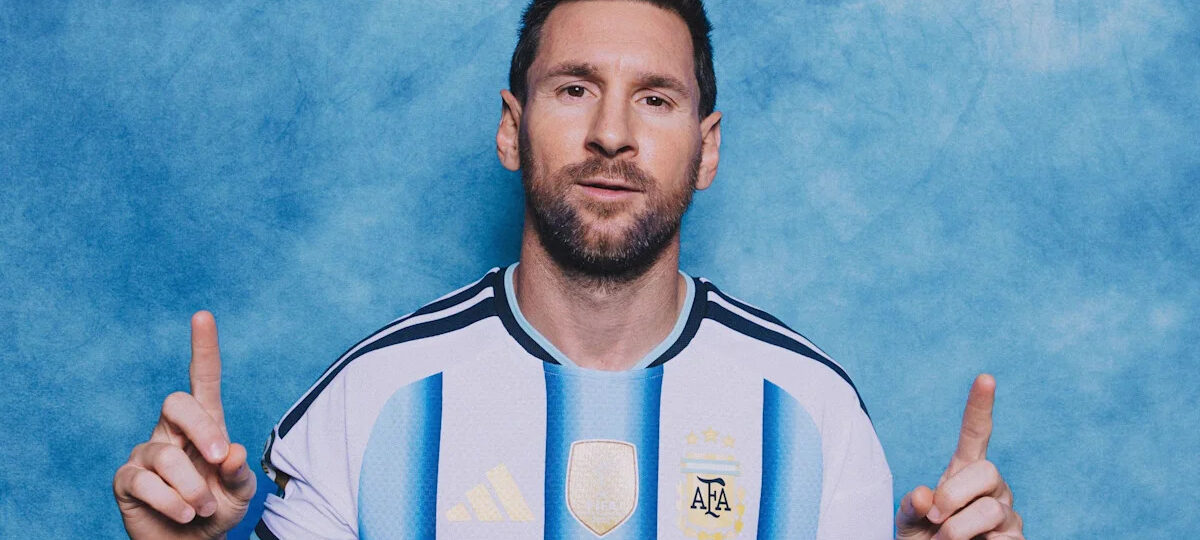
“I’ve given it my all, I have nothing left to give.”
Lionel Messi retired from international football on Monday as Argentina’s all-time leading scorer and most-capped player. He captained them to World Cup glory at Qatar 2022 and to Copa America triumphs in 2021 and 2024.
But the world was almost denied his most successful period in the famous blue and white shirt.
On Sunday, 26 June 2016, at MetLife Stadium in New Jersey, Messi broke the hearts of a nation.
Just two days after his 29th birthday and soon after missing a penalty in Argentina’s Copa America final loss to Chile in a shootout, Messi decided he had seen enough.
After 113 appearances, he was adamant. In his mind, he would never pull on an Argentina shirt again.
“For me, the national team is over. I’ve done all I can. It hurts not to be a champion,” he said.
The pain was understandable. Argentina had lost in the 2014 World Cup final, plus Copa America finals in 2007, 2015 and now 2016. The player many classed as the world’s greatest had failed when it mattered most for him.
“It was the thing I wanted the most, but I couldn’t get it, so I think it’s over,” Messi said, fighting back tears after another trophy chance slipped away. “I think this is best for everyone.”
Fortunately for Argentina, Messi would have second thoughts.
Over the subsequent 10 years, he completed one of football’s greatest ever stories. But it was a decade of dominance that almost never happened.
Since that retirement U-turn, Messi has played a further 94 times and scored another 70 goals for Argentina. He has lifted four major trophies.
The six-week period between his June 2016 retirement declaration and the 12 August announcement he would play on for the “love of the country” could be considered the most significant in Argentine football history – even in world football.

Diego Maradona and Lionel Messi both won one World Cup with Argentina [Getty Images]
As Messi departs the international stage, words of criticism 10 years ago from the country’s other legendary number 10 seem almost laughable.
“He’s a really good person, but he has no personality,” Diego Maradona said just weeks before Messi’s first retirement. “He lacks the character to be a leader.”
Back then it was the comparison with Maradona that was held against him. Yet Messi had already won eight La Liga titles and four Champions Leagues with Barcelona and was a five-time Ballon d’Or winner, and not yet 30.
Maradona’s club career hadn’t come close, but Messi’s only major international honour had been Olympic gold at the 2008 Games. Maradona had almost single-handedly won the 1986 World Cup for Argentina.
It’s hard to imagine it now, with Messi shirts dominating the last two World Cups, the Argentina team being built completely around him and the nation’s fans worshipping him to an almost religious extent – but, back then, there was a lot of criticism.
“He’s not as good as Diego”, “he goes missing on the big occasion”, “he is part of the country’s failure”. All accusations that were thrown in his direction.
This wasn’t the first time Messi had considered walking away either.
Spanish football expert – and Messi biographer – Guillem Balague said: “Leo goes really down when he loses. He felt the pressure of being the captain of Argentina and the Maradona thing.
“Pecho Frio, people in Argentina called him, which means cold chest. It was an insult to say he had milk in his veins. So when he failed in 2016 at the Copa America, that was the third time – the first time in public – he had decided to leave the national side.
“The two previous ones was a matter of letting him lick his wounds, but this one he came out and said I’ve had enough. He sometimes cannot help himself as he says what he thinks.”
The Maradona versus Messi debate is now surely over. Messi is Argentina’s greatest, by most judgements. There are many who will say he is challenging Pele for the title of football’s greatest ever.
Even people who criticised Messi eventually said sorry.
From the moment Messi quit his country, shockwaves reverberated around Argentina.
Yes, he had lost in four successive finals. But he was also the country’s record goalscorer and the world’s best player.
The ‘Get Messi back’ campaign started immediately as team-mates called for him to change his mind just minutes after his announcement.
“I can’t imagine a national team without Messi,” said goalkeeper Sergio Romero.
The social hashtag #NoTeVayasMessi (Don’t go Messi) was used more than 20,000 times within 24 hours.
By that time, Argentina’s President Mauricio Macri had already spoken with Messi over the phone to try to convince the Barcelona star to reconsider.
“I told him not to pay any attention to the comments being made because, in truth, we are very happy” with the job he has done,” Macri told journalists at the time.
Less than a day later, the mayor of Buenos Aires, Horacio Rodriguez Larreta, had unveiled a statue in Messi’s honour and called on the public to show him their love.
“As a football fan, Leo, I am asking you to please reconsider your decision,” the mayor said.
Thousands of fans gathered in central Buenos Aires, while street signs throughout the capital displayed implored Messi to play on for Argentina.
Maradona stated Messi had to stay to take the team to the 2018 World Cup.

Messi retires with 125 goals in 207 appearances for Argentina [Getty Images]
Edgardo Bauza became Argentina coach in August 2016, replacing Gerardo Martino after the Copa America failure. He lasted just eight months – but maybe his first few days were his most important.
The first thing he did was travel to Barcelona to persuade Messi to change his mind. The huge clamour for Messi to return proved irresistible.
“I love this country and this shirt too much,” Messi said as he returned to the international fold.
“I’m grateful to all the people who wanted me to continue playing with Argentina. Hopefully we can give them something to cheer about soon.”
Still, success didn’t come instantly. In 2018, Argentina fell to France in the last 16 of the World Cup and many wrote off Messi’s chances of ever lifting the trophy.
Quite incredibly, Messi did not win a senior international tournament until the age of 34 – and then he went on to win four in barely three years, including the 2022 Finalissima.
Questions about his international future were raised after each of those triumphs, but he played on to his sixth World Cup in 2026 where he scored eight goals and registered four assists en route to Argentina’s defeat by Spain in the final.
He was strolling through games, lacking the speed of years gone by, but somehow proving every bit as effective.
The final took place in the same stadium where Messi ‘retired’ a decade earlier.
“When Messi retired [10 years ago] it reminded us all how much we loved him,” said Argentina fan Benjamin who was in the Metlife for the 2016 showpiece final.
“When I heard him retire, I cried, the country cried. He did get criticism but only because everyone cared so much. Without Lionel Messi, Argentina would still be waiting for their next World Cup since 1986.”
Messi’s footballing future became a matter of fresh doubt after the death of his father Jorge just three weeks after this year’s World Cup final.
This decision seems final and, at 39, another return to international football looks unlikely.
But South American football writer Tim Vickery said an official farewell in Argentina could be on the cards.
“Remember that, as a result of their behaviour at the World Cup, the next game Argentina play on home soil will only be in front of a crowd at 50% capacity,” Vickery told BBC Radio 5 Live.
“But once those punishments are out of the way, I’m sure it will be in the mind of the Argentina FA: ‘Why don’t we hold a game back in Buenos Aires? River Plate, they have the biggest capacity in South America. Why don’t we do an official farewell there? What do you think about it, Lionel? One last time?’.”
Discover more from NAIRAVOICE.COM.NG
Subscribe to get the latest posts sent to your email.