
In an interview shortly less than two months after being announced as the new Blazers governor, Tom Dundon offered some insight into his operational style.
The 54-year-old stated that he wasn’t particularly a fan of predraft workouts or interviews, preferring to lean on talent, information and volumes of data. Dundon essentially encouraged his scouting department not to emotionally attach themselves to players, rather to channel energy into contingency plans.
But one distinct sentiment of Dundon’s, combined with some of his aforementioned qualities, sheds some light on Portland’s future.
“I want to run the business properly,” Dundon said. “But I want to win more than I want to make money.”
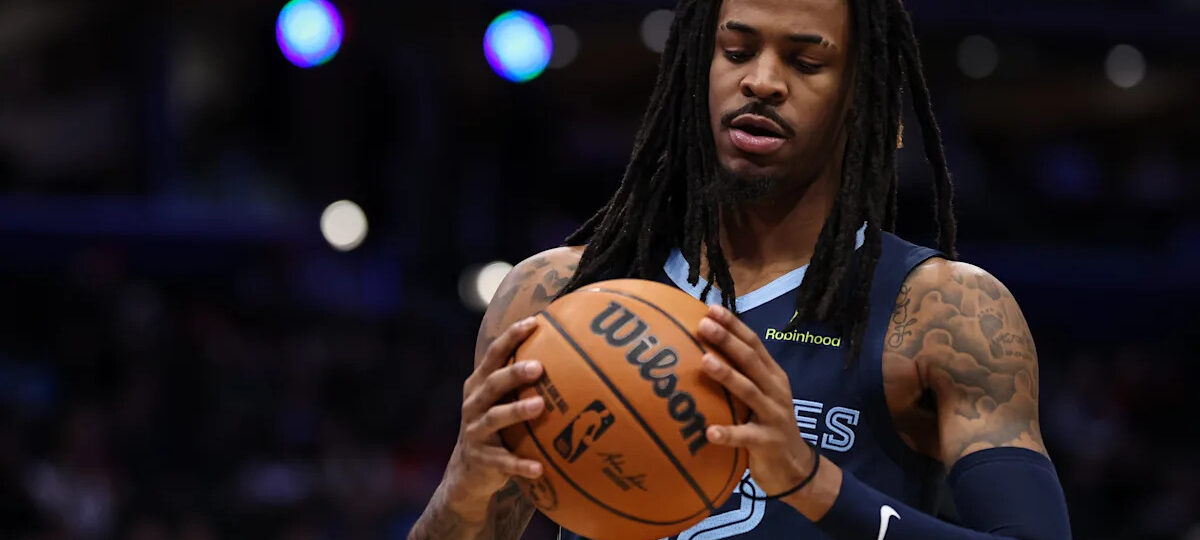
On Monday, less than 24 hours before the official start of free agency, the Blazers agreed to trade veterans Jerami Grant and Kris Murray to Memphis for Ja Morant. While the move itself comes with questions, pulling the trigger now for the talented Morant — essentially buying low on the exiled 26-year-old for a costly Grant and seldom-used Murray — is a solid at-bat hit.
From Memphis’ (or Morant’s) perspective, the trade signals the end of what had become an awkward, unfortunate divorce. Over the past few months, Morant’s value around the league had rapidly declined as potential landing spots dried up, so much so that rival executives wondered if the Grizzlies’ brass would approach Morant for a buyout if nothing ever materialized.
Morant, who is currently back home in the Carolinas, is said to be excited about the prospect of not only teaming up with a player of Damian Lillard’s caliber in Portland, but the opportunity to learn and work closely with a veteran guard. One of the reasons why Morant preferred not to end up in Sacramento was the lack of veteran leadership or structure, and why Miami was held in high regard as a potential destination for so long. Lillard’s combination of experience and work ethic should be welcome changes for Morant, even if the organization’s new structure under Dundon is unknown at this juncture having only been in place for three months.
(There are some around the league who wonder if Morant could be re-routed to Boston in a hypothetical Jaylen Brown (or other star player) trade, but longtime reporter Chris Haynes insists the Blazers view Morant as part of a new-look backcourt with Lillard. Technically, an addition of that magnitude is possible even without including Morant in a deal; a package of Jrue Holiday, Shaedon Sharpe and Sidy Cissoko works under the CBA, and the Blazers have six first-round picks through 2030.)
But can a Lillard-Morant backcourt actually work? And more importantly, what does that look like?
Given the Blazers have ascended over the last couple of years (21 wins in 2024-25 to 42 wins last season), one could reasonably wonder why Portland would commit to Lillard, a near 36-year-old coming off a major Achilles injury, and Morant, whose game has been in gradual decline.
The answer could reside in a combination of Morant’s playmaking prowess and Lillard’s elite 3-point shooting. The Blazers finished 28th in 3-point percentage during the regular season and the re-insertion of Lillard, the franchise’s all-time leader in made 3s, is an obvious boost. But with Lillard coming off a major leg injury, one that has a propensity for limiting explosiveness and lift, it’s probably unwise to suggest the veteran point guard, who at one point finished in the 90th percentile or higher in usage rate in nine consecutive seasons, should be thrown headfirst into a barren spacing wasteland. He’ll need to be gradually eased back into the swing of things as he gets his bearings and mechanics back to a sense of normalcy.
And that’s where Morant steps in. The young lead guard may have butted heads with his former head coach over system and style of play, but there’s no denying his gravity and ability to create plays for others. Even in a down year, Morant’s combination of ball dominance and assist rate — 96th percentile in both categories — along with a positive assist-to-usage rate suggest some success in new head coach Micah Nori’s guard-dominant approach. To take it a step further, consider Lillard’s historic catch-and-shoot production. (I have a conspiracy theory that Lillard has taken so many self-created shots in his career that having quality looks generated for him could be somewhat new for him, but there’s enough meat on the bones there.)
- 2024-25: 3.5 attempts per game, 41.5%
- 2023-24: 2.8 attempts per game, 32.3%
2022-23: 3.8 attempts per game, 36.2%
2021-22: 2.5 attempts per game, 36.5%
2020-21: 2.3 attempts per game, 45.4%
Enjoying this article? Support our work with a small crypto donation.
2024-25: 3.5 attempts per game, 41.5%
2023-24: 2.8 attempts per game, 32.3%
2022-23: 3.8 attempts per game, 36.2%
2021-22: 2.5 attempts per game, 36.5%
2020-21: 2.3 attempts per game, 45.4%
Playing Morant alongside Lillard should also vastly improve Portland’s ball security issues, which had them ranked dead last in turnover rate during the regular season. Such is to be expected having paired Scoot Henderson with Deni Avdija, as the two embraced more control of half-court possessions, but expect the Blazers to be more competent in that department.
Portland also finished 29th in half-court efficiency, which should see considerable improvement. One method Nori could adopt is taking a page out of Mike D’Antoni’s Houston playbook, staggering Lillard and Morant similar to how Chris Paul and James Harden were deputized. Doing so would ensure that a capable floor general is on the court at all times, allowing for Nori to deploy different lineups depending on how games go. It also helps that only Trae Young, Josh Giddey, Cade Cunningham and Nikola Jokić finished with more assist points created than Morant — he was tied for eighth in secondary assists and fourth in potential assists — a godsend for a unit that ranked in the bottom eight in total assists.
(Last year’s Wolves team, in which Nori was an assistant, involved a good helping of guard-to-guard actions, so expect Morant to be utilized as a screener as well for Lillard and vice versa.)
Defensively, natural challenges will arise with a pair of 6-foot-2 guards, one coming off a long-term injury and the other having dealt with health issues of his own. But Morant’s willingness to compete at that end of the floor has often gone unnoticed due to how much attention his offensive decline has gotten. Over the past three seasons, Morant has finished in at least the 86th percentile or better in both defensive real-adjusted plus-minus and defensive true shooting. While Morant doesn’t force a lot of turnovers, he is a smart and crafty screen navigator and can stay attached to opposing ball-handlers. Other metrics won’t paint him in the best light — largely due to his inability to cause chaos and the Grizzlies’ woes as a whole — but there’s more than meets the eye with Morant. (Lillard’s issues are well-documented — not a great shot contester, falls victim to ball-watching — and I don’t expect them to improve with less athleticism.)

Figuring out the next move for the Blazers remains imperative. Because Morant was acquired via the 125% trade exception — a stipulation that allowed Portland to receive Morant’s $42.2 million salary for 2026-27 while only sending out around $39 million — the Blazers are hard-capped at the first apron. They are still able to use their full non-taxpayer mid-level exception, the bi-annual exception and a pair of smaller trade exceptions worth roughly minimum contracts. Their first order of business should be re-signing reserve center Robert Williams. Williams, a rim-running, shot-blocking big who remains one of the NBA’s premier protectors — opposing teams shot nearly 14% worse with Williams as the closest defender — should mesh smoothly with Morant. (There’s also the curious case of evaluating Portland’s playoff lineups; the starters with Williams were an impressive +37.5 in net rating, compared to a minus-14 with Donovan Clingan.)
Aside from that, what does the rest of the team look like moving forward? If the Blazers are unable to make any additional major moves of the Brown variety, a starting lineup of Lillard, Morant, Avdija, Clingan/Williams and Toumani Camara has a smooth blend of offensive variety, shot creation, perimeter defense and rim protection. Shooting remains a premium asset and should be on the table with names that will be attached to Portland in the coming days. The conversation of how to account for the Blazers’ bevy of guards now — Holiday and Sharpe are still on the roster as of today — will only continue to grow in volume. There’s simply not enough ball to go around.
But make no mistake, this is what the new NBA looks like. Is adding Morant enough to guarantee, say, 48 wins in the West? That would depend on how the rest of the roster is filled out (the departing Grant and Murray accounted for the fourth- and eighth-most minutes last season). But with a new owner, head coach and now backcourt in place, the Blazers are clearly signaling an intent on competing — which is what Dundon hoped for in the first place.
Discover more from NAIRAVOICE.COM.NG
Subscribe to get the latest posts sent to your email.