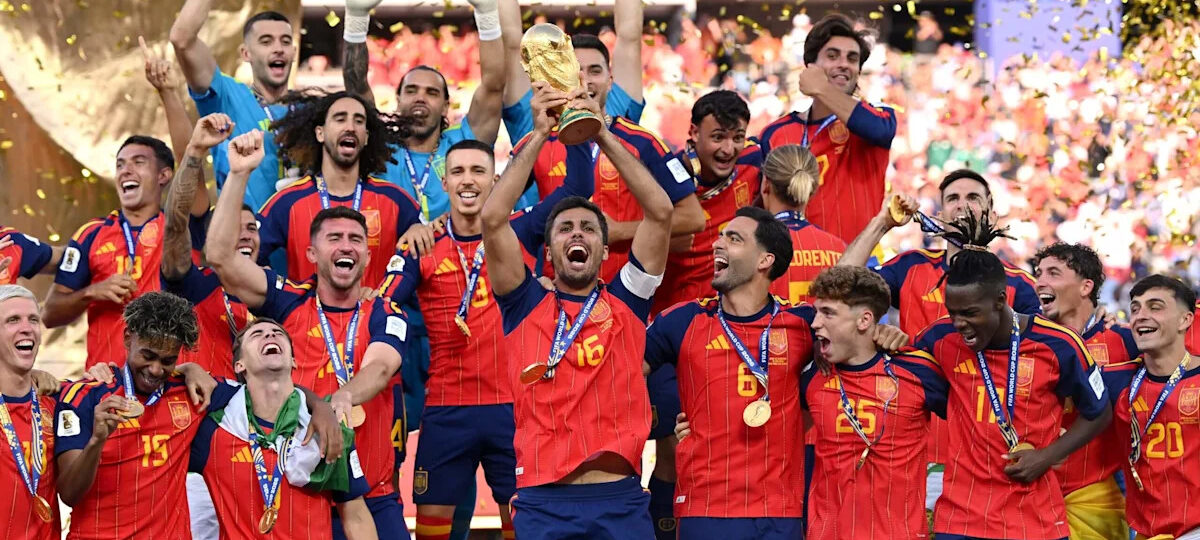
 More than 60 million viewers across the U.S. tuned into the 2026 men’s World Cup final between Spain and Argentina last month, between Fox and Spanish-language rights holder Telemundo. How many will tune into Netflix’s coverage of the 2027 women’s World Cup final, as of now, remains arguably the biggest experiment for FIFA and the women’s game — and a potential test case for the men.
Fox, the American broadcaster that has held the English-language rights for six editions of the men’s and women’s tournaments, will be off duty for the first time since 2014. The shift from one of the primary broadcasters in the United States to streaming giant Netflix is a seismic one that has inspired plenty of nerves among women’s soccer fans. It also opens up the doors to reimagining the coverage of the sport’s biggest moment.
No financials were disclosed when the deal was announced in 2024, though last week Bloomberg News reported that Netflix paid around $200 million for the two editions of the tournament. FIFA’s decision to split up the men’s and women’s tournaments’ media rights allowed the women’s tournament to establish and develop its own commercial value. Fox shelled out $485 million for the 2026 men’s World Cup alone. That price is expected to rise considerably for the next men’s tournament. (FCC Chairman Brendan Carr has gone on record saying that the men’s tournaments should, in part, remain free to air.)
Netflix has been making some bets of its own on live sports, picking and choosing where to acquire more events, including the MLB Home Run Derby, boxing and NFL holiday games. Netflix hit a high mark for the most-streamed NFL game thanks in part to Beyoncé’s halftime show during a game between the Baltimore Ravens and Houston Texans on Christmas Day 2024, with the stream peaking at 27 million during halftime.
Netflix co-CEO Greg Peters noted on an earnings call that live events have been key to driving sign-ups. Live programming has driven six out of the top 10 new subscriber sign-up days over the past five years.
As with all other live sporting events the streamer has aired, there’s no upcharge to existing subscribers. The platform’s cheapest subscription package, which includes ads, costs $8.99 per month. As of 2025, Netflix had around 90 million subscribers across the U.S. and Canada (meanwhile, ESPN’s TV subscriptions continue to drop — by 2024, it was in less than 68 million homes, though customers have shifted to the network’s streaming service).
FIFA, not Netflix, will make the call on whether hydration breaks, which punctuated every game this summer, return. Though it will be winter in Brazil, the men’s tournament had hydration breaks during games played in indoor venues, too.
Netflix’s countdown page promises, “Coverage will be available in multiple languages, with English and Spanish telecasts in the United States and English and select French telecasts in Canada. Alongside the live matches, fans can expect studio coverage, commentary, entertainment, and documentary programming that brings them closer to the players, teams, and stories shaping the global women’s game.”
Very little else is known beyond the hiring of two experienced outside broadcasters who will serve as executive producers of the tournament in Michael Cohen and Eli Velazquez. (Disclaimer: I worked with Cohen during the NWSL on Lifetime era from 2017 to 2019.) Elle Duncan, who joined Netflix from ESPN in 2025, served as the primary expert for Netflix’s storylines to watch published in June.
Still, there are nerves around the preeminent sporting event shifting to a streaming service. The good news for Netflix is that the tournament is in a far more favorable time zone for American and Canadian audiences than in 2023, when the tournament took place in Australia and New Zealand.
There’s only room for growth after the viewership mark for the 2023 final, which was the highest-viewed final in the U.S. not featuring the U.S. women’s national team — despite airing at 6 a.m. ET.
World Cup English-language viewershipYearNetworkTeamsDay & time (ET)LocationViewership2026FOXSpain vs. ArgentinaSun, 3 pmEast Rutherford, USA38.9m2023FOXSpain vs. EnglandSun, 6 amSydney, AUS1.7m2022FOXArgentina vs. FranceSun, 10 amLusail, QAT16.8m2019FOXUSA vs. NetherlandsSun, 11 amLyon, FRA14.3m2018FOXFrance vs. CroatiaSun, 11 amMoscow, RUS11.4m2015FOXUSA vs. JapanSun, 7 pmVancouver, CAN25.4m2014ABCGermany vs. ArgentinaSun, 3 pmRio de Janeiro, BRA17.3m2011ESPNJapan vs. USASun, 3 pmFrankfurt, GER13.5m
The 2027 final is set for Sunday, July 25, with the host stadium and exact time still to be determined. Even if FIFA pushes start times to be more favorable for European viewers, as a source with knowledge of Netflix’s plans indicated, it’s likely to be a favorable Sunday afternoon time slot.
While specific details of Netflix’s plans remain unknown, the main question is how it approaches the shift in accessibility and viewership habits.
Stepping onto the main floor of Fanatics Fest in New York City before the men’s World Cup final in July, sports fans were met with a massive tournament-themed fan zone, and, immediately to the right, were welcomed into a corner dedicated to the 2027 Women’s World Cup. Fans could test their shooting skills and pose for a photo with the tournament’s trophy in front of a backdrop advertising Netflix nearly as much as the tournament itself.
Netflix has continued its marketing activations by sending large statues of a bronze hand with painted nails (featuring the U.S. and Canada flags for their streaming rights, the Brazil flag for the host, and a soccer ball) and an old school Netflix mailing envelope that reads, “Come to Play, FIFA Women’s World Cup Brazil 2027, Live on Netflix” to NWSL stadiums in Orlando and Portland. (Retired NWSL and New Zealand player Ali Riley may have had the best comment, asking just how many current players even remember the envelope mailers.)
Netflix has also sent promotional boxes to influencers featuring press-on nail sets that match the statue, as well as a camera. Of the handful of videos posted on Instagram, Netflix skewed in a health and fitness direction rather than a prime women’s soccer — or general soccer — direction with its marketing.
A source familiar with Netflix’s planning said they have considerable plans for the tournament on the product side and will have a dedicated World Cup hub on the platform while still stressing discoverability for their subscribers. The company plans to ramp up its marketing closer to the World Cup and around the group stage draw in December; though the source noted that there will be call-outs for the 2027 tournament during its five NFL streams, including the day before Thanksgiving and the Christmas Day doubleheader.
Netflix still needs to address the needs of three primary groups: dedicated women’s soccer fans with a deep base of knowledge who will watch games beyond the U.S. or Canada teams, casual national team fans who will only watch their team, and bandwagoners.
According to one source, Netflix is working to ensure that dedicated fans get the broadcast experience they expect (and demand, in many cases), because it also hopes that if their needs are met, they will become evangelists for the World Cup on Netflix.
USWNT fans are the driving force behind that demographic. U.S. Soccer has its own media rights deal that includes linear and streaming broadcasts with TNT Sports and HBO for friendlies and other competitions outside of the World Cup and Concacaf.
“Making the Women’s World Cup available to every household with Netflix is a tremendous moment for the sport,” Judy Matthew, vice president of media at U.S. Soccer, said in a statement issued to The Athletic. “When you pair the world’s biggest women’s soccer tournament with one of the world’s biggest entertainment platforms, you can expand the audience, give fans a more in-depth look at the athletes, and strengthen the future of the game. Along with TNT and Telemundo, we’re excited to be creating fan experiences that are continuous and accessible year-round.”
While Netflix continues preparations, there are suddenly other major questions swirling around the tournament. With 321 days left until the first game, the latest FIFA developments over President Gianni Infantino’s foiled plans to sell a stake in a World Cup commercial entity to private investors leave the governing body on unstable grounds. The winds are rapidly shifting and it’s certainly something Netflix is monitoring, even as the president has made a U-turn on his original plans.
FIFA politics aside, it’s a crucial moment for the women’s game. The 2027 World Cup is the first chance the women will have to set their own marker on commercial value. FIFA has, at least, found a willing partner in Netflix — with deep pockets and an understanding that there will be real pressure on them to get this moment right.
This article originally appeared in The Athletic.
US Women’s national team, NWSL, Sports Business, Women’s Soccer
2026 The Athletic Media Company
Discover more from NAIRAVOICE.COM.NG
Subscribe to get the latest posts sent to your email.