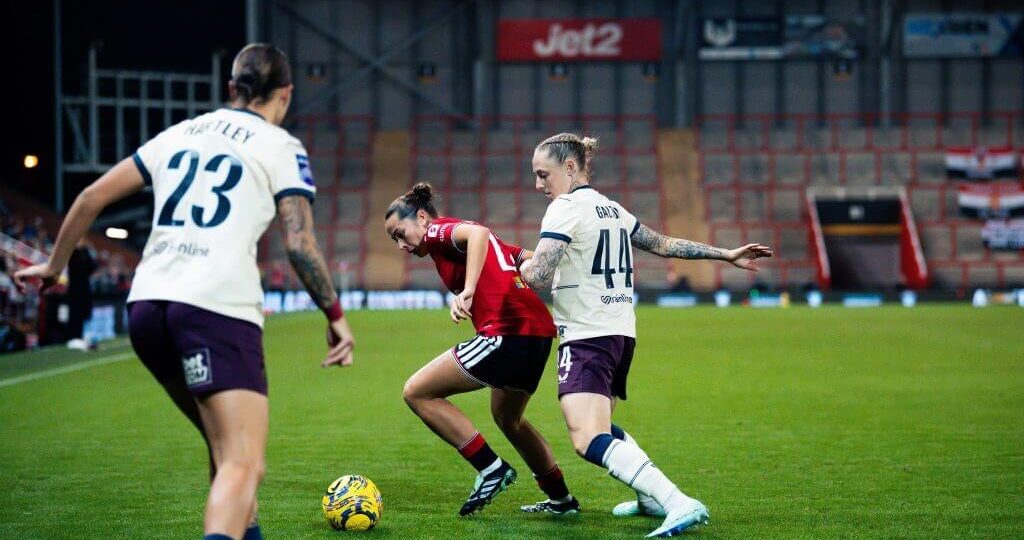
 Burnley’s visit to Manchester United Women on Wednesday brought a kind of closure for Leah Galton.
The 32-year-old Burnley forward left United in the summer after an eight-year spell dating back to their first professional season in 2018. She had been nervous all day — the fun, exciting nerves. “It does still feel like home,” she says. “It threw me right back. Last season kind of ended a bit abruptly and I didn’t really have a chance to say bye and go and see everyone I wanted to see.
“In some moments on the pitch, I completely forgot that’s not my team anymore,” she laughs, recalling Burnley’s 3-0 defeat to United in round one of the Women’s League Cup. “Then I was like: ‘No, no! Wrong team! Wrong team!”
Galton is now focused on establishing newly-promoted Burnley in WSL2 and searching for a first win of the season. More than 170 appearances for United have given her much to share with her new employers; she and 38-year-old former United teammate Rachel Williams, who joined Burnley weeks before Galton, have witnessed the sport’s transition to professionalism. They guide Burnley on how to do the same.
The team recently appointed a nutritionist and Galton has started speaking to the club doctor about their fertility and maternity policy. She feels she has found her voice. “I think it’s since I moved away from United, (I) felt a bit more valued at Burnley, more confident to speak and use my knowledge and experience.”
It has been some turnaround for her given she was close to calling time on her career a few months ago. “I was probably about a week away from writing to the PFA, getting a letter from a doctor, like: ‘It’s the best thing for my body and my head to retire,'” she says.
Galton suffers from chronic back pain owing to a disc at the bottom of her spine that has “kind of just disintegrated over time”. She has been left with a “nasty, deep, nervy pain” that often robs her of sleep and leaves her reliant on her partner, Sheridan, to dress in the morning.
“It takes me a good couple of hours till I can start moving,” she says. “After training, I come home and because I’ve pushed myself with my back, I can’t really do much. I struggle to walk the dogs. I think the only way I’m gonna get through the next couple of years, unfortunately, is to sacrifice some of these things.”
She says specialists were reluctant to order her retirement when she was otherwise still coping with life as an athlete. “It’s almost like deciding myself if getting through training for two hours is worth then being uncomfortable and in pain for the rest of the day,” Galton says.
The injury made for a disjointed final season at United when she was neither playing nor healing. She left as the club’s record WSL goalscorer — an honour she now shares with Ella Toone — but to limited interest once clubs learned of her injury.
“It was probably one of the lowest points I’ve had,” she says. “Looking at it now, I was probably right at the bottom, waking up most days being like: ‘What’s my purpose?’ One day I’m like: ‘Yep, I can go play’, but then teams want to do a medical and see if I can do this and do this. And I know I can’t do those things on cue. They’re not going to want me because they don’t want to invest in someone who might play, might not — which I understand.
“All summer, it was back and forth. Do I look for a club? Do I not look for a club? A lot of me was not wanting to play because I wanted to have a life. But then a lot of me was like: ‘I can’t just give up what my life is’? This has been my whole life. I have never had another job. It’s always been football. It was a real crash and burn situation.”
By March, United had told her that they were looking to youth and she wouldn’t be part of their plans. She holds “no resentment” towards an evolving club and a medical team that had done all they could, but it was human to hurt after so long. “In the moment, when it’s been my world for the past eight years, it was hard to see them be like: ‘Well, good luck,'” she says. “It was a bit of a kick in the teeth.
“There was some feeling a little bit hard done by, but they have to do what they have to in a business sense. I do think I’m on the right path so I don’t hold any regret against them.”
She helped United to their first FA Cup win in May 2024, a highlight despite breaking her shin three minutes in and pushing through the pain until she could bear it no longer.
She partied that night in boot in London for six hours, waking up to find her foot swollen “like a balloon. It must’ve been bad because the guy on the train upgraded us to first class.” Then there was her Champions League debut, against Atletico Madrid. “I always joked with my dad when I was younger: I just want to hear the Champions League music. That’s got to be one of the things that I do in my career.'”
Mostly, she is proud of United’s development from their days as a fledgling side, which has seen players like Toone, once new kids on the block in their first years of professional contracts, become the face of the women’s team and seasoned Lionesses. “We were carrying gym equipment underneath the sports village to do a gym workout,” Galton says. “We had to carry it back in shopping trolleys. That’s where we started, to having our own gym, full of equipment — just a woman’s gym — our own big changing room, a private chef. For me, they were big wins.”
Resources have become an indelible part of the conversation around United in the past few years and were understood to be key in the departures of former head coaches Casey Stoney and, this summer, Marc Skinner.
“I think like you always hear it and see it everywhere,” Galton says. “You can’t fully lock it out and just forget about it. Everyone sees everything. And we had conversations as a team just to be like: ‘We’ve seen this. We’ve noticed this. We know this is going on, but unfortunately there’s nothing we can do about it.’ Then you have to shut it out as a team. We’re zoning out. We don’t let anything in. We don’t give anything out. It was quite like that for everything. Any news, any leaks and stuff we were aware of — things had to be locked down in the meeting room and things couldn’t get out. If they did, they were known. It was quite a sensitive thing at United.”
When Galton met with Burnley manager Jackie Bachteler this summer, her belief reawakened her fire.
“I feel like (football has) been ripped away from me way too quickly,” she says of her injury. “I had someone behind me that was willing to be, like: ‘You can train today, you can’t train today, whatever. We’re not expecting you to play every single minute of every game. We just want you to do what you can.’ That gave me a lot of hope. I wasn’t going to get that anywhere else because not many teams are like that. They can’t be. I’m so grateful that they came in because if they didn’t, I wouldn’t be playing.”
This article originally appeared in The Athletic.
Manchester United WFC, Women’s Soccer, Women’s Super League
2026 The Athletic Media Company
Discover more from NAIRAVOICE.COM.NG
Subscribe to get the latest posts sent to your email.