If you have watched some uninspiring Dodgers baseball this summer, you have likely had a singular thought during the team’s recent .500 stretch, or thereabouts, as of September 5:
Wait, the Dodgers spent how much for this offense to be this bad?!? Didn’t we just go through this lull last year?
Wait, the Dodgers spent how much for this offense to be this bad?!? Didn’t we just go through this lull last year?
While one always has to resist the urge to put on airs, it’s always a bit of an ego check to effectively get confirmation that Joe Davis and Orel Hershiser are unfamiliar with my work.
I’m not complaining. A throwaway line in a broadcast three seasons ago has led to quite a bit of unexpected copy.
After all, I have spent three seasons on the Jack in the Box beat with little fanfare, especially now that there’s a website that does what I was doing in my spare time for me. Naturally, this season will be the last one in which I keep daily track of the free gastronomical happenings caused by Dodger baseball.
The lead broadcaster duo recently discussed their confusion over the team’s seemingly annual summer dip during the series against the Detroit Tigers. Those who are regulars at True Blue LA know that we have extensively covered the now-annual dip into mediocrity.
SportsNetLA broadcast, August 28, 2026, top of the third inning with Shohei Ohtani batting:
Joe Davis: “It’s crazy how similiar it is to last year, the slump that the Dodgers have. It started at almost the same exact time in early July … lasted about two months last year.”
/Ohtani grounds into a 4-6-3 double play
Davis: “Another double play. That’s been one of the mystifying things in this stretch and really all year. Even though they don’t have an exceptionally high ground ball rate. They hit into way more double plays than anybody. Part of that as you have touched on is that is they have more guys on in those situations.”
Orel Hershiser: “It’s a headshaker. Especially from power hitters that usually hit the ball in the air.”
/after Freddie Freeman walks, while Mookie Betts is up to bat, after Davis and Hershiser discuss the Chris Sale game to close out the Atlanta series
Davis: “No runs their last 14 innings.”
Hershiser: “You would think with [Tarik] Skubal coming back here, the offense would want to get him some runs early to get the nerves off of Skubal. I really think the offense wants to get going to get the nerves off themselves.”
Davis: “Sometimes that wanting and that trying becomes the problem.”
Joe Davis: “It’s crazy how similiar it is to last year, the slump that the Dodgers have. It started at almost the same exact time in early July … lasted about two months last year.”
/Ohtani grounds into a 4-6-3 double play
Davis: “Another double play. That’s been one of the mystifying things in this stretch and really all year. Even though they don’t have an exceptionally high ground ball rate. They hit into way more double plays than anybody. Part of that as you have touched on is that is they have more guys on in those situations.”
Orel Hershiser: “It’s a headshaker. Especially from power hitters that usually hit the ball in the air.”
Davis: “No runs their last 14 innings.”
Hershiser: “You would think with [Tarik] Skubal coming back here, the offense would want to get him some runs early to get the nerves off of Skubal. I really think the offense wants to get going to get the nerves off themselves.”
Davis: “Sometimes that wanting and that trying becomes the problem.”
Quibbles aside, apart from Joe Davis insisting that nine batters batting in an inning is batting around, which requires ten batters, i.e., the person who led off the inning is now back up to bat. To their credit, Davis and Hershiser eventually noted that, apart from the Wild Card Series last year, the Dodgers’ offense was largely absent during the postseason tournament.
Yes, there were moments of individual glory, but let us not forget that the Dodgers had the lowest team batting average of any eventual World Series champion since 1966 (Baltimore, .200), hitting .203 while the Blue Jays collectively hit .269.
Just about every break, miscue, and happening had to break the Dodgers’ way to prevail in seven games.
As an aside, do you know who reads my work and actually references it, even without citation? Stephen Nelson.
What can I say? The customer is always right in matters of taste.
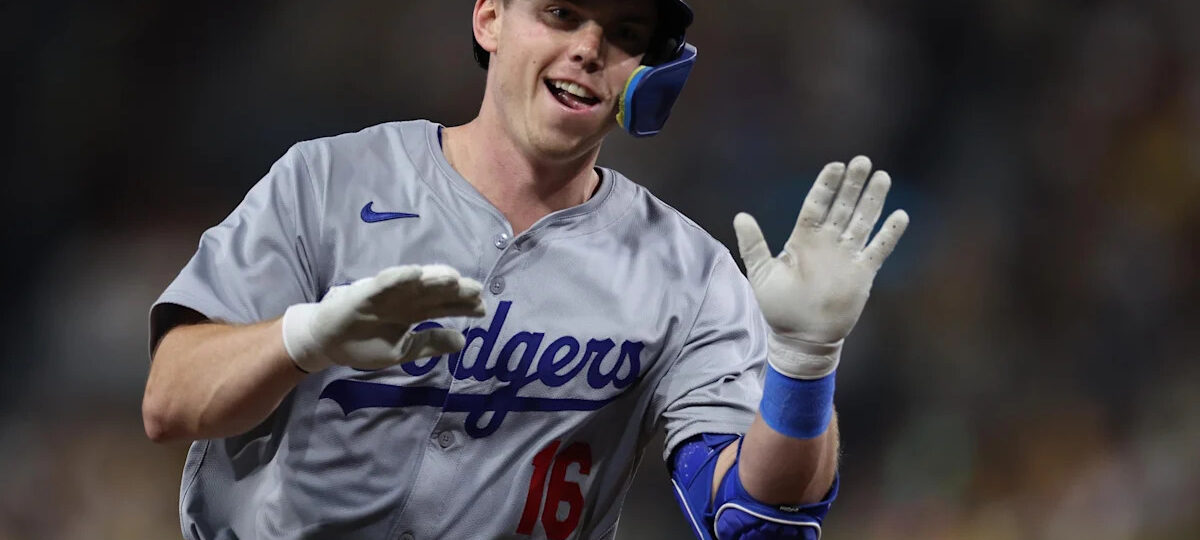
Chad Moriyama of Dodgers Digest has an excellent breakdown of the answer to “are the Dodgers that bad offensively?”, which is a resounding “yes, the Dodgers are even worse than you remembered in July and August.” The wheels figuratively fell off when Will Smith went down with an injury, as the supposed superteam became super mortal in a hurry.
Thankfully, Smith has finally returned. And almost, as if on cue, the offense is showing signs of life against the Nationals.
Unlike Reggie Jackson of the New York Yankees in the late 1970s (allegedly?), Will Smith would never describe himself as the straw that stirs the drink. He’s just that taciturn and can’t tell a joke to save his life, which is a problem I can relate to.
See — absolutely terrible. There was a crime, and it was against comedy.
Smith and Shohei Ohtani were the only Dodgers to hit with any regularity in last year’s Fall Classic, so it was not a shock that the Dodgers offense sputtered when Dalton Rushing, Chuckie Robinson, and Eliézer Alfonzo had to pick up the slack. At the trade deadline, the lack of punch led to reunions with Hunter Feduccia and Ben Rortvedt. Rortvedt has since been designated for assignment, yet again, but actually cleared waivers this time.
If at first you don’t succeed, keep trying until your man gets to Oklahoma City.
In my view, the Dodgers are one of the biggest disappointments this season. Granted, one can disappoint and still succeed. Unlike the absolute train wrecks in Queens or Seattle, the season-long hangover in Toronto, or the clinic in how to alienate a fanbase in San Francisco, I compare the Dodgers to an underachieving A-student:
[The team was] billed as the second coming of the 1992 NBA Dream Team, which I didn’t buy for a minute; [and it’s] been less than the sum of the considerable parts.
If they end up pulling off the 3peat – great, I’ll zip it; but as built and as on the field, feels like an older, warmed over version of last year’s flawed championship model.
[The team was] billed as the second coming of the 1992 NBA Dream Team, which I didn’t buy for a minute; [and it’s] been less than the sum of the considerable parts.
If they end up pulling off the 3peat – great, I’ll zip it; but as built and as on the field, feels like an older, warmed over version of last year’s flawed championship model.
As someone who was an underachieving A-student for most of his life, it took a lot of humbling and therapy to realize that I was coasting in life on talent, not work ethic, and doing just enough to excel in less-than-optimal surroundings. Eventually, the crash between what is required and what you have been doing comes like a thunderclap.
To succeed in life, outside of nepotism, regardless of talent, you have to put in the effort, and 90% of that effort is just showing up and being attentive.
Dave Roberts met with the team on August 10, and, to his credit, he has been managing with urgency.
As often as I have disagreed with Roberts over the years, and apart from one mind-boggling decision to use Edwin Diaz last month, Roberts is largely not to blame for the team’s offensive malaise. After all, he’s not the one in the batter’s box.
The problem is that he keeps putting the accelerator down, and instead of this mighty offensive engine roaring to life, there’s a figurative sputtering sound before the car screeches to a halt, usually by double play.
This figurative car clearly has the best brakes in its class.
Breaking down those double plays is a topic for another day, because it’s one thing to hit a pitcher’s pitch into a twin killing; it’s another baffling thing to hit something that would usually be driven into the outfield in the air right into the ground to snuff a rally.
If you were fortunate enough to buy a supercar and it ended up performing like a Honda Accord that needed a tune-up, you would understandably be both concerned and deeply annoyed.
However, Bill Plunkett of the Orange County Register recently asked whether everyone is just expecting too much from the Dodgers offense. To their credit, they said no, the expectations are valid:
“No. I don’t think you can expect too much of us. And we like that. We like that you think we should be scoring more,” first baseman Freddie Freeman said to that. “If you were content with us scoring three, four runs then we wouldn’t have a very good offense. I’m okay with you guys expecting more out of us. We expect more out of ourselves.”
Dodgers manager Dave Roberts takes a similar approach to the question.
“I don’t know. I would say, ‘No,'” he said. “Expectation for our offense is a good thing. It speaks to the talent we have.
“I expect more from our offense. And I think they do as well. … I wouldn’t have it any other way.”
And there it is – “the talent we have.” It’s the names in the Dodgers’ lineup that create the expectations which they aren’t meeting…
“I absolutely agree with that,” Roberts said. “That’s just Father Time. That’s reality.
“I think the reason people do have big expectations is the track record. But I still don’t expect this team offensively to fall off a cliff. … In the last two months, yes (it has).”
Enjoying this article? Support our work with a small crypto donation.
“No. I don’t think you can expect too much of us. And we like that. We like that you think we should be scoring more,” first baseman Freddie Freeman said to that. “If you were content with us scoring three, four runs then we wouldn’t have a very good offense. I’m okay with you guys expecting more out of us. We expect more out of ourselves.”
Dodgers manager Dave Roberts takes a similar approach to the question.
“I don’t know. I would say, ‘No,'” he said. “Expectation for our offense is a good thing. It speaks to the talent we have.
“I expect more from our offense. And I think they do as well. … I wouldn’t have it any other way.”
And there it is – “the talent we have.” It’s the names in the Dodgers’ lineup that create the expectations which they aren’t meeting…
“I absolutely agree with that,” Roberts said. “That’s just Father Time. That’s reality.
“I think the reason people do have big expectations is the track record. But I still don’t expect this team offensively to fall off a cliff. … In the last two months, yes (it has).”
Mookie Betts pushed back at this narrative with Plunkett, if only by degree.
Betts agrees. But he adds another factor – hitting has gotten harder since they put up those numbers on the backs of their baseball cards. Every pitcher seems to throw 100 mph – or higher – these days and “a computer tells him (the pitcher) what to throw to get you out. And a computer tells them (the defense) where to play to get you out.”
“That was when guys were throwing 92, 93 when we did that. And we were younger, yes,” Betts said of the prime years of the Dodgers’ stars, exaggerating how quickly velocity has jumped in MLB.
“I don’t care who you are. You can be Shohei or anybody, the best player in the league. You’re not hitting 100 (mph) consistently every day. Nobody is doing that. We’re facing 97, 98 every day. Then the guys who are 92, 93 – there’s something to it. Sometimes we hit it. Sometimes we don’t. That’s part of the human element of the game. But I think that part is getting missed. Y’all expect us to score six or seven (runs) every day, you know what I’m saying?
“The game is way harder than people give credit to. They think it doesn’t matter who’s pitching, we’re going to hit them. Shohei’s going to hit a homer (every at-bat).”
Betts agrees. But he adds another factor – hitting has gotten harder since they put up those numbers on the backs of their baseball cards. Every pitcher seems to throw 100 mph – or higher – these days and “a computer tells him (the pitcher) what to throw to get you out. And a computer tells them (the defense) where to play to get you out.”
“That was when guys were throwing 92, 93 when we did that. And we were younger, yes,” Betts said of the prime years of the Dodgers’ stars, exaggerating how quickly velocity has jumped in MLB.
“I don’t care who you are. You can be Shohei or anybody, the best player in the league. You’re not hitting 100 (mph) consistently every day. Nobody is doing that. We’re facing 97, 98 every day. Then the guys who are 92, 93 – there’s something to it. Sometimes we hit it. Sometimes we don’t. That’s part of the human element of the game. But I think that part is getting missed. Y’all expect us to score six or seven (runs) every day, you know what I’m saying?
“The game is way harder than people give credit to. They think it doesn’t matter who’s pitching, we’re going to hit them. Shohei’s going to hit a homer (every at-bat).”
Respectfully, I think Betts is missing the mark here. Yes, it is wildly unrealistic for a baseball team to go 162-0, which is why I personally get so salty at those who get overly enthusiastic in the preseason. Yes, it is wildly unrealistic for everyone to be performing at peak offensive efficiency at all times throughout the year.
But no one is asking the right question here.
It is not a matter of whether the Dodgers are playing like All-Stars. No one is seriously arguing that the team is a failure just because everyone is not playing at their peak; the question is whether the team is playing well or not.
No one has compared Betts or Freeman to regular-season MVP candidates in a long while, and maybe never again. The problem is that the Dodgers are struggling to be average at the plate, which is unacceptable given the offensive firepower they have assembled.
From July 1 to the start of play on September 4, here’s a quick and dirty calculation of everybody’s OPS+, except Will Smith and Alex Freeland for either lack of playing time due to injury or being in the minors.
As a reminder, an OPS+ of 75 or less is poor, 100 is average, up to 120 is good, up to 140 is an All-Star, and 150+ is MVP-level production. Spoiler: any discussion beyond “good” for this stretch is academic.
- Ohtani – 128, Raw OPS .833
Betts – 93, Raw OPS .698
Freeman – 121, Raw OPS .793
T. Hernández – 84, Raw OPS .668
Tucker – 71, Raw OPS .613
Muncy – 108, Raw OPS .760
Pages – 114, Raw OPS .773
Edman – 98, Raw OPS .711
Rushing – 123, Raw OPS .815 (in 26 games)
Rojas – 85, Raw OPS .671 (in 32 games)
Call – 67, Raw OPS .590 (in 23 games)
Feduccia – 64, Raw OPS .595 (in 22 games)
Rortvedt – 3, Raw OPS .370 (in 16 games)
K.Hernandez – 21, Raw OPS .434 (in 21 games)
Rushing – 123, Raw OPS .815 (in 26 games)
Rojas – 85, Raw OPS .671 (in 32 games)
Call – 67, Raw OPS .590 (in 23 games)
Feduccia – 64, Raw OPS .595 (in 22 games)
Rortvedt – 3, Raw OPS .370 (in 16 games)
K.Hernandez – 21, Raw OPS .434 (in 21 games)
Ohtani has been superhuman for so long that seeing him be just “above average” is a bit shocking.
While Betts and Teoscar have rebounded over the past week or so, reducing their performance to a single number puts the situation over the past two months at the plate in stark relief. The Dodgers have been paying premium prices for literally subpar performances from major contributors in the lineup, most notably Kyle Tucker, who homered at home for just the third time this season on September 4.
Pages and Rushing were performing admirably, but then injuries knocked them out of the lineup, to the team’s offensive detriment.
This roster isn’t supposed to be like the group of homegrown goobers that played in 2017 or 2018. Yes, those teams were flawed and felt less like collections of All-Stars and more of a homegrown product, which is a bit of a misnomer and inaccurate because just about every team signs free agents.
Apart from the hangover to start 2018 and the lull to end all lulls in September 2017, expectations about the offense went accordingly, and the 2017 and 2018 Dodgers got the job done until they didn’t.
Is it unreasonable to expect this year’s lineup to individually have an OPS+ over 120? Probably, almost certainly.
I understand that not all playing time is distributed equally, and that bench players or injury substitutes often cannot fill in without an offensive drop-off.
Is it unreasonable to expect this year’s lineup to individually have an OPS+ of at least 100? Not for the starters, certainly. It’s a collective problem that everyone will have to work through together, or, alternatively, folks will need to return from injury to some semblance of form. There are certainly some encouraging signs before the start of Labor Day.
Actual consistency is something that has felt missing for the past couple of months, and time will tell whether this play is leading to something or just another mirage.
The rebounds from Betts and Teoscar are a welcome sight to see. There’s still room to grow, and still time for people to, to quote Dave Roberts, “play like the back of their baseball card” over the final twenty-or-so regular season games of 2026.
Discover more from NAIRAVOICE.COM.NG
Subscribe to get the latest posts sent to your email.