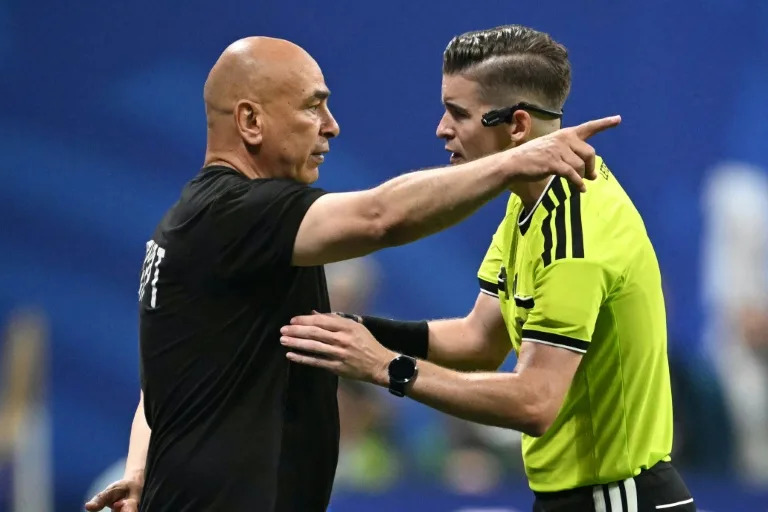
FIFA referees chief Pierluigi Collina has hit out at “unfounded allegations” against World Cup match officials in the wake of Argentina‘s controversial last 16 victory over Egypt.
In comments posted on FIFA’s official website, Collina defended officials who oversaw Argentina’s 3-2 win in Atlanta and were accused of malpractice by Egypt coach Hossam Hassan.
Hassan speculated that the officiating team for the game, headed by French referee Francois Letexier may have been subjected to “external pressure” to favour Argentina.
The claims came after a string of decisions went against the Egyptians, including a goal chalked off by VAR for a foul committed much earlier in the move at the other end of the field.
Collina though rejected any suggestion of wrongdoing or a conspiracy to assist Argentina’s World Cup campaign.
“Of course, constructive discussion about decisions will always be part of football, but unfounded allegations have no place in our sport,” Collina said.
“Nobody can question the integrity of the FIFA World Cup match officials. When this happens, it may provoke reactions that lead to threats against them and their families. This is not right.
“Equally, nobody can claim that FIFA Refereeing can be influenced by anyone, not even by the FIFA President (Gianni Infantino).
“Match officials make honest decisions and, just like players and coaches, they always try to do their best.”
Egypt coach Hassan said his team had been the victims of “injustice” by officials.
“We have been cheated unfairly today, we have suffered injustice,” Hassan said after his team’s loss, suggesting that FIFA “wanted to keep the world champions in the competition. Perhaps they wanted Messi to stay in the running.”
“In football, there are sometimes external factors that go beyond the technical aspects. The world champions received support at every level,” Hassan told BeIn Sports.
But on the specific case of the decision to disallow Mostafa Zico’s superb breakaway goal which would have given Egypt a 2-0 lead, Collina said referees had acted correctly after VAR spotted a foul in the build-up.
“If a foul is identified in the build-up and is deemed to have had an impact on the goal, the VAR will recommend an on-field review,” the Italian said. “There is no defined limit regarding either the distance from goal or the amount of time between the incident and the goal.
“We believe that a foul is a foul. Regardless of whether the foul appears ‘obvious’, if the referee did not see it on the field of play, the VAR can intervene.”
Discover more from NAIRAVOICE.COM.NG
Subscribe to get the latest posts sent to your email.