
I wonder if thriller or action movies have warped our sense of expectation. Take The Karate Kid, Whiplash (underrated), or Spider-Man: Into the Spider-Verse, for example. Our main character gets put into a situation where they have to learn new skills; the stakes couldn’t be higher, and it all culminates in an event where they come out (mostly) on top. However, it’s the mastering-of-abilities part that we gloss over.
Training-camp montages and clips of practice don’t give us a sense of how much a player is retaining. It leads to the assumption that more time equates to greater absorption. But if the last two weeks have shown us anything, it’s that progress isn’t linear. Sometimes it takes a moment of clarity for things to click.
And for a few teams, that hasn’t happened yet.
A thought just hit me, and I’ll share it with you using the gift of hindsight bias.
We’ve often looked at Justin Herbert as a robot QB. He’ll check all his reads, make the risk calculations on the fly and throw the optimal pass. Herbert’s been more aggressive as of late, but you’ll still catch shades of it depending on the situation.
Anyway, contrast his play-execution approach to OC Mike McDaniel’s style. The guy who ponders mortality, but has the sneaker mindset of a 20-year-old. You couldn’t find two more dissimilar people outside of their love for football. So, communicating the details might be hard for the Chargers’ OC and QB.
To be clear, and as Josh indicates above, this is a collective failure. I’ll get to Herbert’s part in all of this in a bit, but even staying at the team level gives us an idea of what’s changed.
- Pre-Snap Motion: 50.0% (2025), 73.8% (2026)
- Play-Action Pass Rate (Early Downs): 32.0%, 42.5%
Plays per Game: 64.4, 56.5
Pre-Snap Motion: 50.0% (2025), 73.8% (2026)
Play-Action Pass Rate (Early Downs): 32.0%, 42.5%
Remember, heavy motion before the snap with an intermediate or deep shot off a play-action concept was a staple of the Dolphins offense. And we loved it. Well, we liked it, mostly because it worked. Or when it did, we’d get the explosive plays that would show up in the box scores of Tyreek Hill or Jaylen Waddle. But there’s a tradeoff.
Pre-snap motion can help receivers get up to their top speed faster. The payoff is throwing the ball farther downfield, and that’s what Herbert has done through two weeks. His passing aDOT is up 19.4% to 9.2 air yards. On play-action reads, it’s at 10.6!
But more time before the snap plus longer routes downfield takes more time off the clock, leaving the Chargers with fewer plays per game. Or, said another way, they’ve reduced their number of chances to pick up yards under the assumption an efficiency bump will give them the edge. This all sounds reasonable because we’ve seen it work before. And that’s part of why the finger-pointing goes toward No. 10.
- aDOT (using Play Action): 8.0 (2025), 10.6 (2026)
Pressure Rate: 48.5%, 65.0%
CPOE: +1.57% (2025), -6.24% (2026)
aDOT (using Play Action): 8.0 (2025), 10.6 (2026)
Admittedly, I’m presenting you with Herbert’s numbers in bad faith. Sure, if you were asking your QB to throw farther under more pressure, a steep drop in their completion percentage shouldn’t be a surprise. Such is the case for the Chargers’ QB1. But I’ll give you a few more metrics to contextualize the situation.
- (Early Down) Pass Rate Over Expectation: +1.91% (2025), -10.5% (2026)
Adj. Yards Before Contact per Att.: 0.68, 0.75
Yardage Needed on Third Downs: 6.7, 8.5
(Early Down) Pass Rate Over Expectation: +1.91% (2025), -10.5% (2026)
Adj. Yards Before Contact per Att.: 0.68, 0.75
Yardage Needed on Third Downs: 6.7, 8.5
Like any McDaniel system, the play sequencing relies on the combination of the rush and the pass. Accordingly, L.A.’s early-down PROE has dropped as compared to ’25. But Omarion Hampton‘s push from the interior offensive line to get to the LOS hasn’t improved. The result is Herbert and co. needing to go an extra two yards for a new set of downs. And even when he’s found the right throw, calamity still follows.
Because there are so few samples, intermediate attempts with at least a yard of separation will act like an anchor to a passer’s CPOE. That should be an “easy” completion. But Herbert’s receivers already have three drops collectively. Which could be why Herbert started to view the shorter passes as the better option versus letting it fly later in the game.
The losses are the exclamation point on all this. Without the full mastery of the offense, flashes are all we’ll get until things click between Herbert and McDaniel. Ladd McConkey is still a WR2 (when healthy), and Hampton ranks ninth in team rush rate. Along with Herbert, they’re your only viable starters until the QB-OC mind meld is complete.
So, I wanted to revisit the Buccaneers after my initial takeaways from their inexplicable loss to the Browns. Not to walk anything back, but to give a more forward-looking view. Tampa has three players with a top-100 ADP. Even some stability to the offense would be nice. Let’s look for the signs that things are back on track.
No, I’m not advocating for Baker Mayfield taking on an extra job as a lead blocker. Let’s focus on Bucky Irving‘s big run. Over the past two weeks, Tampa has split its early-down play calls between run and pass (-1.27% PROE). That means Irving’s results have as much of an impact as Mayfield’s. And we saw that influence on Sunday.
- (Early-Down) Rushing Success Rate: 62.5% (at CIN), 37.5% (vs CLE)
Forced Missed Tackle Rate: 62.5%, 12.5%
Third-Down Yardage Needed: 6.0, 9.2
(Early-Down) Rushing Success Rate: 62.5% (at CIN), 37.5% (vs CLE)
Forced Missed Tackle Rate: 62.5%, 12.5%
Third-Down Yardage Needed: 6.0, 9.2
Unfortunately for my argument, I’d expect to see RBs bouncing off Bengals’ defenders at a high rate. But an 80% drop isn’t just about the opponent. Irving’s adjusted yards per contact also fell by more than half. And the cascade effect put Mayfield at nearly 10 yards to go on third down. His Week 3 rival (Vikings) might not allow it, but Weeks 4-9 feature favorable matchups for Irving, making life easier for the passing game. But Mayfield can also help himself.
I’ll make a simple statement: making big plays is a good thing! But a “peaks and valleys” passing game has a short half-life after a big burst. And it looked like Mayfield understood that against Cincinnati.
- Passing aDOT (early downs, play-action): 6.0 (at CIN), 11.3 (vs CLE)
Passing Success Rate: 47.8%, 38.5%
Enjoying this article? Support our work with a small crypto donation.Pressure Rate: 18.5%, 34.6%
Passing aDOT (early downs, play-action): 6.0 (at CIN), 11.3 (vs CLE)
At least on the surface, these are the same problems the Chargers are experiencing. A less efficient running game leads to an overcompensating aerial attack. A third of Mayfield’s attempts on early downs using play-action concepts against the Bengals turned into a first down. That same rate fell to 20.0% against the Browns as his aDOT nearly doubled.
Mayfield had four pass-catchers average eight or more yards AFTER the catch per reception in Week 1. From Irving to Chris Godwin Jr., a short-to-intermediate plan not only extended drives, but (mostly) kept Mayfield upright. Ted Hurst and Tez Johnson will always be downfield threats. But finding a rhythm with his interior receivers will keep the offense on schedule and fantasy managers happy.
Narrative Street
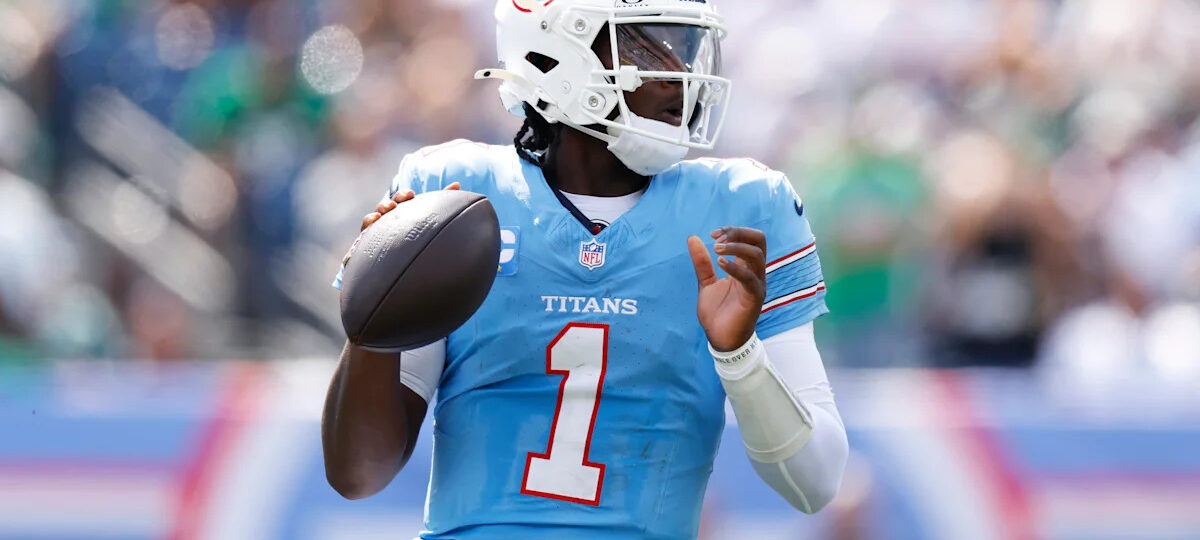
I started the Eagles defense in the Yahoo Expert league, under the assumption that they’d prey on Cam Ward‘s mistake-prone nature. But as I kept getting more updates about the game and Philadelphia‘s narrow loss, I decided to take a walk down Narrative Street regarding Tennessee‘s sudden reversal of fortune on offense.
Take 1: HC Brian Daboll still knows how to game plan.
Nothing about the Titans’ Week 1 offense indicated they could hang with the Eagles. Jayden Daniels‘ mobility and Stefon Diggs‘ route-running skills were the Commanders’ superpower against them the prior week. Tennessee can’t boast the same talent. But there was something about Philadelphia’s defense that Daboll could attack.
Before anyone with a 215 area code starts hollering at me, I recognize this is just one play. But Sunday was Tony Pollard‘s first outing with a rushing success rate at or above 50.0% against a solid rushing defense since Week 3 of last year. And Tyjae Spears wasn’t too far behind his RB1 with 70 all-purpose yards.
The results don’t matter to us because the single-digit PPR point totals are insignificant. But Philadelphia closed out the final month of the ’25 season as a league-average run defense, returned most of its starters and opened 2026 allowing the seventh-most first downs on the ground to RBs. Fittingly, Week 2 was when Daboll, the former Giants’ HC who played against the Eagles twice a year, decided to adjust Tennessee’s offensive tendencies.
- PROE: +5.4% (Week 1), -20.1% (Week 2)
Pre-Snap Motion: 45.7%, 63.6%
Under-Center Passing Rate: 8.6%, 27.3%
PROE: +5.4% (Week 1), -20.1% (Week 2)
Under-Center Passing Rate: 8.6%, 27.3%
Again, I’m trying not to focus on the results. Instead, let’s look for the signs of an offense prepared for its opponent. And at least for this one matchup, the Titans understood the assignment by pulling on the levers needed to limit the Eagles’ possessions while maximizing theirs. They averaged over 25 yards per drive for the first time since playing the Mahomes-less Chiefs. Even better, Ward showed some signs of life as a QB.
Take 2: Cam Ward is buying into how to be an effective passer.
I’ll be the first to admit Ward is still leaving plays on the field. But let’s compare his passing charts over his last two games.

Cam Ward Pass Chart. (Photo by Cam Ward/Next Gen Stats)
He’s throwing fewer passes to the boundary while allowing his receivers to work after the catch. His CPOE flipping from -5.6% to +3.4% is our first encouraging sign. But so is his YAC per completion nearly doubling from 3.9 to 7.7. And that’s not from a single play.
Elic Ayomanor picked up chunk plays on two intermediate targets. Spears (14.0 YAC per reception) and Pollard (8.0) also contributed to giving the offense a fresh set of downs. And even though Carnell Tate only turned in 27 scoreless yards, his shortened aDOT (9.8) and team-leading target share (29.4%) are indicators of a positive shift.
With more positive matchups in their future, call me “Titans curious” for the next month.
Since Seattle is 2-0 with the second-best point differential (+27), I almost forgot they had a new play-caller. Because it’s not like it’s mattered for the overall WR3 in most drafts.
Watching Jaxon Smith-Njigba is like that scene in Sherlock Holmes where Robert Downey Jr. explains ahead of time how he’s going to beat a bare-knuckle boxer. You know it’s coming, and the outcome is still a shock. And as JSN is the only WR with top-three marks in catches, yards and TDs, the “new Klint Kubiak,” OC Brian Fleury, deserves some praise. That’s especially true with Drew Lock starting in place of Sam Darnold.
But then there’s also Jadarian Price’s two-week output to consider.
The good news is that Price looks the part of a Seahawks’ RB. Fleury has built on Kubiak’s use of outside-zone blocking schemes to provide rushing lanes, pushing Seattle’s usage rate from 33.5% in ’25 to 48.3% through two weeks. Undeniably, Price has the burst and power to get to the formation’s boundary and up the field. But we haven’t seen enough of him.
- Rushing Rate: 50.0% (Week 1), 57.5% (Week 2)
Routes per Dropback: 26.0%, 32.5%
Goal-line Share: N/A, 25.0%
Rushing Rate: 50.0% (Week 1), 57.5% (Week 2)
While Price took a backseat to Jeremiyah Love in college, a first-round RB does carry workload expectations. Sure, it’s nice to see his usage ticking up, but he was still competing with George Holani and Emanuel Wilson for touches before getting hurt in Week 2. It’s bad enough Zach Charbonnet may be practicing in the next couple of weeks. Coupled with a shared backfield right out of the gate, Price’s opportunity level is the worst-case scenario. But he’s shown he has the talent to change Fleury’s mind.
- Adj. Yards After Contact per Att.: 3.96, 8th (out of 39 qualifiers – min. 30% team rushing rate)
Forced Missed Tackle Rate: 30.4%, 7th
Explosive Run Rate: 13.0%, T-4th
Adj. Yards After Contact per Att.: 3.96, 8th (out of 39 qualifiers – min. 30% team rushing rate)
Forced Missed Tackle Rate: 30.4%, 7th
Price’s advanced metrics back up what we’ve seen on game day. And if you give any credence to PFF’s charting, he’s yet to allow a pressure or sack on pass-blocking snaps. In his only full game, he took 50% of the carries with a 40% route rate. With his shoulder injury not considered a lingering issue, Price becomes a buy-low candidate for those hunting for a low-end RB2.
Discover more from NAIRAVOICE.COM.NG
Subscribe to get the latest posts sent to your email.