

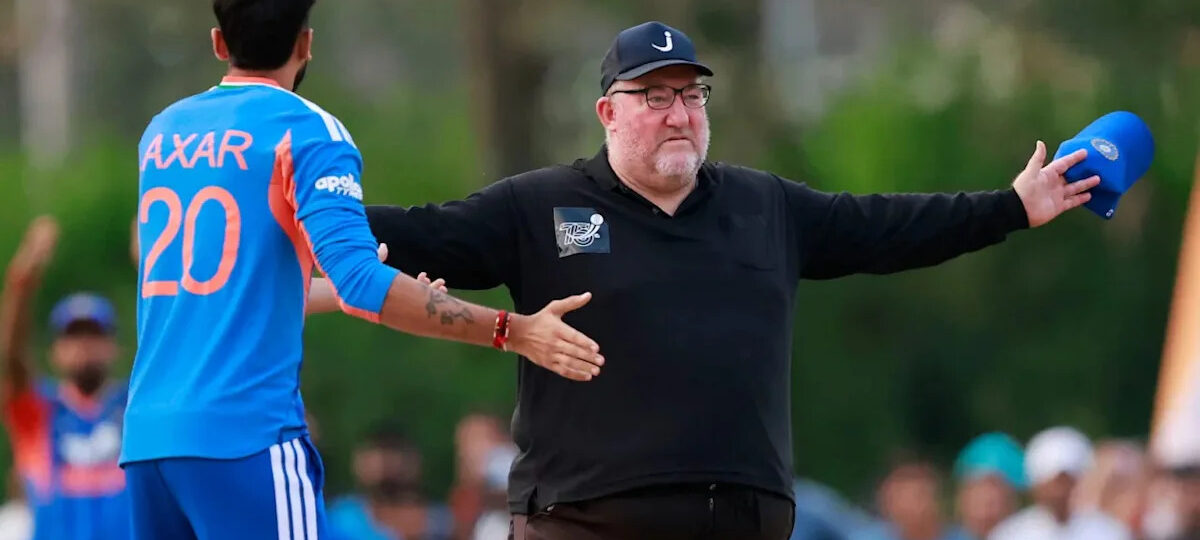

Explained: Why Axar Patel’s second wide in final over vs Japan was reversed by umpire as India avoid embarrassment in Sano originally appeared on Cricket News.
Add Cricket News as a Preferred Source by clicking here.
KEY TAKEAWAYS:
- India barely beat Japan by two runs in a five-over T20I, with Axar Patel defending the final over.
- An umpiring controversy arose in the last over when a wide call against Axar was reversed after Shreyas Iyer’s intervention with the officials.
- The reversal became a significant call that impacted the match result.
Why Axar Patel’s wide call was reversed to save India from a shock loss vs Japan
India’s nerves were fraying by the time the final over of Japan’s chase arrived in Sano on Tuesday.
Axar Patel was entrusted with the ball to save India’s blushes, and the spinner did not disappoint. However, it took a rattled Sanju Samson behind the stumps, Shreyas Iyer marching over to the square-leg umpire, to give them a lifeline by reversing, in all fairness, one of the more unusual umpiring decisions in recent T20I history.
As the over progressed, Japan’s Alexander Shirai-Patmore attempted a reverse sweep off Axar, going for a big shot against a delivery that was spinning away. The ball went down the leg side, and the umpire called it wide. Axar bowled the same line and length and the batsman once again failed to connect.
The umpire again spread his arms to signal wide and this time, the frustration boiled over. Samson was not pleased behind the stumps, and Axar not pleased in front of it. Iyer then stepped in, walked across to speak with square-leg umpire Chris Brown while the two on-field officials consulted with each other.
MORE: IND vs JPN one-off T20I 2026 scorecard, result and highlights as Japan miss out on historic win
The key debate was whether Shirai-Patmore had moved his stance early enough, or more specifically, whether he’d switched before Axar had actually released the ball.
Under the rules governing wide deliveries in T20I cricket, if a batter moves their stance and a delivery that would otherwise have been wide passes them, the umpire is entitled to rule it not wide because the batter was moving across the stumps. The crucial judgement was whether that change of stance happened prior to the point of delivery.
After the consultation, the decision was reversed. The ball was ruled not a wide, much to India’s relief and Japan’s disappointment.
MORE: ‘Flat track bullies’: Fans slam India as they narrowly beat minnows Japan
🔴 BIG CONTROVERSY BETWEEN SHREYAS IYER & UMPIRE 🤯
– Axar Patel bowled a legal delivery, but umpire called it a wide.
– Axar was angry with the umpire as it was already back-to-back wides, & Japan needed only a few runs to win.
– Shreyas Iyer then spoke to the umpire.
-… pic.twitter.com/VQtdQf6XvHEnjoying this article? Support our work with a small crypto donation.— Sam (@cricsam02) September 22, 2026
India breathe a sigh of relief after narrow escape against Japan
India eventually got over the line by two runs, as they restricted Japan to 30 for nine across their five overs. The reversed wide decision meant one fewer run in Japan’s column, and with the margin of victory being just two, every single run mattered.
It was the kind of ending that will be talked about in Japanese cricket circles for years. Axiomatically, the rules were applied correctly once the umpires had time to consult and make their call, but the fact that India needed the reversal to avoid being in an even tighter position summed up the extraordinary evening.
The right call was eventually made, but the wider picture is concerning
The umpiring controversy attracted headlines, but the controversy India should really be examining is the one that preceded it: how a full-strength Indian T20I squad managed to score only 32 runs in five overs on a surface that, while helpful to spin, should still have produced a more competitive total.
The reversed wide is a technicality. It was the correct decision based on the applicable rules. But India couldn’t afford to be in a position where a single wide reversal was the difference between winning comfortably and losing to a team playing their first T20I against a full member nation.
The batting lineup’s inability to adapt to conditions that aren’t tailor-made for attacking is the real story here. It’s been raised before and the Sano match gave it another, louder voice.
For all the latest cricket news, opinion, and commentary and to share your voice, head to our Facebook, Instagram, and X (Twitter) pages.
Discover more from NAIRAVOICE.COM.NG
Subscribe to get the latest posts sent to your email.