The world’s newest private jet is breaking speed records, but the manufacturer’s CEO and chief engineer say going supersonic isn’t worth the time.
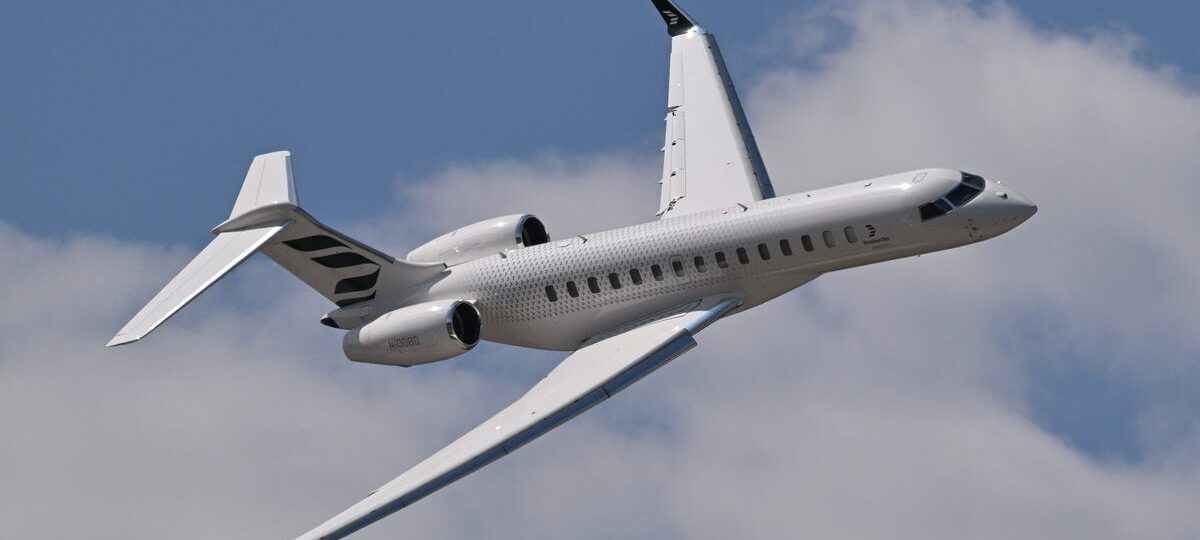
Bombardier’s Global 8000 is the fastest civil aircraft since Concorde and costs at least $78 million to buy.
It entered service in December and made its airshow debut at last week’s Farnborough Airshow, near London.
Farnborough Airport is popular for private jets; it does not operate any commercial flights.
The journey there from Los Angeles took 8 hours and 46 minutes, the fastest time ever recorded between the two destinations.
A commercial flight from LA to London typically takes up to 10 hours.
But Concorde could fly over Mach 2 — twice the speed of sound, or over 1,500 mph, connecting New York and London in under four hours.
The Global 8000’s top speed is Mach 0.95.
When you’re building airplanes for the world’s wealthiest people, why not push further to break the sound barrier? “Flying supersonic would be a bit of a niche,” Bombardier CEO Éric Martel told Business Insider at Farnborough. “It would be very expensive for certification — it’s another level.” The rich and powerful love private jets because they can help save time, which becomes ever more valuable as a high-flying CEO with a busy schedule.
They can avoid waiting hours at the airport or in security and be driven to the plane whenever it suits them.
However, going past Mach 1 introduces several engineering challenges to overcome increased drag, friction, and heat. “To go beyond the speed of sound, you actually need quite a lot of thrust to go beyond it,” said Stephen McCullough, Bombardier’s chief engineer.
He added that the Global 8000 gets close enough to supersonic without the complications of actually doing so.
For certification, Bombardier had to prove it had the structural integrity to withstand supersonic flight, which required a NASA F-18 to follow the test aircraft.
McCullough pointed to the hurdles that going supersonic posed for Concorde.
It had four Rolls-Royce Olympus engines with afterburning, which required huge quantities of fuel.
Plus, its triangular delta-wing design required a very steep angle of attack at takeoff and landing, which is why the nose drooped so pilots could see the runway.
McCullough, who’s worked at Bombardier for 37 years, said there’s always been talk about a Concorde replacement, “but the economic feasibility of it, and just the level of compromise to go at that speed, you sort of suffer for the day-to-day part of it all.” “I know there are a couple of companies that are trying,” he added. “In aviation, we like to see innovation, but it’s a challenge at the moment we’re in, in the space that we’re in.” Boom Supersonic, a startup building an airliner capable of flying up to Mach 1.7, or about 1,300 mph, has faced a few hurdles.
Most notably, it decided to make its own engine, called Symphony, after the major manufacturers declined to help.
Rolls-Royce had a contract with them before deciding it didn’t want to prioritize commercial supersonic flight. “People called us crazy for building our own engines, but what I’ve come to believe is we were crazy to think of doing it any other way,” Boom CEO Blake Scholl previously told Business Insider.
Last January, its scaled-down test aircraft broke the sound barrier — without the sonic boom being audible from the ground.
A few months later, President Donald Trump signed an executive order lifting the ban on supersonic civil aircraft over land.
The Global 8000 is named for its 8000 nautical-mile range, enough to fly nonstop for 17 hours.
The world’s fastest private jet isn’t only about speed and range.
Customers also expect superlative comfort. “People really want to be able to have nice meals, and so people want a very good galley,” McCullough said.
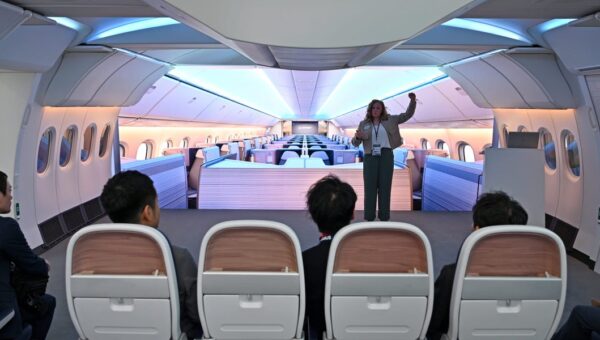
He added that a lot of customers want the aircraft to be “very quiet,” and to have “more of whatever they have at home.” This includes high-speed internet, comfortable seats, ample space, good views, and a bedroom in the back.
Plus, the Global 8000 has the lowest cabin altitude of any private jet, which reduces jet lag and dehydration because passengers will have more oxygen.
While cruising at 41,000 feet, the cabin pressure means it feels like being at 2,691 feet — compared to about 6,000 feet on the newest airliners like the Boeing 787 or Airbus A350.
Discover more from NAIRAVOICE.COM.NG
Subscribe to get the latest posts sent to your email.