
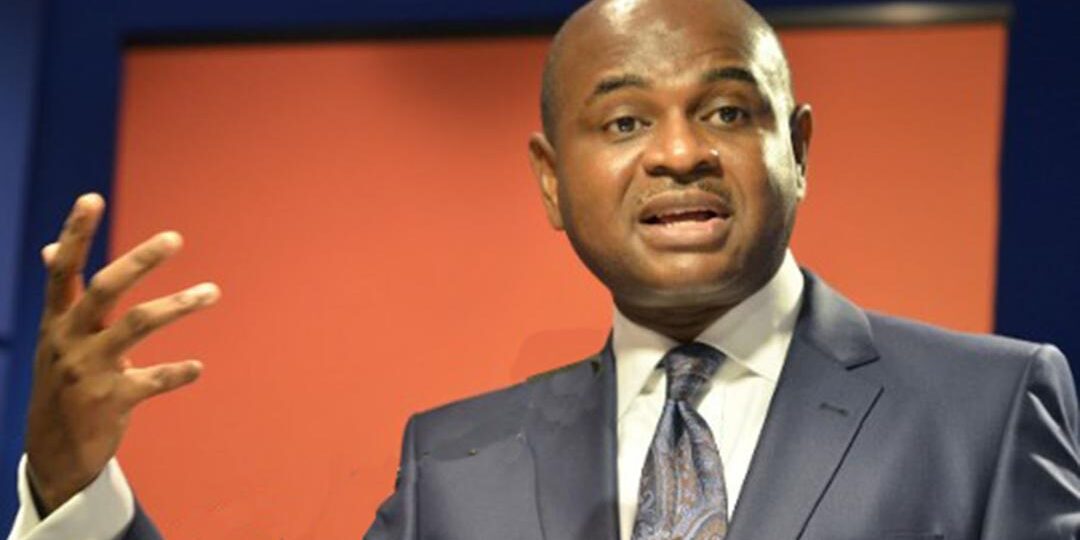
Former Central Bank of Nigeria Deputy Governor, Kingsley Moghalu, has welcomed a United Nations resolution supporting the use of world maps that show Africa’s size more accurately.
However, he said changing the map alone would not bring economic prosperity to the continent.
Moghalu said in a post on X on Sunday that the UN General Assembly voted 164-1 in favour of the “Correct the Map” resolution, which was introduced by Togo on behalf of the African Group and supported by the African Union.
The resolution encourages schools, governments, international organisations and technology platforms to use equal-area maps, such as the Equal Earth projection, instead of the traditional Mercator map.
The Mercator projection was developed in the 16th century mainly for navigation. It makes areas closer to the North and South Poles appear larger while making areas around the Equator appear smaller.
Moghalu noted that Africa is about 14 times larger than Greenland, even though both appear almost similar in size on the Mercator map.
He stressed that the UN resolution is not legally binding, does not stop the use of the Mercator projection for navigation and will not change national borders.
“The resolution is not binding. It does not ban Mercator for navigation. It does not redraw a border. It asks the world to stop teaching a distortion as geography,” he said.
Moghalu said the importance of the resolution goes beyond maps because the way countries and continents are represented can influence how people see their importance in the world.
“Maps are never only maps. They are instruments of worldview. They tell children who is large and who is small, who is central and who is peripheral,” he said.
He said showing Africa’s true size was important for the continent’s dignity and global image, but warned that it would not automatically lead to economic development.
“A map can change how the world sees Africa. It cannot change how African states organise themselves,” Moghalu said.
Referring to his book, Emerging Africa, Moghalu said Africa was “emerging, not rising”, arguing that greater visibility and a change in global perception were not the same as real development.
He said sustainable development requires higher productivity, skilled people, good governance, proper planning and a clear national purpose.
“Development is first a state of the mind. Without that inner architecture — values, strategy, organisation — we keep mistaking symbols for substance,” he said.
Moghalu also referred to countries such as China, South Korea, Singapore, Taiwan and Vietnam, saying their economic progress came from investment in education, industries, strong institutions and long-term national planning.
“The map followed the factories, not the other way around,” he said.
He urged Africans to use the new focus on Africa’s true size as an opportunity to rethink what the continent can achieve with its land and natural resources.
“Teach the true size of Africa. Let children see that this continent can contain the United States, China, India, Japan, Mexico and much of Europe and still have land to spare,” he said.
He, however, urged African leaders and citizens to look beyond pride in the continent’s size and concentrate on building productive economies.
Discover more from NAIRAVOICE.COM.NG
Subscribe to get the latest posts sent to your email.