 Icon Sportswire via Getty Images
It was an eventful Week 2 of the college fantasy football season, with plenty of surprises from a CFF standpoint that we need to account for. I focused on players who were rostered in 10% of leagues or less in order to spotlight players who can help your college fantasy teams immediately.
Play Yahoo’s new College Fantasy Football game: Create or join a league now!
Quarterbacks
Michael Hawkins Jr., West Virginia — 4% Rostered
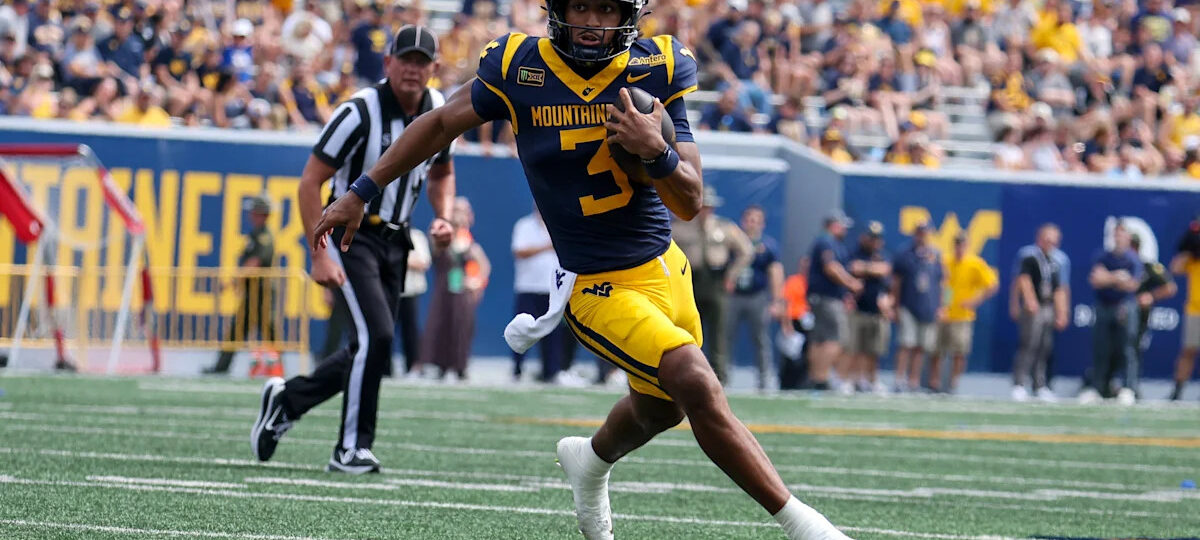
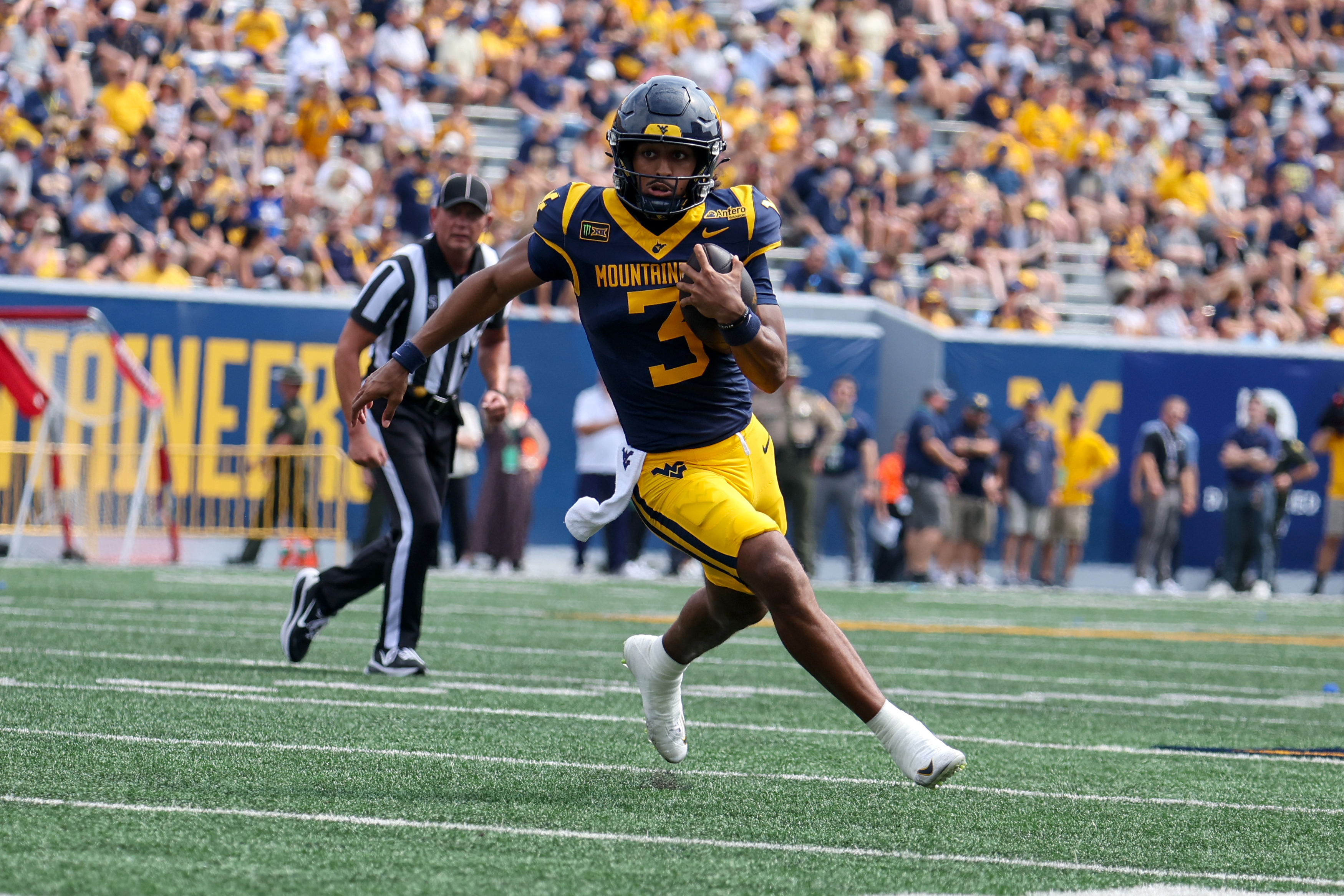
The athletic specimen continued his torrid start by accounting for four touchdowns in West Virginia’s 52-7 demolition of UT Martin, producing 35.8 fantasy points. Hawkins completed 5-of-7 passes for 155 yards and two touchdowns while adding 96 rushing yards and two scores, including an explosive 71-yard touchdown run that showcased his game-breaking athleticism. The Oklahoma transfer has now exceeded 23 fantasy points in consecutive outings after scoring 23.6 points in Week 1, giving him 59.4 points through his first two appearances. While Saturday’s abbreviated seven-attempt passing workload limits the predictive value of his aerial production, the designed rushing involvement and open-field explosiveness are sustainable CFF assets in HC Rich Rodriguez’s run-heavy scheme.
West Virginia’s upcoming schedule features Virginia at a neutral site, Oklahoma State at home and Iowa State on the road. Virginia represents Hawkins’ first meaningful Power Four test, but Oklahoma State just surrendered 31 points in a shootout win vs. Oregon and projects as the most attractive matchup of the three. His passing efficiency will inevitably regress against stronger defenses, but a quarterback averaging 29.7 fantasy points per game with a featured rushing role deserves immediate attention.
Gio Lopez, Wake Forest — 1% rostered
Lopez authored one of Week 2’s most impressive dual-threat performances while leading Wake Forest past Purdue in double overtime. Lopez completed 16-of-27 passes for 225 yards and one touchdown while adding 59 rushing yards and two scores on 13 carries, producing 32.9 fantasy points. The 13 rushing attempts are the most important number for CFF purposes, as they reveal a designed component of the offense rather than production derived solely from broken-play scrambles. Lopez protected the football, consistently extended drives and accounted for three of Wake’s touchdowns in a competitive road environment.
Wake Forest hosts Miami next before traveling to Louisville and welcoming Stanford, providing Lopez with three games that should preserve four-quarter volume. Miami represents a significant defensive test, but Louisville should force Wake Forest into aggressive offensive scripts with 35-plus pass-and-rush opportunities for Lopez. Stanford is the obvious streaming target at the end of the stretch. Lopez’s combination of secure volume and goal-line rushing involvement makes him a viable QB streamer.
Jaden Craig, TCU — 2% rostered
Craig eviscerated Grambling State by completing 24-of-31 passes for 391 yards and four touchdowns without committing a turnover. The Harvard transfer also gained 53 rushing yards, combining for 36.9 fantasy points in TCU’s 63-7 rout. Craig displayed legitimate vertical intent, connecting on touchdowns of 52 and 29 yards while repeatedly utilizing TEs Kari Ashley and Ka’Morreun Pimpton down the seams. His 31-yard scramble on a broken fourth-down play further reinforced the athletic component of his CFF profile.
Craig now hosts a CFF-friendly tilt against Arkansas State before beginning Big 12 play at UCF and returning home against BYU. Arkansas State supplies an enticing streaming matchup, while UCF and BYU should generate the competitive scripts needed to keep TCU’s offense aggressive into the fourth quarter. Craig’s 391-yard explosion must be discounted slightly because of the opponent, but the efficiency, downfield usage and rushing production are all transferable traits. He profiles as a strong speculative QB2 with major streaming potential.
Running Backs
Daniel Hill, Alabama — 11% rostered
The full-sized tailback seized control of Alabama’s backfield in Saturday’s 45-17 victory over Kentucky, rushing 18 times for a career-high 104 yards and one touchdown. Hill generated 18.6 fantasy points and handled 18 of the Crimson Tide’s 30 running-back carries, easily outdistancing Trae’shawn Brown, Kevin Riley and EJ Crowell. His 31-yard gain set up his own three-yard touchdown in the third quarter, providing the physical inside presence Alabama needed after trailing 17-13 at halftime. The fact that Hill received such a heavy workload in an SEC road game validates the performance far more than his two-touchdown eruption against an overmatched opponent like ECU the week prior.
Alabama hosts Florida State and South Carolina before visiting Mississippi State over the next three weeks. Those matchups are roughly on par with Kentucky, and the presence of three capable reserve backs prevents Hill from attaining true bell-cow status immediately. However, his 18-carry workload indicates that he has moved to the front of the rotation. Hill is a strong waiver-wire option coming off two consecutive 18+ point performances and should be treated as a workload-driven RB2/Flex.
Matt Fuller, South Carolina — 5% rostered
Fuller dialed up 125 yards and a touchdown on only 11 carries in South Carolina’s rain-soaked 45-9 victory over Towson. His 55-yard touchdown highlighted a hyper-efficient outing in which he averaged 11.4 yards per attempt and scored 17.8 fantasy points. Fuller has now accumulated 199 yards and two touchdowns on 21 carries through two games, averaging a robust 9.5 yards per tote. The 221-pound runner was named South Carolina’s Joe Morrison Offensive Player of the Spring, while QB LaNorris Sellers and WR Nyck Harbor both publicly praised his physical, north-south running style.
The looming schedule—Mississippi State, at Alabama and Ole Miss—will provide a far sterner examination of Fuller’s role. South Carolina continues to rotate Jabree Coleman and Isaiah Augustave, while Sellers’ rushing ability further complicates the distribution of goal-line work. However, Fuller’s blend of size and explosiveness has become increasingly difficult for the coaching staff to contain. He is a worthwhile speculative addition, though managers should initially value him as a matchup-dependent flex rather than an unquestioned starter until we see how he performs against SEC caliber opponents.
Rodney Fields Jr., Kansas State — 5% rostered
Rodney Fields Jr. surpassed 100 rushing yards for the second consecutive week during Kansas State’s 34-7 domination of Washington State. Fields supplied the game’s defining offensive play with a 75-yard touchdown and scored approximately 16.5 fantasy points, establishing himself as the most explosive member of the Wildcats’ crowded backfield. Kansas State amassed 295 rushing yards on 40 attempts, with its offensive line consistently creating clean second-level opportunities. Fields’ ability to generate chunk gains separates him from a rotation that also includes 2025 starting RB Joe Jackson.
Kansas State hosts Tulane before traveling to Cincinnati, two very appealing matchups for fantasy purposes. Keep in mind, he produced 890 scrimmage yards at Oklahoma State last season and has now translated that experience into consecutive 100-yard performances for the Wildcats. Fields is an ascending RB2/Flex play whose big-play capability makes him especially valuable in deeper leagues.
Wide Receivers
Collin Dixon, Illinois — 3% rostered
Illinois’ WR1 detonated for 11 receptions, 166 yards and three touchdowns against Duke, producing a gaudy 40.1 fantasy points in one of Week 2’s premier receiving performances. Dixon caught touchdowns from 40 yards and twice inside the red zone, including a two-yard score after his own 30-yard reception placed Illinois at the goal line. He now leads the Illini with 17 catches, 236 yards and five touchdowns through two games after recording 35 receptions for 548 yards and five scores across the entire 2025 season. His offseason work with QB Katin Houser has translated into immediate chemistry at every level of the field.
Dixon draws a tasty matchup against Southern Illinois next before traveling to Ohio State and hosting Purdue. The Southern Illinois matchup offers another eruption spot, while Ohio State represents an obvious downgrade that could nevertheless produce elevated target volume in comeback mode. Purdue then returns Dixon to a more appealing matchup in Week 5. His five touchdowns will regress, but the 17 receptions and established WR1 role make Dixon a priority waiver claim who should be started immediately.
Na’eem Abdul-Rahim Gladding, Maryland — 0% rostered
Na’eem Abdul-Rahim Gladding delivered a definitive breakout against UConn, catching eight passes for 130 yards and one touchdown. The performance generated 23.0 fantasy points and followed a six-catch, 57-yard, one-touchdown opener, giving Gladding 14 receptions and two scores through his first two games at Maryland. QB Malik Washington completed 18 consecutive passes during the 38-14 victory, repeatedly exploiting UConn’s man coverage through Gladding and Chris Durr Jr. Gladding’s 14 targets and 100% catch rate through two games suggest his emergence is driven by a stable role rather than a fluky collection of deep connections.
Maryland hosts Virginia Tech and UCLA before an early-October bye. Virginia Tech’s revamped defense presents a formidable test, but UCLA’s lackluster Week 1 performance against Cal showed that its secondary can surrender both volume and explosive plays. More importantly, Maryland’s faster spread offense is placing Washington in position to support multiple fantasy-relevant receivers. Gladding is a priority addition with immediate WR3 utility and the target profile to develop into a weekly WR2.
Joseph Williams, Colorado — 4% rostered
Williams reminded CFF managers of his game-breaking ability by catching four passes for 123 yards and two touchdowns in Colorado’s 52-21 victory over Weber State. The explosive performance equated to 26.3 fantasy points, with Williams averaging a staggering 30.8 yards per reception. He entered the season as a core returning starter after recording 37 receptions for 489 yards and four touchdowns in 2025, so this was an established contributor capitalizing on an expanded vertical role—not an unknown reserve accumulating garbage-time statistics. Williams’ 6-foot-2, 200-pound frame also makes him Colorado’s most natural boundary and contested-catch option complementing Danny Scudero and Texas transfer DeAndre Moore.
Colorado visits Northwestern and Baylor before hosting Texas Tech. Northwestern is an attractive matchup for maintaining Williams’ momentum, while Baylor and Texas Tech possess the offensive firepower to create elevated passing volume and potential shootouts. His Week 2 efficiency is obviously unsustainable, so managers should focus more closely on whether the target volume rises against stronger opponents. Williams is a boom-oriented Flex option with enough potential to warrant a speculative claim.
JV Gibson, Cincinnati — 6% rostered
The clear WR1 at Cincinnati, Gibson has scored a touchdown in each of his first two contests, recording 13.4 fantasy points in Week 1 vs. BC and 16.4 points in a comfortable win over WCU this weekend. Remember, he recorded 70 receptions for 1,215 yards and nine touchdowns during his 2024 All-American season at Arkansas-Pine Bluff, then flashed his scoring potential with three touchdown catches in Cincinnati’s spring game.
Cincinnati faces Miami (Ohio), Kansas State and Iowa State over its next three games. Miami (OH) offers an appealing return spot, while the ensuing Big 12 contests should generate significantly more passing volume than Saturday’s runaway victory. Gibson’s elite pedigree and proven vertical production makes him worthy of a speculative add given the attractive matchups ahead.
Tight End
Jaleel Skinner, Louisville — 1% rostered
Skinner caught two passes for 82 yards and a touchdown in Louisville’s 59-13 rout of Villanova, producing 15.2 fantasy points. After dropping an earlier opportunity, Skinner responded with a 69-yard touchdown reception shortly before halftime, showcasing the field-stretching athleticism that once made him one of the nation’s most coveted tight-end recruits. He averaged 41.0 yards per catch and helped QB Lincoln Kienholz finish with 332 passing yards and four total touchdowns. Skinner’s ability to threaten vertically distinguishes him from the low-aDOT, touchdown-dependent options that typically populate CFF waiver wires.
Louisville hosts SMU and Wake Forest before traveling to NC State. Those three opponents should keep the Cardinals throwing far deeper into games than Villanova did, although Skinner must compete with Lawayne McCoy, Tre Richardson and the rest of Louisville’s receiving corps. His two-target line warns against treating the Week 2 eruption as a secure-volume breakout. Skinner is a rising TE1 whose athletic upside makes him worth rostering in all formats.
Discover more from NAIRAVOICE.COM.NG
Subscribe to get the latest posts sent to your email.