
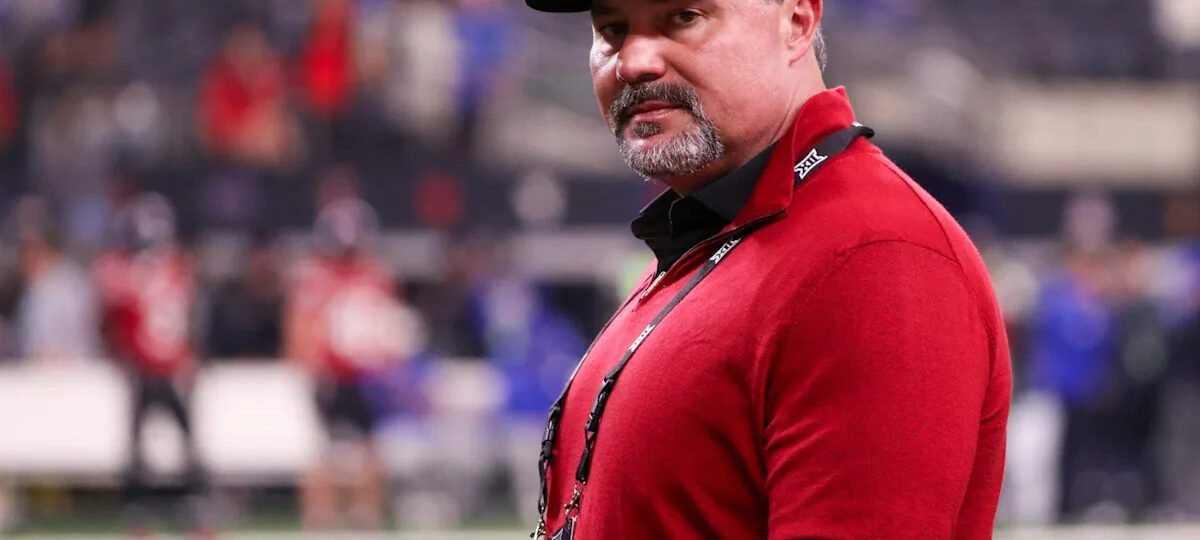
Cody Campbell is Chairman of the Board of the Texas Tech University Board of Regents, Founder of Saving College Sports, a non-profit organization formed to preserve the institution of intercollegiate athletics and a Senior Member of the President’s Blue Ribbon Council on College Sports.
For the past seven years, the college sports system has been pleading with Congress to take action, to save it from its own inevitable demise. During that time period, the Big Ten and SEC alone have spent millions of dollars on federal lobbying. The crisis is real — and the solutions have been hard fought.
In recent weeks the United States Senate finally achieved a significant development toward a resolution with the introduction of the bipartisan Protect College Sports Act of 2026, put forth by Sen. Maria Cantwell (D-Wash.), Sen. Ted Cruz (R-Texas), Sen. Eric Schmitt (R-Mo.), and Sen. Chris Coons (D-Del.). The bill also has the endorsement of President Donald Trump, who has said he would like to sign it into law this summer. This bill is serious, comprehensive, and weighty; it’s moving quickly and has a legitimate chance to become law.
Let’s take a step back and reexamine the legal chaos that created the need for Federal legislation in the first place.
The NCAA said no to Brendan Sorsby. A court just said yes. Here’s why
In doing so, perhaps it’s best to revisit Supreme Court Justice Brett Kavanaugh’s words from his opinion in the unanimous Supreme Court decision in the case of Alston v. NCAA:
“Nowhere else in America can businesses get away with agreeing not to pay their workers a fair market rate on the theory that their product is defined by not paying their workers a fair market rate, and under ordinary principles of antitrust law, it is not evident why college sports should be any different. The NCAA is not above the law.”
The Court unanimously struck down the NCAA’s limits on education-related benefits as a violation of antitrust law, and Justice Kavanaugh went even further, describing the NCAA’s broader refusal to pay athletes a market rate as the kind of price-fixing that would be illegal in any other industry. The NCAA (similar any conference, league or governing body) has no legal right to join together to enforce rules or regulations (including transfer rules, eligibility rules, NIL, etc.) for the athletes because collusion (in sports, no different than in business) is illegal in this country and has been for over 100 years.
Also well established, and noted by Kavanaugh, there are two ways the NCAA can regain ability to enforce rules: through collective bargaining with the players, or through an anti-trust law exemption, that must be granted by Congress.
And right as we’re on the cusp of solving these legal problems, here comes the opposition. Different groups, including many who were asking for legislation to straighten out the mess in the initial arguments, have emerged to oppose the Protect College Sports Act. Disappointingly, this opposition includes the Big Ten and SEC.
In an about face from their long-held position in favor of legislation, some members of the SEC have called for “secession” from the NCAA, in favor of advancing this bipartisan bill. They suggest pursuing anti-trust protection through collective bargaining, as the professional leagues all do. A more likely explanation is they dislike the bill because it would limit their ability to grow an emerging duopoly and to form a “Super League,” which will choke out smaller conferences and schools, as well as “non-revenue” women’s and Olympic sports.
But the collective-bargaining argument doesn’t stand up to legal practicality or scrutiny. Unlike the NFL, NBA and other professional sports leagues, in college sports the universities (the would-be “employers” negotiating a Collective Bargaining Agreement with a hypothetical college athletes’ union), are state entities. State entities, including public universities, unlike professional sports teams, are specifically and explicitly exempt from the National Labor Relations Act (NLRA), and so each of the schools is controlled only by the various labor laws in each state and cannot be regulated by the Federal government through the National Labor Relations Board (NLRB).
In the State of Texas, for example, which has labor laws similar to many “Right to Work” states (including all but one of the SEC states), it is illegal for a state entity to negotiate with a labor union, and any CBA negotiated is automatically void. In SEC country, it could be summed up in saying that State Law “Just Means More.”
Given that college sports operate in all 50 states, where roughly 80% of FBS members are public, state-controlled institutions, there is no pathway to creation of a cohesive national union and CBA, as the national professional sports unions do.
If the SEC (or any other conference) were to secede, they would have the exact same rules enforcement issues under anti-trust law the NCAA does. In other words, collective bargaining would not be a path to protection from anti-trust lawsuits.
Some who advocated (and continue to advocate) for the thrice-failed SCORE Act say this new bill does not adequately address employment matters. This criticism is valid in that there are certain employment issues that will remain unresolved. But the big-ticket employment concern is nothing more than a ghost, and the hand-wringers haven’t considered a national collective-bargaining path is not possible for college sports. Simply recognizing the legal limitations of Federal action eliminates the largest and most contentious issue in this vein.
Prior attempts to push a legislative solution have been politically divisive and legally faulty. The Protect College Sports Act is not. This bill accounts for the clear fact Congressional anti-trust protection is the only legally practical way to restore order to college sports, and save our collegiate athletes in the process. But, time is working against us; the legislative window is closing, and there are no other options available to protect and save our national treasure. We must get serious, come together with transparency and in good faith, and make this bill law. Our student-athletes, universities and fans deserve nothing less.
Cody Campbell is Chairman of the Board of the Texas Tech University System, a member of the President’s Council on Sports, Fitness, and Nutrition, a Senior Member of the President’s Blue Ribbon Council on College Sports, a Distinguished Fellow at America First Policy Institute, and a board member of Texas Public Policy Foundation.
Discover more from NAIRAVOICE.COM.NG
Subscribe to get the latest posts sent to your email.